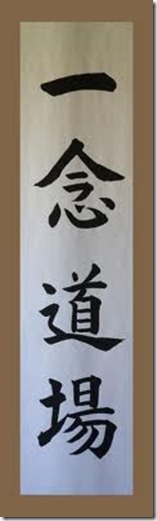
Determination

IchinenIchinen is a Japanese word meaning determination (amongst other things).

ichinen

[一念] (Jpn; Chin i-nien )

A single moment of life, one instant of thought, or the mind or life at a single moment. Also, life-moment, thought-moment, or simply a single moment or instant. Ichinen has various meanings in Buddhism: (1) A moment, or an extremely short period comparable to the Sanskrit term kshana. The Treatise on the Great Perfection of Wisdom defines one kshana or moment as a sixtieth of the time it takes to snap one’s fingers. (2) The functioning of the mind for one moment. The “Distinctions in Benefits” (seventeenth) chapter of the Lotus Sutra speaks of a single moment of belief and understanding. (3) To focus one’s mind on meditating on a Buddha; Shan-tao (613-681), a patriarch of the Chinese Pure Land school, defined ichinen (one instant of thought) as chanting Amida Buddha’s name once. (4) T’ient’ai (538-597) philosophically interprets ichinen in his doctrine of three thousand realms in a single moment of life ( Jpn ichinensanze Chin i-nien san-ch’ien ). In this doctrine, ichinen indicates the mind of an ordinary person, which at each moment is endowed with the potential of three thousand realms; its characteristics are: (a) it pervades the entire universe; (b) it includes both body and mind; (c) it includes both self and environment; (d) it gives rise to good and evil; and (e) it encompasses cause and effect simultaneously. Nichiren (1222-1282) embodied this philosophical framework in the form of a mandala known as the Gohonzon. By this he aimed to establish a practical way for ordinary people to manifest Buddhahood from among the Ten Worlds of their own lives. (Taken from the SGI Dictionary)

Being a success at something isn’t just about talent, it’s about having the desire, in your heart, to be the best that you possibly can be.

If you have a strong Ichinen, you are far more likely to reach your goal. You still have to put in the effort and in fact, the more talent you have, the more effort is needed, because your end result might be far more exacting than a less talented person.

If you think you will fail, you will. You must embrace your goals, your targets, with every fibre of your being. Strive with all your might, night and day towards that goal and you are far more likely to succeed.

Success takes focus, desire, effort, hard work, determination and perseverance.

Ichinen covers them all and chanting for what you want to achieve makes your ichinen stronger and stronger.

Every Cloud

SunriseIt has been pretty cold for the last week, yesterday I even had frost on the car first thing, and the days are so short. The mornings are dark, the evenings are even darker, and it feels natural to get home after a long day at work, and curl up like a bear in his cave.

This morning wasn’t so cold, though the car was still covered in a fine dew. There was no breeze and because the children have finished school for the holiday, it felt like I was the only one not to be still tucked up in bed. But as with most things in life, and particularly in Buddhist life, every cloud has a silver lining. Every drop of poison can be turned into a drop of medicine and so it was this morning.

Driving down the Blandford road, the headlights of the oncoming cars and trucks were so bright against the velvet blackness of the early morning. The traffic was slow and I was wondering whether I was going to get to the office on time. Then very suddenly every thought changed, and my worry turned to wonder.

As the first rays of the sun peeped over the horizon they created a majestic and awe-inspiring sunrise, illuminating a beautifully sculptured high bank of clouds. It was amazing, the colours were stunning, and the whole spectacle changed second by second. It was so huge, completely filling the sky, it was impossible to take in the whole. It transformed my journey and in fact my whole day. Of course, the sun comes up every day, but some days it does it in much more wondrous ways than others.

Life, What Is It All About?

Man's Search For MeaningWe have all asked ourselves this question, maybe once or twice, maybe a thousand times, but the answer to the question turns out to be so simple, so eloquent, so meaningful, when it is asked from a position of total hopelessness.

Taken from Man’s Search For Meaning (p.113), by the late Dr Viktor E. Frankl, this is the most sensible and acceptable explanation of the age old question, ‘what is the meaning of life?’ I have ever read. It is a question we should all ask ourselves on a regular basis, for as you will see, there is no one single answer.

”I doubt whether a doctor [we] can answer this question in general terms. For the meaning of life differs from man to man, from day to day and from hour to hour.

What matters, therefore, is not the meaning of life in general but rather the specific meaning of a person’s life at a given moment.

To put the question in general terms would be comparable to the question posed to a chess champion: “Tell me, Master, what is the best move in the world?” There simply is no such thing as the best or even a good move apart from a particular situation in a game and the particular personality of one’s opponent.

The same holds for human existence. One should not search for an abstract meaning of life. Everyone has his own specific vocation or mission in life to carry out a concrete assignment which demands fulfilment.

Therein he cannot be replaced, nor can his life be repeated. Thus, everyone’s task is as unique as is his specific opportunity to implement it. As each situation in life represents a challenge to man and presents a problem for him to solve, the question of the meaning of life may actually be reversed.

Ultimately, man should not ask what the meaning of his life is, but rather he must recognize that it is he who is asked. In a word, each man is questioned by life; and he can only answer to life by answering for his own life; to life he can only respond by being responsible.”

This short explanation, taking less than a page in the book, encapsulates an answer to which I can relate.

The book itself covers Dr Frankl’s own struggle for survival in Auschwitz and other Nazi concentration camps. It has tragic as well as surprisingly humorous passages, but reading it will leave you forever changed and, I believe, better for the experience.

Taking On Challenges

Challenges NOT ProblemsWe have discussed the difference between problems and challenges, and we know that there is no difference, other than in our head. Problems are things we worry we cannot overcome, challenges are things we believe that we can. Having the confidence and determination to tackle things head on enables us to stay positive, to turn poison into medicine, to take on those challenges (we don’t do problems here) and ultimately to live a happy and fulfilled life. But if we let our mind magnify the challenge, our Fundamental Darkness takes control, and these obstacles grow and grow.

Overcoming Obstacles

This negative aspect is often referred to as the ‘three obstacles and four devils’ (in Japanese, sansho shima). Obstacles refer to things which appear to be outside of ourselves (but which ultimately have their origins in our lives) and the devils, or negative elements, are ‘internal’. What makes these obstacles and devils serious is that if we are influenced by them we may stop practising Buddhism. They confront us at a specific point in time – usually when we are about to grow in our lives and move forward. The fact that at a difficult moment we may think that we should stop practising is a sign that it is an attack of one of the three obstacles and four devils. From a positive point of view these hindrances enable us to see a weakness in our lives so that we can chant and become stronger in that area.

The first is the obstacle of earthly desires. Buddhism teaches that our earthly desires may be transformed into enlightenment. Second is the obstacle of karma, which includes the influence of those who are close to us such as a spouse, partner or children. Third is the obstacle of retribution, which means opposition from those with power over us, such as our superiors, parents or people in authority.

The devils come from within our own lives. We create our own negativity, our own doubt, uncertainty and confusion. The first devil arises from our earthly desires. It can include egoism, craving for personal fame and riches, laziness or being dominated by force of habit. It can also arise from the three poisons of greed, anger and stupidity.

Second is the devil of weakness that can arise in our own bodies, such as an illness which will hold us back and reduce our capacity. Third is the devil which manifests as the hindrance of death. Unless we are confident that death is not ‘the end’, but rather another phase in the cycle of life and death – then another person’s death can trigger a sense of doubt and can considerably weaken our will to practise Buddhism, even though Buddhism is intended to relieve us from the sufferings of birth and death.

Finally the fourth devil is known as the Devil King of the Sixth Heaven who, in Buddhist mythology, works to obstruct Buddhist practice and drain our life force. This is the manifestation of fundamental darkness inherent in life. And because of this can be seen as the most challenging aspect of negativity to conquer. When influential people persuade or threaten us to stop practising this could be said to be the workings of the Devil of the Sixth Heaven.

Whatever form they take, the Daishonin advises us to take these obstacles and devils as confirmation that we are properly practising the true Law through which ordinary people become Buddhas. They offer us insight into aspects of our human revolution, ways to strengthen our lives and assurance that we are on the verge of achieving this, so long as we are neither influenced nor frightened by them. Human revolution includes experiencing this process and transforming some aspect of ourselves. It indicates the real experience of finding we have to confront something. It also includes our need to gain the inner conviction that we can win over the obstacle in question.

In Buddhism, the term ‘fundamental darkness’ is used to describe the ignorance and delusion inherent in human life. This is the ignorance of the fact that we all have the state of Buddhahood in our lives, at all times, latent and ready to be revealed. The aim of our great struggle for kosen-rufu, our movement of human revolution, is to transform that innate darkness into light. Our goal is to vanquish the destructive tendencies within human life that give rise to mutual distrust and hate, violence and fear. The three obstacles and four devils become an indispensable means for doing this. That is why we should rejoice when they appear.

Heaven And Hell

Heaven And HellA man was offered the chance to visit Heaven and Hell. Upon entering Hell he was greeted by the sight of an infinitely long room filled with tables laden with the finest of foods, meat, fruit, wine and all manner of delicacies. But around the tables sat groups of starving people, crying out in their hunger. He realised that each person was holding a spoon, but the spoons were so long that they were unable to feed themselves.

He then went to Heaven and was surprised to see exactly the same scene. The same room was filled with the same tables, covered with the same food. But this time, around the tables sat groups of well fed, happy people. They too were holding spoons, the same length as those poor souls in Hell. The difference was that these people were feeding each other and so could eat as much as their hearts desired.

Here on Earth, that might just be the difference between our own personal Heaven or Hell. Helping others, in Buddhism, also helps us, indirectly, through the accumulation of positive karma. But whether you are Buddhist or not, helping others is the best way to make life better for everyone, and in this festive season, can give us all a wonderfully warm feeling.

Such A Laugh

Company Christmas PartyWhat a wheeze, the company Christmas bash, held in the Cumberland hotel, Bournemouth was everything, and more, that I expected this evening. Having never been a huge fan of taking taxis, nor getting blotto on corporate hospitality, I was one of the more sober ones tonight, and what fun!

Of course, with the company executives in attendance, people were on their best behaviour as the evening commenced. But as the time rolled on, and the wine, beer and spirits flowed, inhibitions were slowly eroded and a few home truths came to the surface.

We are not the largest company in the world, and we are still a little like a family run business, where everyone knows everyone else by their first names. There was mention made of the fact that all the executives sat together on one table, with comments about the wannabe’s fawning around them, and it all made for an entertaining spectacle as the evening wore on.

Not a drop of alcohol passed my lips all night, so being stone cold sober, I was in the perfect position to watch the fun and games. Not that there was too much to report, but people do say and do the funniest things when they get a bit squiffy. As far as I know, no videos or photos have made their way onto the social networking sites, yet, but it is a good feeling to be able to let, what little hair I have, down, whilst being in total control of my faculties.

I’m sure there will be a few tales told on Monday, but apart from me being more of an observer than a participant, none of them will be about me.

The Unity Of Body And Mind

Stay PositiveWe must never underestimate the power the mind has over our bodies. If we can remain positive, with high life-energy and in one of the higher worlds, not only will our bodies respond positively, but also those around us will feel more positive too. If we allow negativity to creep in the battle will be all the harder, and we will find that we do not inspire those who need our support to try that little bit harder to support themselves.

The Nichiren phrase for this connection between our body and mind is Shikishin-Funi. Two, but not two, not two, but two, meaning that they are separate, but cannot function alone.

[色心不二] (Jpn shikishin-funi )

Also, non-duality of body and mind. The principle that the two seemingly distinct phenomena of body, or the physical aspect of life, and mind, or its spiritual aspect, are essentially non-dual, being two integral phases of a single reality. One of the ten onenesses formulated by Miao-lo (711-782) in his Annotations on “The Profound Meaning of the Lotus Sutra.” In the Japanese term shikishin-funi, shiki means that which has form and colour, or physical existence, while shin means that which has neither form nor colour, or spiritual existence, such as the mind, heart, and soul. Funi is an abbreviation of nini-funi, which indicates “two (in phenomena) but not two (in essence).” This means that the material and the spiritual are two separate classes of phenomena, but non-dual and indivisible in essence, because they are both aspects of the same reality. In the above annotations, Miao-lo states that, from the viewpoints of the whole and its components, life at a single moment is the whole, while body and mind are its components. Neither body nor mind is a separate entity; there is not one without the other. They are inseparable components of life. In the Lotus Sutra, the principle of the ten factors of life represents the oneness of body and mind. The ten factors are listed in the “Expedient Means” (second) chapter of the sutra, where it states that the true aspect of all phenomena consists of “appearance, nature, entity, power, influence, internal cause, relation, latent effect, manifest effect, and their consistency from beginning to end.” On “The Profound Meaning” states: “Appearance exists only in what is material; nature exists only in what is spiritual. Entity, power, influence, and relation in principle combine both the material and the spiritual. Internal cause and latent effect are purely spiritual; manifest effect exists only in what is material.” The Record of the Orally Transmitted Teachings reads, “[Concerning the term dedication of one’s life ] ‘dedication’ refers to the element of physical form as it pertains to us, while ‘life’ refers to the element of mind as it pertains to us. But the ultimate teaching tells us that form and mind are not two.” – Taken from the SGI Dictionary of Buddhism

Not exactly easy to understand, but essential for us to prosper in these difficult times. By being positive, we give out positive energy to those around us. Whether we are in a difficult situation in our life, looking for a job, trying to make ends meet financially or just trying to grin and bear it in the face of seemingly unending bad news, being positive is the only way to win through.

The Perfect Gift

tbgamI know, I’m always going on about this brilliant book, but The Buddha, Geoff and Me is the perfect Christmas gift for the Buddhist in your life (if that isn’t an oxymoron).

An amazing, invigorating and enlightening story about a young man’s friendship with a Buddhist, who teaches him the basics of the religion and covers aspects of practice.

For anyone, interested in Buddhism (particularly Nichiren Buddhism) its teachings and practices, in most readable form, this book is a must read.

This book will transform your thinking, help you to control your mood (life states) and lead you towards a more meaningful life. Buy it here or listen to it in podcast form here.

I don’t think it is overstating the case, when I say that this book changed the course of my life forever. It relates Nichiren Buddhism to everyday life so well, and in such an understandable form, it should be required reading for all students, it would change the world.

Wow, What A Day !!!

SuccessDo you ever have one of those days, where everything you touch turns to gold? Well today has been just such a day. Not in terms of financial gain, but in terms of resolving problems and making great strides, all in the right direction. On the face of it, today could have been a disaster. I was the only IT professional in the office, Knobby No-Mates, all alone and left to face the oncoming hordes, and the date was 13/12/11 … rather spookily.

But in the event, it has been one of my best days for some considerable time. I had the mundane housekeeping tasks out of the way in short shrift, and that really set me up to get a handle on everything else that I needed to do. Every challenge was despatched with energy, and consummate ease, though I say so myself.

Even down to introductory con-calls to new contacts, in-depth discussions with clients, one of whom offered to be the fonder member of a working party on one of our major projects. So by the time I left the office, way after normal hours, I was buzzing with the successes of the day.

I’m not going to fool myself into thinking that it will last, these things have a habit of falling apart as fast as they appear, but I have enjoyed the feeling and will do my upmost to keep it going as long as I can. The trick to making the most of such a day, is to appreciate it for what it was, but not get hung up when it vanishes again. That is how to cope with life generally. Make the most of the good times, but not fretting over the not-so-good ones. At the end of the day, it all balances out, and having a decent average is what it is all about.

Victory From The Jaws Of Defeat

Chelsea FCOn a very wet and windy night in west London, my life-long team Chelsea have tonight snatched a fantastic victory from the jaws of what seemed, early on, a horrible defeat. Having gone a goal down, inside two minutes, to a wonderfully gifted Manchester City side, Chelsea clawed their way back into the game and drew level ten minutes before half time.

Manchester City, the only Premiership side to remain unbeaten until tonight, looked every part the league leaders in the first thirty minutes, but Chelsea stayed strong and gradually took the upper hand. Determination, as well as strength, skill and energy saw them push the Manchester side back into their own third for long stretches of the second half. Then, with a renewed vigour, Ramires sprinted onto a through ball, only to be fouled by Gael Clichy, who, having been earlier shown a yellow card, was sent off.

The game changed in the instant, with Chelsea pressing for a winner against the ten men of City. Having the lions share of possession, Chelsea attacked in wave after wave, and were finally rewarded when Julian Lescott handled a shot from Sturridge in the area, and were awarded a penalty.

Frank Lampard, who has been forced to sit out the last couple of games as a substitute, and who had come on only minutes earlier, kept his nerve and scored a priceless winner past the current England keeper Joe Harte.

So a victory for Chelsea, lifting them to third in the league. But more importantly a lesson, how to gain a victory through determination, through wisdom, courage and skill. A victory over the set back of going a goal down, and the reward for never giving up. I have a big smile on my face as I write this, but it is a good lesson for us all. When things go against us, we must dig deep, focus on our own abilities, use all our inner strength to go on, despite the odds, and triumph in the face of defeat.

Previous Older Entries Next Newer Entries