What is the Gohonzon?
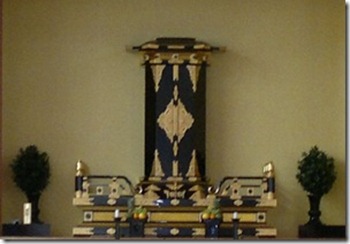 The Gohonzon is the prime point of faith, practice and study in Nichiren Buddhism.
It provides us with a correct model or standard of faith and practice for our time. It usually takes the form of a paper scroll, with Chinese and Sanskrit characters printed on it in black ink.
It is kept in a protective box, or butsudan. The area around the Gohonzon often has offerings of light (in the form of candles), evergreen, incense, water, and fruit. You may also see other offerings, and items like a bell around the butsudan.
In Reply to Kyo’o the Daishonin writes,
“I, Nichiren, have inscribed my life in sumi ink, so believe in the Gohonzon with your whole heart.”
Although the Gohonzon takes the form of a paper scroll, it is vital that when we are chanting to it, it is not seen as outside one’s life. It is through our chanting to the ‘external’ Gohonzon in the butsudan, that we activate all the forces and functions within our own lives.
Nichiren Daishonin began to inscribe the Gohonzon for his followers around the time of his exile to Sado in 1271. He wanted to establish an object of fundamental respect which would enable anyone chanting to it to awaken the Buddhahood in their lives, and to experience the same life state as he did. Nichiren Daishonin provided us with the means to draw out the state of Buddhahood inherent in life.
The word ‘Gohonzon’ is translated into English as ‘object of fundamental respect’. ‘Go’ is an honorific prefix, and ‘honzon’ means what it is that we base our lives on.
Nichiren Daishonin was aware of the difficulty people had in believing that the life state of the Buddha could exist in their lives, and then how hard it is to manifest it. His writing The Object of Devotion for Observing the Mind [WND p354] is in the form of a dialogue which strives to persuade the listener that if all the other nine worlds can be perceived in one’s life, then Buddhahood must be too. He inscribed the Gohonzon for individuals so that they would have a constant reminder of the eternal law, the cause for this life state, and which would serve as a focus for their daily practice, as well as functioning as the external cause for drawing out Buddhahood and revealing their greater self.
It is not necessary to be able to read or understand the characters on the Gohonzon in order to experience benefit from chanting to it. The Daishonin used script or calligraphy for the Gohonzon because he wanted the Gohonzon to be a universal mirror, free of the connotations of race and gender inherent in pictures or images.
The Calligraphy on the Gohonzon
The Gohonzon is sometimes described as a ‘mandala’, a word used in the East to describe an object in which Buddhas and bodhisattvas are depicted or on which a philosophical doctrine is expressed. Originally it meant a circle drawn in the earth around the place where a religious ceremony was to take place. The circle embraced all the people who participated in the ceremony, and was believed to protect them from negative influences. The word mandala was rendered in Chinese as ‘perfectly endowed’ or ‘cluster of blessings’.
Using Chinese calligraphy, Nichiren Daishonin put the characters Nam-myoho-renge-kyo Nichiren boldly down the centre of the Gohonzon. This represents the oneness of the Person and the Law. In other words, the ordinary person is the Buddha, and the Mystic Law is inherent in each living being. He then surrounded these characters with the names of people referred to in the Lotus Sutra, such as Shakyamuni Buddha and Many Treasures and others. All the characters represent an aspect of life, whether as a protective function, or as a representative of the ten worlds, and all are illuminated by the Law of Nam-myoho-renge-kyo.
In the writing The Real Aspect of the Gohonzon Nichiren Daishonin explains why he placed the particular characters where he did. The blueprint for the Gohonzon was the description in the Lotus Sutra of the Ceremony in the Air, when a great jewelled Treasure Tower emerged out of the earth, and many Buddhas and bodhisattvas gathered to hear the Buddha Taho (or Many Treasures) confirm the truth that Shakyamuni had taught – that we all have the potential to reveal our Buddha nature in our daily life, as we are. This story in the Lotus Sutra represented the emergence of the state of Buddhahood in countless peoples’ lives, called Bodhisattvas of the Earth (the people who promised to propagate Nam-myoho-renge-kyo at the time we now live).
Shakyamuni described the dramatic events of the Tower emerging from out of the ground and reaching high into the sky. It was encrusted with precious gems and was intended to represent life with all its mystic and wonderful qualities. As it halted, floating in the air, the doors of the Tower opened and the Buddha Many Treasures was seen sitting inside. This Buddha invited Shakyamuni to enter and sit in the place of honour on Many Treasures’ right hand side. As we look at the Gohonzon, then, it is as if Shakyamuni and Many Treasures are in the Tower looking out at us and all the other characters on the Gohonzon. Then the Buddhas lifted the tower and the assembled company into the air, in what is known as the Ceremony in the Air, an event not limited to any particular time or place. When we look at the Gohonzon in this way, we realize that we are among the Bodhisattvas of the Earth. Through chanting to the Gohonzon, we are participating in the Ceremony in the Air, just as described in the Lotus Sutra.
The Gohonzon is said to contain all aspects of life, so it includes not just the positive and value creating qualities of life represented by the Buddha’s good disciples, but also examples of evil and destruction. For instance the representative of fundamental darkness, the Devil King of the Sixth Heaven is also included on it, although he too is bathed in the transforming power of Nam-myoho-renge-kyo and revealing his enlightened rather than his negative aspects.
The four corners of the Gohonzon each contain a Heavenly King, a character that represents the protective forces of the universe. Between these, in the middle of each side, and written in Sanskrit calligraphy are the characters Aizen (or Craving Filled) on the left as we look at the Gohonzon and Fudo (or Immovable) on the right, who represent the principles that `earthly desires are enlightenment` and `the sufferings of birth and death are nirvana`, respectively. Nichiren Daishonin’s teachings enable us to transform our desires and our sufferings into enlightenment, rather than having to deny them.
Practising with the Gohonzon
Nichiren Daishonin teaches that the Gohonzon enables us to see the ten worlds in our lives, in other words, that we have Buddhahood, and can use it. It is easy to see the lower life states, and to have the illusion that we can never be like the Buddha. The Gohonzon is described as a clear mirror which shows the law of Nam-myoho-renge-kyo and all its manifestations in the different life states, revealing their enlightened qualities.
The way to practise is to have the attitude while we are chanting that we are in no way different or separate from the eternal Law of Nam-myoho-renge-kyo, or the Buddhas who are enlightened to that Law. The key is to praise one’s inherent Buddhahood and then go out into the world and practise as a bodhisattva, treasuring others, encouraging them to experience their Buddhahood too.
Through studying Nichiren Daishonin’s writings and awakening the wisdom we have within our lives, we become alive with the qualities of the Buddha state that are embodied in the Gohonzon. At the same time, we develop a natural desire to change our lives so that we bring out more and more consistently the condition of Buddha revealed by the Gohonzon. The more we practise with this desire to change, the more our lives and Nichiren Daishonin’s life-state embodied in the Gohonzon become as one.
This is a gradual process. When we practise to the Gohonzon, Nichiren Daishonin said we are simultaneously in the state of Buddhahood or enlightenment, but we cannot easily discern that life condition with our minds; therefore we do not always act accordingly. However, through our constant relationship with the Gohonzon, we gradually challenge and overcome the influence of negativity arising from our karma. As we open up our hearts we can begin to experience all those qualities of Buddhahood working naturally and vibrantly inside us and affecting everything that we think and say and do.
President Ikeda has recently described the process as this:
“When we chant Nam-myoho-renge-kyo while practising for ourselves and others, with the Gohonzon of Nam-myoho-renge-kyo manifested by the Buddha as our clear mirror, and with deep confidence in the Gohonzon existing in our own lives, Myoho-renge-kyo within us resonates with the Myoho-renge-kyo outside us, and the world of Buddhahood emerges within us.”
[World of Nichiren Daishonin’s Writings Part 12]
 When we start changing things through our practice, our life-state, our life-energy, we must expect to encounter a reaction.
 When bad things happen to us, events that we can’t explain, there is a tendency to blame fate, bad luck or coincidence. It is perhaps more comfortable to believe that when something goes wrong, we are at the beck and call of forces unknown and unseen.
 On the day that saw the passing of Margaret Thatcher, it might be a good point to remind ourselves to make the most of our time.
 Last weekend it was Oxford in the University Boat Race, this weekend it’s the 66-1 long shot Auroras Encore ridden by Ryan Mania in his very first Grand National.
 Self awareness, the realisation of who, or what you really are, comes to some people with age, but for me, it came at a point in life where I was at my all time low. Seeing my true reflection in the mirror was a long and painful process, there’s no joy in realising that you are someone you don’t really like, but it lead me to the turning point that has allowed me to change for the better.
 Things such as money, fame, and material possessions may offer a degree of fleeting satisfaction, something that can be called relative happiness.
  Not for the first time, and rather like a scratched record, I hear myself once again explaining, that unlike almost every other religion, Nichiren Buddhism sees things differently. Not that I feel I am apologising for that, just that because it is a philosophy for life and living, rather than a religion in the more generally accepted sense, the meaning and purpose of prayer are in my opinion, fundamentally different.
 So the IT gang returned all rested and chilled out after the Easter holiday. Of course it was a Tuesday masquerading as a Monday, but things were going swimmingly until BANG … the power to the office went off, completely, no warning. All hands on deck and much discussion with Southern Electric and a certain degree of resignation, but not the easy start we might have hoped for.
  So many of us wish for things we would like, or wish to be things we aren’t. Short people wish they were taller, plump people wish they were thin, people with straight hair wish it was curly, people with curly hair wish it was straight.
 The Search For Enlightenment
Recents Comments