Fix Your Anchor

Fix Your AnchorDo you ever find yourself getting into a state over a situation that is mainly in your own head? If your world is not anchored by your faith and is dependant on factors outside your control, your imagination can run riot. Our Fundamental Darkness, or My Evil Friend, is a devious character and will use everything to get it’s way. Your imagination is one of it’s most powerful weapons.

This is how I was until I found Nichiren Buddhism, and it is a very precarious state in which to live. Each day can be up, or down, at the whim of something or someone else, and that’s no way to go through life, particularly if that something or someone cannot be relied upon. Everything, everyone changes over time, so basing your happiness on them is bound to fail, sooner or later.

Taking back control of your life is simple, it is a state of mind, a determination to re-centre, re-focus your life. That certainly doesn’t mean that you have to rid yourself of the something or someone, and it doesn’t mean that your relationship with them is any less important. It’s just that your life centres around something infinitely stable, and that can make all the difference in the world.

My anchor, my honzon is my practice, and I’m a better, calmer, more contented person for that. I am happier for that, and at the end of the day, isn’t that what we all seek from life, a little more happiness?

Stick To Your Guns

As one of my recent posts said, having the wisdom and courage to make a difficult decision is to be admired and saluted. Even though that decision might be painful, if it is made for the right reasons, it should never be regretted.
At times, we follow the same path as others for many years, sometimes our paths cross very briefly. Either way, the outcome can be beneficial for both parties and have deep and far reaching results. Karma works in ways we sometimes do not understand.

So do not regret those decisions that might have left you in a slightly unsettled situation. Think rather about what the outcome may have been had you not used your wisdom, courage and compassion, at that time, and remember that hindsight is always 20-20 vision.

Wouldn’t it be wonderful if we could run our lives through a ‘what if’ machine, where we could input every situation and foresee the outcome of each and every decision. Would we always make the right decision, given that circumstances change over time? I somehow doubt it.

Nam Myoho Renge Kyo

My Hero

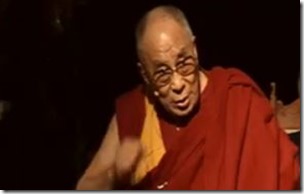
His Holiness The Dalai LamaI was privileged to be able to listen to a talk and a Q&A session from His Holiness The Dalai Lama today, live on “The Culture of Compassion” from Ebrington Plaza in Derry, Northern Ireland. His Holiness, who is patron of the Children in Crossfire charity, showed his abundance of compassion and humility in a most moving gathering of like minded people.
His message revolved around using our hearts and minds, rather than guns and bombs, to create a world where everyone has a place, and a role in making the world a peaceful and wonderful place to live.

He touched on the painful subject of the gap between rich and poor, a problem that exists in every country on earth, but which is more acute in some than in others. He talked about the responsibility of the rich to help the poor and also the responsibility of the poor to make stronger efforts to improve their own lot through learning.

You can see videos of the entire event here. The video of the talk and the Q&A session is here.

The Dalai Lama is an amazing man, albeit a man in a privileged position, but one who instils an atmosphere of peace, love and happiness, but above all hope for the future. He is a brilliant example of how we should react to those around us, but there is no doubt, that he is just a man, and that we can be just like him with practice.

Merely Another Beginning

Merely Another BeginningThe funeral of Margaret Hilda Thatcher was performed with dignity and a degree of humour, befitting such a huge political figure. I was pleased that, although there were occasional expressions of dissent from the crowds lining the funeral route, there was no apparent protest.

Whilst many people harbour angry memories of the policies of Mrs Thatcher during her time in government, I was privatised myself whilst working for British Telecom, her death is not, in my opinion, a fitting time to resurrect those feelings in any public fashion. Of all the aspects of life, death is the one and only event that comes to us all, whether we be rich or poor.

The Christian funeral service celebrates the passing of the soul from this world into the next, an ending of earthly things and a beginning of heavenly ones. In this respect, Christianity and Buddhism agree, death is not the end, merely another beginning.

Buddhism looks at death in a similar way to sleep, it is not the end of something, it is a period of rest before the beginning of something new. In the case of sleep, it is the beginning of a new day. Death, on the other hand, is the beginning of a whole new life.

So I do not fear death, though I do not wish to hasten its coming. I intend to make the most of each and every day, and when death does arrive, as it will, I will enjoy the rest before being reborn into a new and exciting experience.

Boston Thoughts

Boston Marathon BombingWith the shock and sadness upon hearing the news of the bombings in Boston still sinking in, I have again been forced to think about why people could ever consider the injuring and killing of others as a rational form of protest or demonstration?

Of course, it could be said, that these people are sick, psychologically deranged, but such acts require complicated and detailed planning and execution, so there must be a fair degree of intelligence being used.

While the US authorities search for the perpetrators, we should concentrate our thoughts and prayers on the victims and their families and friends. We should also give our full support for those within this country who are planning the security for this weekend’s London marathon in an effort to stop anything similar happening here.

Whether any good ever comes out of such incidents depends, in the broadest sense, on your viewpoint. Whilst it is very difficult for us to see things from the point of view of the bomber, we must try, if we are to make any progress towards averting any future attempts to repeat the events of yesterday.

The only way we can move forward into a world without terror, is for all parties involved, and that means including the bombers, to use Wisdom, Courage and Compassion to address the conflict, what ever that might be.

That may sound naive, but the only way to resolve any of these issues is to resort to dialogue rather than violence.

It’s The Smile That Says It All

A Smile Like A Cheshire CatThe kids went back to school this morning, so like many of us, my journey to work involved sitting in near stationery queues of traffic most of the way to the office. A perfect time (and place) to chant, so chant I did.

Having spent over 30 minutes chanting Nam Myoho  Renge Kyo, I was buzzing, a better buzz than any strong coffee could deliver, and I was feeling ready to tackle the world.

I was feeling great, and apparently it showed. I was smiling, walking with a spring in my step and people noticed. I was greeted with many happy ‘Good Mornings’ from people smiling straight back, and I could see that it had made a positive change to their morning too.

Nichiren teaches that chanting increases our life-energy, which is brilliant. What is even more amazing, is that it also affects all those around us, by increasing their life-energy too.

Ghandi said ‘be the change you want to see in the world’ and chanting is changing me. As if by magic, the changes in me are causing changing my colleagues, and all for the better.

I don’t think I have ever really been the ‘bear with a sore head’ type of person in the morning, but my increased energy levels are having a profound effect, and I love it !!!

The Goal Of Kosen-Rufu

Global PeaceWith talks on-going between the US and China over the continued sabre rattling of North Korea, it is clear that the goal of world peace, Kosen-Rufu, still requires much effort if it is ever to come to fruition.

The sanctity of life is known to everyone. At the same time, there is universal confusion about the essential meaning of life’s sanctity.

If the sanctity of life can become a solid touchstone of wisdom for all people, then humankind’s destiny to experience war and misery repeatedly can be transformed.

As Sensei explains it: “Kosen means ‘to widely declare.’ Widely implies speaking out to the world, to an ever-greater number and ever-broader spectrum of people. Declare means ‘to proclaim one’s ideals, principles and philosophy.’ The ru of rufu means ‘a current like that of a great river.’ And fu means ‘to spread out like a roll of cloth.’

“The teaching of the Mystic Law has nothing to do with appearance, form or pride. It flows out freely to all humanity the world over. Like a cloth unfolding, it spreads out and covers all. So rufu means ‘to flow freely, to reach all.’

“Just like a cloth, kosen-rufu is woven from vertical and horizontal threads. The vertical threads represent the passing of Nichiren Daishonin’s teaching from mentor to disciple, parent to child, senior to junior. The horizontal threads represent the impartial spread of this teaching, transcending national borders, social classes and all other distinctions. Simply put, kosen-rufu is the movement to communicate the ultimate way to happiness—to communicate the highest principle of peace to people of all classes and nations through the correct philosophy and teaching of Nichiren”It is toward this end, towards Kosen-Rufu, that we Nichiren Buddhists are struggling.

It is toward this end, towards Kosen-Rufu, that we Nichiren Buddhists are struggling.

Nam Myoho Renge Kyo

The Love Of Learning

The Reluctant BuddhistWith the weather being the way it is, I spent much of the morning finishing The Water Road, a great book about a four month, event filled, narrowboat odyssey around the extensive British canal network. I then started re-reading William Woollard’s The Reluctant Buddhist, a superb book if you are looking for a good grounding in Nichiren Buddhism.

The great thing about William’s book, is that he explains his own path into Buddhism in such a way that you can easily relate it to your own journey. Sixteen chapters of beautifully explained Buddhism principles, all annotated with his own feelings of doubt and reticence as he slowly grows into the philosophy.

My own path started with many years of Buddhist study into New Kadampa Buddhism. Although the ideas of quietening the mind and removing feelings of desirous attachment were very interesting, the deities never sat well in my mind. It was only when I discovered, if that is the right term, Nichiren Buddhism through Jason and Karen Jarrett’s A Buddhist Podcast and the serialisation of William’s book, that I realised I had found the right life philosophy for me.

Every time I read, or listen to The Reluctant Buddhist, I get a little more from the book. Of course, many of the aspects covered are common with those in The Buddha, Geoff and Me or The Buddha in Daily Life, but each book covers them in a slightly different way. I think that by comparing and contrasting the different views gives me a better and more complete understanding of the principles.

I love reading and the World of Learning. It gives me a great feeling of academic satisfaction as well as the joy of expanding my knowledge of the anchor of my life, my own Practice.

The Ultimate Question?

Taken from the book Man’s Search For Meaning (p.113), by the late Dr Viktor E. Frankl, this is a most sensible and acceptable explanation of possibly the ultimate question, ‘what is the meaning of life?’ I have ever read. It is a question we should all ask ourselves on a regular basis, for as you will see, there is no one single answer.

Man's Search For Meaning - Viktor Frankl”I doubt whether a doctor [we] can answer this question in general terms. For the meaning of life differs from man to man, from day to day and from hour to hour.

What matters, therefore, is not the meaning of life in general but rather the specific meaning of a person’s life at a given moment.

To put the question in general terms would be comparable to the question posed to a chess champion: “Tell me, Master, what is the best move in the world?” There simply is no such thing as the best or even a good move apart from a particular situation in a game and the particular personality of one’s opponent.

The same holds for human existence. One should not search for an abstract meaning of life. Everyone has his own specific vocation or mission in life to carry out a concrete assignment which demands fulfilment.

Therein he cannot be replaced, nor can his life be repeated. Thus, everyone’s task is as unique as is his specific opportunity to implement it. As each situation in life represents a challenge to man and presents a problem for him to solve, the question of the meaning of life may actually be reversed.

Ultimately, man should not ask what the meaning of his life is, but rather he must recognize that it is he who is asked. In a word, each man is questioned by life; and he can only answer to life by answering for his own life; to life he can only respond by being responsible.”

This short explanation, taking less than a page in the book, encapsulates an answer to which I can relate.

The book itself covers Dr Frankl’s own struggle for survival in Auschwitz and other Nazi concentration camps. It has tragic as well as surprisingly humorous passages, but reading it will leave you forever changed and, I believe, better for the experience.

Closer Every Day

BuddhaThe purpose behind my Buddhist Practice is to bring me a little closer to Buddhahood, each and every day.

That is to say, to emulate, as closely as possible, the Buddha himself, in the way he was able to see all things in a pure clarity.

Siddhārtha Gautama was a man, albeit a prince, who forsaking his life of comfort and position, went out into the world to meditate on the causes of, and ways to reduce or remove, the suffering of life.

In Nichiren Buddhism we learn about the Ten Worlds, from Hell to Buddhahood.

The Buddha state originates from the very depths of life, called the amala consciousness, meaning the fundamentally pure life force or consciousness. The function of the Buddha state is to bring out the positive side of the other nine worlds.

The principle of the Ten Worlds shows that the Buddha state is a naturally occurring condition of life in every living being. The purpose of Buddhist practice is to enable us to cause the Buddha state to appear; to have it working strongly in us.

In Nichiren Buddhism, therefore, the Buddha is not some perfect, ideal being, but is rather an ordinary person living in rhythm with the law of the universe, taking wise, courageous and compassionate action for the benefit of others, through the functioning of the nine worlds in daily life.

The more I practice, the closer I come to Buddhahood, and I think that is a very positive thought for today.

Previous Older Entries Next Newer Entries