 It is rather remarkable how the apparent darkness of life can be lifted by Buddhist Practice, even after what can feel like a lifetime of wandering in the wilderness. When we change, everything around us changes too. When we embrace dedicated Practice, there is nothing out there that can defeat us.
Everything comes from within, even defeat comes from within ourselves. When we are resolute, when we decide to win, we will win. This is not an egotistical view, it is based purely on the fact that, ultimately we can control our own karma and with that control we take control of our surroundings. This is called The Oneness of Life and its Environment and importantly, nothing that has gone before affects what will be in the future if we make the changes in ourselves.
Historically, human societies worked in co-operation with and felt a profound physical and spiritual connection with their natural environment. Arguably, the by-product of scientific advance has been the loss of this reverence, for example, the creation of industrial cities at the expense of vast tracts of land. This has led to an increasing need to dominate and exploit natural phenomena for profit.
These days we know that the environment has an immense effect on people, for example, turn on the television and we may well find a programme trying to unravel whether our path in life is shaped through ‘nurture’ (one’s upbringing) or through ‘nature’ (genetic inheritance). Plus the lack of green space in our cities has been blamed for the rise in asthma-related illnesses in children.
However, whilst our environment can influence us either positively or negatively, it also works the other way round: we can influence and change our environment. This is because human beings and their environment are inextricably connected. In his writings Nichiren Daishonin likens human beings to the body and the environment to a shadow cast by the body and stated that when the body bends the shadow bends too. We may already see this theory at work through, for example, a person whose extraordinary presence can ‘light up a room’ when they enter it!
Nichiren Buddhism, however, goes beyond this superficial level. The ‘shadow’ is cast out far beyond human life, it also encompasses the natural environment, space and the entire cosmos. This belief is rooted in an incredibly profound theory known as the oneness of life and its environment (Japanese. esho funi), which firmly places human life as an integral part of the vast physical universe. However, it is not merely a passive statement that we are all ‘part of nature’, rather it should be used as an active tool to overcome problems in our own life and the world.
At a fundamental level there is no separation between our internal life and our immediate circumstances. Therefore, the causes we make through our thought, word and action manifest in our external surroundings. Once we acknowledge that we shape our environment, both constructively and destructively, we become more confident to tackle issues, that cause us suffering.
This is further clarified by examining the doctrine of three realms: the realm of the self, the realm of living beings (society) and the realm of the land (natural environment).
Realm of the Self
Life consists of the five components: form, perception, conception, volition and consciousness. Form is the physical aspect: i.e. male or female, tall or short. It also includes our five sense organs, eyes, ears, tongue, nose and skin. The other four components are the mental aspects of an individual life. Perception is the function of receiving information through the senses. Conception is the function of analysing the received information and forming a coherent mental picture. Volition is the desire to take action based on this information. Consciousness unites all these thought processes.
One of the immediate benefits of chanting Nam-myoho-renge-kyo is that our perception changes and our sense organs become purified. Thus we begin to see ourselves and our environment in a different light. This may result in us no longer seeing our circumstances as hellish or in our perceiving that we have the power to change them in a positive way.
Realm of Living Beings (Society)
This indicates the collective body of individuals who interact with one another. Each individual is born into a social environment with its own unique set of cultural or hereditary rules. A person is a product of this and equally contributes to and modifies it.
This also encompasses other life forms. For example, walking through a forest we can encounter a large amount of life forms, from birds above our heads to tiny organisms in the ground beneath our feet, all occupying their own unique environment and cycle of existence. Yet each one is joined to us and each other by a thread of life. SGI President Daisaku Ikeda explains:
Nature is one vast organic movement directed by a single life-force and operated by means of a single gigantic nervous system, a majestic and harmonious order in which countless living organisms coexist and cooperate, but also devour each other to keep the system alive.
Realm of the Land (Natural Environment)
This is the place or land where people live and carry out their day-to-day activities. The state of the land is a reflection of the state of life of the people living on it. As Nichiren Daishonin points out:
“…if the minds of living beings are impure, their land is also impure, but if their minds are pure, so is their land. There are not two lands, pure or impure in themselves. The difference lies solely in the good or evil of our minds.”
What can we do?
Once we fully grasp the implications of the oneness of life and its environment we realise that in order to create a truly harmonious, peaceful world we must learn how to respect the inherent dignity and greatness of life. This includes not only the beauty and majesty of nature but also of other human beings. The process starts in the realm of the self. As we develop respect for our own life we also establish respect for others. However this process is not one way. Indeed, it is the very act of striving to respect others that at the same time develops our own inner confidence. Learning to respect ourselves and others creates a change in our fundamental life-condition.
It doesn’t mean that in order to achieve this kind of attitude we have to physically cut ourselves off from modern society and retreat to a forest to contemplate or worship nature! Transforming deep-rooted tendencies which have caused us to disrespect ourselves or others is not a matter of will power or finding a way to control our mind. As we continue to chant Nam-myoho-renge-kyo we naturally begin to be in harmony with the universal life force or thread of life that connects us to all living beings. The principle of the ten worlds becomes clearer when we understand this connection.
Through chanting Nam-myoho-renge-kyo we can alter the core condition of our lives. Thus our negative perception of our situation can change to a positive one, the starting point for us to make an actual change in our situation or environment. We gradually move towards a life where our Buddha nature, a state where we feel hopeful, stronger and more confident, is increasingly dominant. Thus we develop the qualities of courage, compassion and wisdom and we can start to overcome our negative and destructive tendencies, which previously we may not even have been able to see.
Nichiren Daishonin also teaches that when we transform ourselves at a profound level we not only resolve our immediate problems, but also make a powerful cause to change issues in the global environment. In other words, when people change, society changes. This may sound like a slow and ineffectual process, especially when we are confronted with an increasing amount of global catastrophes both natural and man-made. It could be argued that urgent action is needed to resolve these, rather than working on our own self awareness. But attempts to solve issues, like global warming for example, often illustrate how unclear we are about our own contribution to these problems. It is easy to feel powerless or even apathetic about what is happening in a world seemingly beyond our control.
Yet we can easily see the impact our own negativity, anger or greed has on our environment, for example, after a bad day at work we could succumb to an attack of road rage and then, arriving home full of anger, take it out on our nearest and dearest. It’s just a small jump to see the collective results of greed, anger and ignorance on an international or global level. War, famine and environmental destruction are examples of man-made catastrophes in the realm of living beings (society), which have had a devastating effect on the natural environment (realm of the land).
Making the concept of oneness of self and environment a core principle in our life gives us courage and hope because as we chant and see our own potential to overcome negativity, we realise that we have the power to alter the progress of our society. As we become more hopeful, so our desire to change things around us grows and a ripple of positive thoughts and actions, starting from us, spreads out to other people in our immediate environment and further still, eventually affecting all humanity. This means that the collective causes made by human beings start to reflect a more positive life-state, one in which the dignity of all life is more important than satisfying a never-ending demand for profit. In this scenario societies will learn how to develop a harmonious relationship with the natural world, taking only what they need to survive.
As President Ikeda concludes:
“At the core of the human spirit, there is a potential love for other human beings and for nature. There is also an irresistible urge to challenge the riddles of life and the universe, an impulse to search for the aesthetic beauty and scientific truth. Love, the longing for beauty, the thirst for religion, the yearning for truth: these are all eminently human energies, and through the expression and manifestation of these energies great changes are brought about in the human environment.”
 We all have the ability to feel sorry for ourselves. Sometimes it seems we have problem after problem, and think the world is against us.
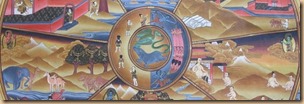 Many thanks to that most learned of fellows, Ken Hawkins, for providing the following explanation of the Chinese symbols of Ichinen Sanzen.


 Yesterday evening, we went to the cinema to watch
 Ladies and gentlemen, I am delighted to be able to announce that the much anticipated weekend is upon us, so make the most of the opportunity.
 The path to enlightenment involves a lot of learning, much of it about ourselves. My growing emphasis on mindfulness leads to much self examination, of feelings, thoughts and of the workings of the mind.
 Going back over our errors, asking ourselves painful questions and giving honest answers is a difficult experience.
 We all live with hopes and expectations, of ourselves, of others, and of the outcome of situations in our lives, and it is all too easy to be disappointed when those expectations are not fully met.
 The Search For Enlightenment
Recents Comments