Shikishin-Funi

Shikishin-FuniWe must never underestimate the power the mind has over our bodies. If we can remain positive, with high life-energy and in one of the higher worlds, our bodies will respond positively. If we allow negativity to creep in, the battle will be all the harder.

The Nichiren phrase for this connection between our body and mind is Shikishin-Funi. Two, but not two, not two, but two, meaning that they are separate, but cannot function alone.

Not exactly easy to understand, but essential for us to prosper in difficult times. By being positive, we give out positive energy to those around us. Whether we are in a difficult situation in our life, looking for a job, trying to make ends meet financially, battling against illness or just trying to grin and bear it in the face of seemingly unending bad news, staying positive is the only way to win through.

[色心不二] (Jpn shikishin-funi )

Also, non-duality of body and mind. The principle that the two seemingly distinct phenomena of body, or the physical aspect of life, and mind, or its spiritual aspect, are essentially non-dual, being two integral phases of a single reality. One of the ten onenesses formulated by Miao-lo (711-782) in his Annotations on “The Profound Meaning of the Lotus Sutra.” In the Japanese term shikishin-funi, shiki means that which has form and colour, or physical existence, while shin means that which has neither form nor colour, or spiritual existence, such as the mind, heart, and soul. Funi is an abbreviation of nini-funi, which indicates “two (in phenomena) but not two (in essence).” This means that the material and the spiritual are two separate classes of phenomena, but non-dual and indivisible in essence, because they are both aspects of the same reality. In the above annotations, Miao-lo states that, from the viewpoints of the whole and its components, life at a single moment is the whole, while body and mind are its components. Neither body nor mind is a separate entity; there is not one without the other. They are inseparable components of life. In the Lotus Sutra, the principle of the ten factors of life represents the oneness of body and mind. The ten factors are listed in the “Expedient Means” (second) chapter of the sutra, where it states that the true aspect of all phenomena consists of “appearance, nature, entity, power, influence, internal cause, relation, latent effect, manifest effect, and their consistency from beginning to end.” On “The Profound Meaning” states: “Appearance exists only in what is material; nature exists only in what is spiritual. Entity, power, influence, and relation in principle combine both the material and the spiritual. Internal cause and latent effect are purely spiritual; manifest effect exists only in what is material.” The Record of the Orally Transmitted Teachings reads, “[Concerning the term dedication of one’s life ] ‘dedication’ refers to the element of physical form as it pertains to us, while ‘life’ refers to the element of mind as it pertains to us. But the ultimate teaching tells us that form and mind are not two.” – Taken from the SGI Dictionary of Buddhism

Inner Strength

Inner StrengthWe are very similar, in many ways, to steel reinforced concrete, in that much of our strength comes from within. The pillars of motorway bridges are immensely strong because, apart from the toughness of the concrete itself, they have a rigid steel structure embedded within them.
In the same way, we have an inner strength, an emotional structure that allows us to handle the rigours of daily life. The strength of that structure is different in each one of us, indeed it can change depending on the strain that life is exerting at any given point in time. But the important thing is that we can increase it through some very simple practices.

Generally speaking, we are stronger, mentally, when we see problems as challenges, and stronger still when we feel we can overcome those challenges and come out the other side unscathed. So how do we improve our resilience to the bumps and knocks that life delivers?

Well in my own case, I find that chanting raises my life-state and allows me to tackle challenges more positively. By chanting about a particular issue, I find that I see the details more clearly and hence have more ideas regarding the possible solutions to solve it.

Of course, other people have their own way to deal with challenges. Some meditate, some pray to their God for guidance or divine intervention, some in fact are so grounded that they seem to have a built in ability to cope.

However you go about it, the most important thing to remember is that confidence and determination are key factors in winning the battle. Sitting and cogitating the fluff in your navel, getting depressed, or feeling that the challenge is just far too great to tackle, will undoubtedly result in failure, so don’t do it.

One really good tip, whatever you are facing, is to try to break down the task at hand into bite sized pieces. As Geoff says to Ed, in The Buddha, Geoff and Me, ‘How do you eat an elephant?’ … ‘One bite at a time’. So take it bit by bit, deal with each day as it arrives, and remember to stay strong and above all positive. If you believe you will win, then you are already half way there.

Practice Makes Perfect Sense

Practice Makes PerfectFor me, my Buddhist Practice is a way of life. A routine that I go through every day, Gongyo, Daimoku, even writing this blog. But routine is also another word for boring, mundane or even hum-drum, so it’s important to keep in mind why we Practice.

We Practice for several reasons …

  • To raise our life-energy levels …
  • To chant for certain outcomes …
  • To move us along the road to Buddhahood …
  • To give a stable anchor in our lives …

and there are many others, often different for every individual.

As a relative novice, I find that I can learn a little more each day Let’s face it, Buddhism has been around for well over two thousand years, so there’s plenty to learn about. I can improve or seek to perfect my Practice and to maintain a more focussed attention to the subject of my chanting.

I look forward to the feeling I get during and after Gongyo. I often find that I am quite warm when I finish chanting and in a really good mood, despite any problems I am facing.

I never cease to be amazed by the effectiveness of chanting either. To start with, the word coincidence came into my mind when I saw results, but not any more. But I do get surprised by the way the Universe solves the problems with which I have asked it to help. Not always the way I expected, and often in better, more subtle ways than I could have  ever imagined.

So my Practice is a pleasure, not a chore. It’s something I enjoy and never something I feel I have to do.

As Nichiren Daishonin said, ‘If you practice something, you must test it’s validity with the results you see’. In other words, if it doesn’t work, stop doing it.

For me, it is working wonders and I think the World would be a better place if more people were to discover those wonders.

Seeing Life Differently

Seeing Life DifferentlyDo you remember the day you mastered the art of riding a bicycle? Of course you do. For me, it was the culmination of a rather lengthy, and very frustrating process, and but for the perseverance  of my father, I might never have learned at all.

I just couldn’t seem to get it. It looked so simple, but the harder I tried, the worse I got. Then suddenly it clicked, I had it nailed, and from that day on I have been able to ride a bike.

Ok, so it’s no huge revelation, but I think learning about Buddhism is a bit like learning to ride a bike.

As you learn, about The Oneness of Self and the Universe, about Karma, about Life-Energy or The Ten Worlds, you also learn to see yourself, life and the Universe in a different way. And just in the way that having learned to ride a bicycle, you never unlearn the skill, once you learn to see the world through different eyes, you never unlearn that either.

Deep in my heart, I know that I am different for having Buddhism at the centre of my life. Some people have noticed that change, others ask what has changed and how I know that it’s a real change, not just a fad, or ‘a phase I’m going through’.

Well as I say, once you see the world differently, you just can’t un-see it that way. It’s a wonderful change, and I’m very confident, not to say delighted, that it’s a permanent change.

And Relax, A Bit …

TranquillitySometimes the World of Tranquillity can be a true blessing, a lull after a period of intense effort.
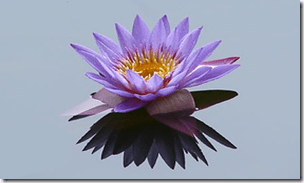
At other times it can be be like the dying notes of a moving piece of music, the echoes of the most magnificent firework display.

Maybe the biggest difference between the two is whether you wished for Tranquillity or not.

If you do wish for it, Tranquillity can be the most restful of time, if not it can be as quiet as the grave, peaceful but not something which you might actively desire.

If you find yourself becalmed in a world of Tranquillity, chanting will raise your life-state and get the energies flowing again.

Just Checking

TranquillityThe advent of each day brings us joys and challenges, each of which have the ability to alter our life-state in some way. Joys tend to raise our life-state, challenges may lower it if we let them, and therein lies the conundrum. We need to be vigilant, to observe our life-state from moment to moment, but in doing so, we affect that life-state.

Just as in quantum physics, the mere act of observation affects the phenomenon being observed, self observation of our life-state can, and most likely will affect it too. Imagine a situation where you become angry because something has not gone the way you would like. Initially you may be reacting instinctively, in an animalistic fashion. But as soon as you realise that you are reacting in such a manner, in other words, you observe your life-state, there is a large chance that you will change to that of a more calm and reflective mood, even into a state of tranquillity.

So we have this little test for ourselves. We must be, as far as possible, aware of our life-state. Ideally we want to be in one of the higher states, not grubbing around in the worlds of Hell, Hunger, Animality or Anger, but in Learning, Realisation, Bodhisattva or even Buddhahood. The act of testing can help us raise our life-state through awareness, which is a good thing. But be warned, when the results come back, and you find you are in one of the lower worlds, that can be a sobering moment, when you realise that you are not as far along the path to enlightenment as you would like to be.

Is It You?

Radiators And DrainsThere are two types of people in this world, and no not those who say ‘There are two types of people’ and those who don’t. The two types are those who are Radiators and those who are Drains.

A Radiator is the kind of person who leaves you feeling more energetic and enthused, after you meet or speak to them, than before. They radiate positive energy and are happy to share their life-energies with others. They appear to have a permanent smile on their faces, as though they know something others do not. In fact they do, they know that the secret path to a happy life is to pass on their happiness to others.

Drains are the complete opposite. They have the unfortunate knack of being able to sap energy and enthusiasm from other people, leaving them feeling unhappy or flat. When you meet one, and there are plenty around, the conversation is hard work, they are negative about things when you ask about how they are. In fact, you probably walk away wishing you hadn’t met them in the first place.

Our life-state can dictate whether we are a Radiator or a Drain if we let it, but concentrating on the positive side of life can change all that. When we are in Heaven we tend to Radiate energy to other people, when we are in Hell we Drain energy from others.

So think of all the good things in your life, walk around with a smile and a cheerful disposition, be a Radiator and see how people react positively towards you.

We all know a Drain when we meet one, and if you don’t, then it’s you.

Stop Waiting, Start Living

Don't Just Sit ThereIf you think about it, although we may not be destined to die five minutes from now, we are all, without exception, going to die at some point. We can count on it 100%. There is nothing surer than this.
Victor Hugo said, “We are all under sentence of death, but with a sort of indefinite reprieve.”

Ideally, we should live every minute of our lives mindfully, as if it were the last moment of our lives. Those who live aimlessly are left with a sense of emptiness at the end of their lives, but those who live all-out, striving to achieve their goals right to the end, will die peacefully.

Leonardo da Vinci said “As a well-spent day brings happy sleep, so a life well used brings happy death.”

One who is aware that death could come at any time, will live each day to the fullest. So don’t wait for something to happen, or someone to come along, before you start living, do it now.

Rays Of Hope

There Is Always HopeWhilst feeling a little adrift given my current situation and enraged by the lack of fairness in the way modern institutions and those in power treat us mere morals, I found this piece by Sensei rather encouraging …

What can the individual accomplish in the face of the huge institutions that run our world? This feeling of powerlessness fuels a vicious cycle that only worsens the situation and increases people’s sense of futility.

At the opposite extreme of this sense of powerlessness lie the Lotus Sutra’s philosophy of three thousand realms in a single moment of life and the application of this teaching to our daily lives.

This principle teaches us that the inner determination of an individual can transform everything; it gives ultimate expression to the infinite potential and dignity inherent in each human life.

~ Daisaku Ikeda

Staying Positive

Stay PositiveWe must never underestimate the power the mind has over our bodies. If we can remain positive, with high life-energy and in one of the higher worlds, not only will our bodies respond positively, but also those around us will feel more positive too. If we allow negativity to creep in the battle will be all the harder, and we will find that we do not inspire those who need our support to try that little bit harder to support themselves.

The Nichiren phrase for this connection between our body and mind is Shikishin-Funi. Two, but not two, not two, but two, meaning that they are separate, but cannot function alone.

[色心不二] (Jpn shikishin-funi )

Also, non-duality of body and mind. The principle that the two seemingly distinct phenomena of body, or the physical aspect of life, and mind, or its spiritual aspect, are essentially non-dual, being two integral phases of a single reality. One of the ten onenesses formulated by Miao-lo (711-782) in his Annotations on “The Profound Meaning of the Lotus Sutra.” In the Japanese term shikishin-funi, shiki means that which has form and colour, or physical existence, while shin means that which has neither form nor colour, or spiritual existence, such as the mind, heart, and soul. Funi is an abbreviation of nini-funi, which indicates “two (in phenomena) but not two (in essence).” This means that the material and the spiritual are two separate classes of phenomena, but non-dual and indivisible in essence, because they are both aspects of the same reality. In the above annotations, Miao-lo states that, from the viewpoints of the whole and its components, life at a single moment is the whole, while body and mind are its components. Neither body nor mind is a separate entity; there is not one without the other. They are inseparable components of life. In the Lotus Sutra, the principle of the ten factors of life represents the oneness of body and mind. The ten factors are listed in the “Expedient Means” (second) chapter of the sutra, where it states that the true aspect of all phenomena consists of “appearance, nature, entity, power, influence, internal cause, relation, latent effect, manifest effect, and their consistency from beginning to end.” On “The Profound Meaning” states: “Appearance exists only in what is material; nature exists only in what is spiritual. Entity, power, influence, and relation in principle combine both the material and the spiritual. Internal cause and latent effect are purely spiritual; manifest effect exists only in what is material.” The Record of the Orally Transmitted Teachings reads, “[Concerning the term dedication of one’s life ] ‘dedication’ refers to the element of physical form as it pertains to us, while ‘life’ refers to the element of mind as it pertains to us. But the ultimate teaching tells us that form and mind are not two.” – Taken from the SGI Dictionary of Buddhism

Not exactly easy to understand, but essential for us to prosper in these difficult times. By being positive, we give out positive energy to those around us. Whether we are in a difficult situation in our life, looking for a job, trying to make ends meet financially or just trying to grin and bear it in the face of seemingly unending bad news, being positive is the only way to win through.

Previous Older Entries Next Newer Entries