Consistently Inconsistent

Dark PassengerI don’t know about you, but when I say I’m going to do something, I mean it. When I decide on a course of action, I try my best to carry it out. So having had a little slide, I’m determined to focus on the goal and get back on course.

The trouble is, sometimes we don’t stick to our goals, and there are many, many reasons for that. Sometimes our Dark Passenger has a little word, introducing doubts or reasons why we should give up. Ignore him and get back on track, if you can.

There is nothing to compare with the feeling of satisfaction when we achieve our goals. In the same way, there is very little to compare with the feeling of disappointment when we let ourselves down and fail.

We all want to be happy, so be constant. You will be more successful, more content and people will know where they stand too. A win-win situation.

Grabbing A Bargain?

Selling OutNearly everyone I know has been rushing out to the Boxing Day sales today, determined to grab that ‘must have’ bargain. But is it a ‘must have’, is it even a ‘bargain’, is it, really?

All over Christmas, at every commercial break, we get bombarded with ‘Bargain Offers’ for buy now, pay later ‘Must Haves’ … Rubbish.

Happiness stems from who you are, and not from what you own. That nice new iPad2 or iPhone 4s that you have been showing off, will very soon be yesterdays toy, and the next big ‘must have’ thing will come along to take its place.

Look around you, see how much you really have, family, friends and all manner of comforts in life. You don’t need that ‘must have’ gizmo, and if it really were such a ‘bargain’, why would the company be selling it at that price? Because they are just ripping you off by a little less than before.

Retail therapy is only therapy for the companies selling the goods. Tell me, honestly, that you have never been out, bought a ‘bargain’, and regretted it, maybe even before you got home. Think before you spend that hard earned cash, think even harder before you pay with your credit card or take a loan. Do you really need it?

A Buddhist Christmas

OogwayI thought it was an interesting choice of film to show on Christmas day, the story of a zero to hero Panda, through the application of Buddhist principles.

DreamWork’s Kung Fu Panda on TV today, not for the first time I have to admit, was a great lesson in humility, wisdom, trust and self confidence. If you haven’t seen the film it is, on the face of it, a kids cartoon, lots of action, lots of fun.

At a deeper level, it tells the story of the underdog, Po the Panda, who is chosen as the Dragon Warrior against the odds. Nobody believes that Oogway the Turtle has made the right decision, that he was chosen  by chance, even though Oogway explains that there is no such thing as chance.

Even Po is convinced that he has been chosen by mistake, and cannot believe that he is the Dragon Warrior. He is slandered by everyone, even Shifu, who is charged with training Po in the ways of Kung Fu. The other pupils of Shifu, Tigress, Monkey, Crane, Viper and Mantis also look down on Po, though they slowly come to see that his determination is to be admired.

After Oogway passes on, having asked Shifu to believe in Po and following a lot of learning, Po has to meet his nemesis Tai Lung to save the valley.

Lots of Buddhist principles are woven through the film, a good watch and a fun way to learn.

Seasonal Greetings

Seasons Greetings

Merry Christmas to all my Christian readers, may you all have a wonderfully peaceful day.

To all other denominations, enjoy the holiday and be nice to one another.

2011 has been an amazing year. The Arab Spring has resulted in the people of several former despotic countries taking back control of their own lands. My wish for 2012 is that the process continues, that there is a levelling of wealth throughout all the capitalist countries, and a general move towards peace throughout the world.

Nam Myoho Renge Kyo

PC Gone Mad?

The following is an email from the boss to his staff …

From: The Boss
Sent: 23 December 2011 16:59
To: The Motley IT Crew
Subject:Merry mas

Dear Staff,

Before you all go your separate ways and eat too much …

Political CorrectnessBest wishes for an environmentally conscious, socially responsible, low stress, non-addictive, gender neutral, winter solstice holiday, practiced within the most joyous traditions of the religious persuasion of your choice, but with respect for the religious persuasion of others who choose to practice their own religion as well as those who choose not to practice a religion at all.

Additionally, … I hope you have a fiscally successful, personally fulfilling, and medically uncomplicated recognition of the generally accepted calendar year of 2012, but not without due respect for the calendars of choice of other cultures whose contributions have helped make our society great, without regard to the race, creed, colour, religious, or sexual preferences of the wishes.

(Disclaimer: This greeting is subject to clarification or withdrawal. It implies no promise by the wisher to actually implement any of the wishes for the wishee or others, and no responsibility for any unintended emotional stress these greetings may bring to those not caught up in the holiday spirit.)

Of course this is a joke, but you can just imagine it being the ways things will go in this world of politically correct madness. As a Buddhist, Christmas has lost much of its meaning, certainly in religious terms. It seems to be more and more of a marketing exercise each year. Still, all is not lost if people at least find it a good reason to be nice to each other for a whole day. The pity being, that they can’t find a reason to be nice to each other for the other 364 days of the year.

Music As It Should Be

Starry NightHaving spent the day being forced to listen to Radio 1, it was a wonderful relief to listen to some proper music, music the way it should be played, watching the Don MacLean Songbook on Sky Arts. I had forgotten just how much I loved the lyrics to his song Vincent.

In my teens, I used to play Vincent on my old Echo six string, and the words are wonderful:

Starry, starry night
Paint your palette blue and grey
Look out on a summer’s day
With eyes that know the darkness in my soul
Shadows on the hills
Sketch the trees and the daffodils
Catch the breeze and the winter chills
In colours on the snowy linen land

Now I understand
What you tried to say to me
How you suffered for your sanity
How you tried to set them free
They would not listen they did not know how
Perhaps they’ll listen now

Starry, starry night
Flaming flowers that brightly blaze
Swirling clouds in violet haze
Reflecting Vincent’s eyes of China blue
Colours changing hue
Morning fields of amber grain
Weathered faces lined in pain
Are soothed beneath the artist’s loving hands

Now I understand
What you tried to say to me
How you suffered for your sanity
How you tried to set them free
They would not listen they did not know how
Perhaps they’ll listen now

For they could not love you
But still your love was true
And when no hope was left in sight
On that starry, starry night
You took your life as lovers often do
But I could have told you Vincent
This world was never meant for one as
beautiful as you

Starry, starry night
Portraits hung in empty halls
Frameless heads on nameless walls
With eyes that watch the world and can’t forget
Like the strangers that you’ve met
The ragged men in ragged clothes
A silver thorn on a bloody rose
Lie crushed and broken on the virgin snow

Now I think I know
What you tried to say to me
How you suffered for your sanity
How you tried to set them free
They would not listen they’re not listening still
Perhaps they never will

Determination

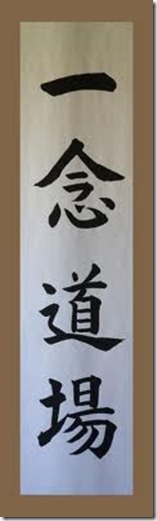
IchinenIchinen is a Japanese word meaning determination (amongst other things).

ichinen

[一念] (Jpn; Chin i-nien )

A single moment of life, one instant of thought, or the mind or life at a single moment. Also, life-moment, thought-moment, or simply a single moment or instant. Ichinen has various meanings in Buddhism: (1) A moment, or an extremely short period comparable to the Sanskrit term kshana. The Treatise on the Great Perfection of Wisdom defines one kshana or moment as a sixtieth of the time it takes to snap one’s fingers. (2) The functioning of the mind for one moment. The “Distinctions in Benefits” (seventeenth) chapter of the Lotus Sutra speaks of a single moment of belief and understanding. (3) To focus one’s mind on meditating on a Buddha; Shan-tao (613-681), a patriarch of the Chinese Pure Land school, defined ichinen (one instant of thought) as chanting Amida Buddha’s name once. (4) T’ient’ai (538-597) philosophically interprets ichinen in his doctrine of three thousand realms in a single moment of life ( Jpn ichinensanze Chin i-nien san-ch’ien ). In this doctrine, ichinen indicates the mind of an ordinary person, which at each moment is endowed with the potential of three thousand realms; its characteristics are: (a) it pervades the entire universe; (b) it includes both body and mind; (c) it includes both self and environment; (d) it gives rise to good and evil; and (e) it encompasses cause and effect simultaneously. Nichiren (1222-1282) embodied this philosophical framework in the form of a mandala known as the Gohonzon. By this he aimed to establish a practical way for ordinary people to manifest Buddhahood from among the Ten Worlds of their own lives. (Taken from the SGI Dictionary)

Being a success at something isn’t just about talent, it’s about having the desire, in your heart, to be the best that you possibly can be.

If you have a strong Ichinen, you are far more likely to reach your goal. You still have to put in the effort and in fact, the more talent you have, the more effort is needed, because your end result might be far more exacting than a less talented person.

If you think you will fail, you will. You must embrace your goals, your targets, with every fibre of your being. Strive with all your might, night and day towards that goal and you are far more likely to succeed.

Success takes focus, desire, effort, hard work, determination and perseverance.

Ichinen covers them all and chanting for what you want to achieve makes your ichinen stronger and stronger.

Every Cloud

SunriseIt has been pretty cold for the last week, yesterday I even had frost on the car first thing, and the days are so short. The mornings are dark, the evenings are even darker, and it feels natural to get home after a long day at work, and curl up like a bear in his cave.

This morning wasn’t so cold, though the car was still covered in a fine dew. There was no breeze and because the children have finished school for the holiday, it felt like I was the only one not to be still tucked up in bed. But as with most things in life, and particularly in Buddhist life, every cloud has a silver lining. Every drop of poison can be turned into a drop of medicine and so it was this morning.

Driving down the Blandford road, the headlights of the oncoming cars and trucks were so bright against the velvet blackness of the early morning. The traffic was slow and I was wondering whether I was going to get to the office on time. Then very suddenly every thought changed, and my worry turned to wonder.

As the first rays of the sun peeped over the horizon they created a majestic and awe-inspiring sunrise, illuminating a beautifully sculptured high bank of clouds. It was amazing, the colours were stunning, and the whole spectacle changed second by second. It was so huge, completely filling the sky, it was impossible to take in the whole. It transformed my journey and in fact my whole day. Of course, the sun comes up every day, but some days it does it in much more wondrous ways than others.

Life, What Is It All About?

Man's Search For MeaningWe have all asked ourselves this question, maybe once or twice, maybe a thousand times, but the answer to the question turns out to be so simple, so eloquent, so meaningful, when it is asked from a position of total hopelessness.

Taken from Man’s Search For Meaning (p.113), by the late Dr Viktor E. Frankl, this is the most sensible and acceptable explanation of the age old question, ‘what is the meaning of life?’ I have ever read. It is a question we should all ask ourselves on a regular basis, for as you will see, there is no one single answer.

”I doubt whether a doctor [we] can answer this question in general terms. For the meaning of life differs from man to man, from day to day and from hour to hour.

What matters, therefore, is not the meaning of life in general but rather the specific meaning of a person’s life at a given moment.

To put the question in general terms would be comparable to the question posed to a chess champion: “Tell me, Master, what is the best move in the world?” There simply is no such thing as the best or even a good move apart from a particular situation in a game and the particular personality of one’s opponent.

The same holds for human existence. One should not search for an abstract meaning of life. Everyone has his own specific vocation or mission in life to carry out a concrete assignment which demands fulfilment.

Therein he cannot be replaced, nor can his life be repeated. Thus, everyone’s task is as unique as is his specific opportunity to implement it. As each situation in life represents a challenge to man and presents a problem for him to solve, the question of the meaning of life may actually be reversed.

Ultimately, man should not ask what the meaning of his life is, but rather he must recognize that it is he who is asked. In a word, each man is questioned by life; and he can only answer to life by answering for his own life; to life he can only respond by being responsible.”

This short explanation, taking less than a page in the book, encapsulates an answer to which I can relate.

The book itself covers Dr Frankl’s own struggle for survival in Auschwitz and other Nazi concentration camps. It has tragic as well as surprisingly humorous passages, but reading it will leave you forever changed and, I believe, better for the experience.

Taking On Challenges

Challenges NOT ProblemsWe have discussed the difference between problems and challenges, and we know that there is no difference, other than in our head. Problems are things we worry we cannot overcome, challenges are things we believe that we can. Having the confidence and determination to tackle things head on enables us to stay positive, to turn poison into medicine, to take on those challenges (we don’t do problems here) and ultimately to live a happy and fulfilled life. But if we let our mind magnify the challenge, our Fundamental Darkness takes control, and these obstacles grow and grow.

Overcoming Obstacles

This negative aspect is often referred to as the ‘three obstacles and four devils’ (in Japanese, sansho shima). Obstacles refer to things which appear to be outside of ourselves (but which ultimately have their origins in our lives) and the devils, or negative elements, are ‘internal’. What makes these obstacles and devils serious is that if we are influenced by them we may stop practising Buddhism. They confront us at a specific point in time – usually when we are about to grow in our lives and move forward. The fact that at a difficult moment we may think that we should stop practising is a sign that it is an attack of one of the three obstacles and four devils. From a positive point of view these hindrances enable us to see a weakness in our lives so that we can chant and become stronger in that area.

The first is the obstacle of earthly desires. Buddhism teaches that our earthly desires may be transformed into enlightenment. Second is the obstacle of karma, which includes the influence of those who are close to us such as a spouse, partner or children. Third is the obstacle of retribution, which means opposition from those with power over us, such as our superiors, parents or people in authority.

The devils come from within our own lives. We create our own negativity, our own doubt, uncertainty and confusion. The first devil arises from our earthly desires. It can include egoism, craving for personal fame and riches, laziness or being dominated by force of habit. It can also arise from the three poisons of greed, anger and stupidity.

Second is the devil of weakness that can arise in our own bodies, such as an illness which will hold us back and reduce our capacity. Third is the devil which manifests as the hindrance of death. Unless we are confident that death is not ‘the end’, but rather another phase in the cycle of life and death – then another person’s death can trigger a sense of doubt and can considerably weaken our will to practise Buddhism, even though Buddhism is intended to relieve us from the sufferings of birth and death.

Finally the fourth devil is known as the Devil King of the Sixth Heaven who, in Buddhist mythology, works to obstruct Buddhist practice and drain our life force. This is the manifestation of fundamental darkness inherent in life. And because of this can be seen as the most challenging aspect of negativity to conquer. When influential people persuade or threaten us to stop practising this could be said to be the workings of the Devil of the Sixth Heaven.

Whatever form they take, the Daishonin advises us to take these obstacles and devils as confirmation that we are properly practising the true Law through which ordinary people become Buddhas. They offer us insight into aspects of our human revolution, ways to strengthen our lives and assurance that we are on the verge of achieving this, so long as we are neither influenced nor frightened by them. Human revolution includes experiencing this process and transforming some aspect of ourselves. It indicates the real experience of finding we have to confront something. It also includes our need to gain the inner conviction that we can win over the obstacle in question.

In Buddhism, the term ‘fundamental darkness’ is used to describe the ignorance and delusion inherent in human life. This is the ignorance of the fact that we all have the state of Buddhahood in our lives, at all times, latent and ready to be revealed. The aim of our great struggle for kosen-rufu, our movement of human revolution, is to transform that innate darkness into light. Our goal is to vanquish the destructive tendencies within human life that give rise to mutual distrust and hate, violence and fear. The three obstacles and four devils become an indispensable means for doing this. That is why we should rejoice when they appear.

Previous Older Entries Next Newer Entries