On Being Open And Honest

HonestyWhen you find yourself in a situation where you have to decide what happens next, you must be completely honest, with everyone concerned, including yourself. When that decision is possibly not what others expect or want, you must be compassionate when you announce it.

Of course you can hurt others if when your decision is contrary to theirs, but you will hurt them more by delaying or by going along with them, just to go with the flow. Eventually, your feelings will show and the result will only be more angst for all.

So when you feel that you have to make a decision that will be difficult for others to accept, make it quickly, announce it gently but firmly, and reduce the pain, to you and those affected, to the minimum.

Having made the decision, you must stick to it. There can be no going back, and doing so only makes it worse for everyone concerned.

Just Another Day … Almost

Just Another Birthday Birthdays are funny things aren’t they When you are little, they are the best thing next to Christmas, you count down the days and they take ages to arrive.

Then you become a teenager and your life changes almost overnight. Shortly after, one day you are a child, the next you are an adult, and so it goes on.

Certain birthdays are real milestones in life. 18, 21, 30, 40, 50, 65, the list goes on. However, 60 isn’t on any list that I subscribe to, so today was really just another day, albeit a very nice one. The last twelve months have been life changing for me, my strengthening faith in Nichiren Buddhism being one of the most important aspects of that.

But now it’s nearly over, and tomorrow will literally be just another day. So it is only left for me to thank all my family and friends for the presents, the cards and the nice greetings on Facebook and the like. I am grateful that I have chalked up another year. When you see the news, every day there are many, many people who don’t. So I should really be most thankful for my good fortune, life in all it’s glory, should never be taken for granted.

Just Bite Your Tongue

Just Bite Your TongueSome situations in life just get stuck, they just refuse to offer a resolution, be that through indecision, lack of control or reluctance to move on.

Having the patience, with a person or situation, to see things through to their conclusion takes Wisdom, Courage and Compassion for the following reasons:

The Wisdom to see that the desired path is both achievable and may lead to the correct outcome.

The Courage to stick to the path, despite setbacks or obstacles.

The Compassion to see things from another’s viewpoint, whether it agrees with your viewpoint or not.

One big problem with being patient, is that you never know what the outcome will be until it’s happened.

I Have A Great Role Model

BuddhaThe purpose for, and the reason behind my Buddhist Practice is to bring me closer to Buddhahood, each and every day.

That is to say, to emulate, as closely as possible, the Buddha himself in the way he was able to see life and all things in a pure clarity.

Siddhārtha Gautama was a man, albeit a prince, who forsaking his life of comfort and position, went out into the world to meditate on the causes of, and ways to reduce or remove, the suffering of life.

In Nichiren Buddhism we learn about the Ten Worlds, from Hell to Buddhahood.

The Buddha state originates from the very depths of life, called the amala consciousness, meaning the fundamentally pure life force or consciousness. The function of the Buddha state is to bring out the positive side of the other nine worlds.

This principle of the Ten Worlds shows that the Buddha state is a naturally occurring condition of life in every living being. The purpose of Buddhist practice is to enable us to cause the Buddha state to appear; to have it working strongly in us.

In Nichiren Buddhism, therefore, the Buddha is not some perfect, ideal being, but is rather an ordinary person living in rhythm with the law of the universe, taking wise, courageous and compassionate action for the benefit of others, through the functioning of the nine worlds in daily life.

The more I practice, the closer I come to Buddhahood, a very positive thought for today.

About Illusions

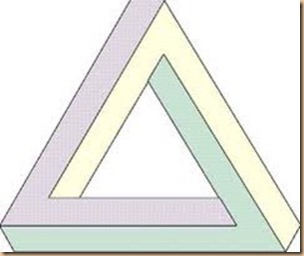
The Penrose TriangleWhile the ‘real’ world is out there, all around us in physical form, ‘our’ world is contained within the amazing structure we call our brain. Whilst we can process, interact with and interpret the events and objects around us, our brains are guilty of playing tricks on us if we do not keep a close eye on them.

Our brains are amazing things, I think we can all agree on  that. But they are also capable of making the simplest of mistakes. Take a look at the image above. Each angle looks like a perfectly plausible part of a three dimensional triangle, but as you move from one angle to the next, it becomes clear that the object we perceive is, in fact, an illusion.

Our brains are programmed by evolution, to make sense of partial information. Being able to recognise a Sabre-Toothed Tiger from just a small part of his outline would be a very valuable asset to pre-historic man. But being able to recognise a scenario from a handful of unrelated, or even imagined mental clues, can lead us right up the garden path, to completely the wrong conclusion.

Imagination, illusion and our Fundamental Darkness are all facets of real life, but beware of leaning too heavily on one or all of these when you are piecing together your next mental jigsaw puzzle, you might find you are confronted by an unpleasant picture that is wholly inaccurate.

Taking A Little More Responsibility

Be ResponsibleResponsibility, they say, can weigh heavy on the shoulders of some people. But that need not be the case if we all accept that each and every action we take comes with automatic responsibility.

We all make mistakes from time to time, we are only human after all and mistakes are an all too human trait. The mistakes themselves are, quite often, easily forgiven, if we take the simple, and honest action of owning up.

Owning up is a bit of a strange saying, don’t you think? Owning means responsible for, owning a dog means being responsible for that animal, owning a house means being responsible for the upkeep of that building. So owning up to a mistake really means accepting that you are responsible for that mistake.

The big problem comes, it seems to me, when we refuse to be responsible for making, or refuse to accept that there is, any mistake we have made. Being a fully paid up member of the human race, I’ve made more than my fair share of mistakes. The problems have always come along when I’ve failed to own up.

So there are two simple ways to help with our mistakes. Think before you think, say or do anything, and if it transpires at a later time that it was a mistake, take responsibility for that mistake before it causes any more problems.

Is This Happiness?

Is This Happiness?Before asking the question, maybe we should ask … what do we mean by happiness?

There may be as many answers to that as there are stars in the sky, everyone has their own idea of what makes them happy, and what doesn’t.

Maybe it is the love of a partner, being part of a family, the pay cheque at the end of the month or that new car you had always promised yourself. Whatever your idea of happiness, we all crave more of it.

We can probably agree that it is all too often a transitory state, punctuated by periods where we are unhappy, or at least a bit glum. So what would you give to have more of this illusive life-state, and how can you go about achieving a happier life?

Well speaking personally, I can almost guarantee happiness from my Buddhist practice. That might sound a little trite or even rather far-fetched, but for me it is true. My practice helps me see life from all angles, the ups and downs, from my view-point and from that of others, and it ‘smoothes’ out the emotional bumps we encounter each and every day.

The idea at the very core of Buddhism is the removal of suffering, and that in itself helps us to be happier. Seeing the beauty in nature, the best facets of another’s personality, the joy in helping others, happiness is there for us all, all of the time and all around us. Living a life that is more concerned with others than ourselves, giving more than we take, and so on, will also bring feelings of happiness. All we have to do is look out for it.

Living in a society that is more concerned about what we own, than who we really are, we all struggle to put those ideas into action. We hear about people earning ridiculous sums, whilst providing little by way of return, and wonder how they can live with the guilt. If society valued the good in people more than the goods of people, the world would be a much fairer, happier place.

Whatever flavour your own happiness comes in, I wish you more of it, now and in the future. And when it arrives, please make sure that you share it around. That way you will find it grows and grows, and that it lasts just that little bit longer.

On Endless Possibilities

This Hubble photo is of a small portion of one of the largest seen star-birth regions in the galaxy, the Carina Nebula.

The challenges of daily life require us to makes choices or decisions.

When we are open and engaged, we experience the greater self.

When we are closed off, we are exhibiting our lesser self.

The lesser self is a deluded condition, whilst our greater self is synonymous with our Buddha nature.

To live for the greater self means to recognise the universal principle behind all things and, being awaked in this way, rise above the suffering caused by the awareness of impermanence. A belief in something eternal is needed to enhance our quality of life.

By believing that this world is the be-all and end-all of existence, we will miss out, we will not live a truly profound life. When our viewpoint expands beyond the boundaries of our present existence to include the entire, eternal universe, we can finally live deeply fulfilling lives.

Remembering War, Working For Peace

A Field Of PoppiesThe two minute silence, in remembrance of those who gave their lives in the service of our country, seemed particularly poignant yesterday.

Being the 100th anniversary of the start of WWI has led to greater emphasis on the event.

But we should not forget the true meaning of the silence and why the sanctity of life is so important.

The sanctity of life is known to everyone. At the same time, there is universal confusion about the essential meaning of life’s sanctity. If the sanctity of life can become a solid touchstone of wisdom for all people, then humankind’s destiny to experience war and misery repeatedly can be transformed.

As Sensei explains it: “Kosen means ‘to widely declare.’ Widely implies speaking out to the world, to an ever-greater number and ever-broader spectrum of people. Declare means ‘to proclaim one’s ideals, principles and philosophy.’ The ru of rufu means ‘a current like that of a great river.’ And fu means ‘to spread out like a roll of cloth.’

“The teaching of the Mystic Law has nothing to do with appearance, form or pride. It flows out freely to all humanity the world over. Like a cloth unfolding, it spreads out and covers all. So rufu means ‘to flow freely, to reach all.’

“Just like a cloth, kosen-rufu is woven from vertical and horizontal threads. The vertical threads represent the passing of Nichiren Daishonin’s teaching from mentor to disciple, parent to child, senior to junior. The horizontal threads represent the impartial spread of this teaching, transcending national borders, social classes and all other distinctions. Simply put, kosen-rufu is the movement to communicate the ultimate way to happiness—to communicate the highest principle of peace to people of all classes and nations through the correct philosophy and teaching of Nichiren”It is toward this end, towards Kosen-Rufu, that we Nichiren Buddhists are struggling.

It is toward this end, towards Kosen-Rufu, that we Nichiren Buddhists are struggling.

Nam Myoho Renge Kyo

Keeping It All In Proportion

Challenges NOT ProblemsWe are all aware of what we mean by problems and challenges, and we know that there is no difference, other than in our head. Problems are things we worry we cannot overcome, challenges are things we believe that we can. Having the confidence and determination to tackle things head on enables us to stay positive, to turn poison into medicine, to take on those challenges (we don’t do problems here) and ultimately to live a happy and fulfilled life. But if we let our mind magnify the challenge, our Fundamental Darkness takes control, and these obstacles grow and grow.

Overcoming Obstacles

This negative aspect is often referred to as the ‘three obstacles and four devils’ (in Japanese, sansho shima). Obstacles refer to things which appear to be outside of ourselves (but which ultimately have their origins in our lives) and the devils, or negative elements, are ‘internal’. What makes these obstacles and devils serious is that if we are influenced by them we may stop practising Buddhism. They confront us at a specific point in time – usually when we are about to grow in our lives and move forward. The fact that at a difficult moment we may think that we should stop practising is a sign that it is an attack of one of the three obstacles and four devils. From a positive point of view these hindrances enable us to see a weakness in our lives so that we can chant and become stronger in that area.

The first is the obstacle of earthly desires. Buddhism teaches that our earthly desires may be transformed into enlightenment. Second is the obstacle of karma, which includes the influence of those who are close to us such as a spouse, partner or children. Third is the obstacle of retribution, which means opposition from those with power over us, such as our superiors, parents or people in authority.

The devils come from within our own lives. We create our own negativity, our own doubt, uncertainty and confusion. The first devil arises from our earthly desires. It can include egoism, craving for personal fame and riches, laziness or being dominated by force of habit. It can also arise from the three poisons of greed, anger and stupidity.

Second is the devil of weakness that can arise in our own bodies, such as an illness which will hold us back and reduce our capacity. Third is the devil which manifests as the hindrance of death. Unless we are confident that death is not ‘the end’, but rather another phase in the cycle of life and death – then another person’s death can trigger a sense of doubt and can considerably weaken our will to practise Buddhism, even though Buddhism is intended to relieve us from the sufferings of birth and death.

Finally the fourth devil is known as the Devil King of the Sixth Heaven who, in Buddhist mythology, works to obstruct Buddhist practice and drain our life force. This is the manifestation of fundamental darkness inherent in life. And because of this can be seen as the most challenging aspect of negativity to conquer. When influential people persuade or threaten us to stop practising this could be said to be the workings of the Devil of the Sixth Heaven.

Whatever form they take, the Daishonin advises us to take these obstacles and devils as confirmation that we are properly practising the true Law through which ordinary people become Buddhas. They offer us insight into aspects of our human revolution, ways to strengthen our lives and assurance that we are on the verge of achieving this, so long as we are neither influenced nor frightened by them. Human revolution includes experiencing this process and transforming some aspect of ourselves. It indicates the real experience of finding we have to confront something. It also includes our need to gain the inner conviction that we can win over the obstacle in question.

In Buddhism, the term ‘fundamental darkness’ is used to describe the ignorance and delusion inherent in human life. This is the ignorance of the fact that we all have the state of Buddhahood in our lives, at all times, latent and ready to be revealed. The aim of our great struggle for kosen-rufu, our movement of human revolution, is to transform that innate darkness into light. Our goal is to vanquish the destructive tendencies within human life that give rise to mutual distrust and hate, violence and fear. The three obstacles and four devils become an indispensable means for doing this. That is why we should rejoice when they appear.

Previous Older Entries Next Newer Entries