Sticking With It

Strength When times are easy and things go our way, it is easy to stick to the plan. It is when things go wrong, problems arise, or we are distracted from our Practice that we need to summon up our inner strength.

Practicing Nichiren Buddhism is rewarding and fulfilling. Chanting and praying before the Gohonzon becomes part of the everyday routine, and wavering makes us feel that we are letting ourselves and our mentor down.

But we have to remember that being constant takes effort and that allowing ourselves to back slide can be the easiest of things. Nichiren Daishonin wrote to Shinjo Kingo on this very topic way back in 1275 ad, so it’s certainly not a new problem.

This is in regard to the passage “This sutra is hard to uphold.” According to Acharya Ben, you said to him: “I have been practicing the Lotus Sutra correctly since last year, when you told me that those who embrace this sutra will ‘enjoy peace and security in their present existence and good circumstances in future existences.’ Instead, however, great hardships have showered down on me like rain.” Is this true, or did he give me a false report? In either case, I will take advantage of this opportunity to resolve any doubts you may have.

A passage from the Lotus Sutra reads that it is “the most difficult to believe and the most difficult to understand.” Many hear about and accept this sutra, but when great obstacles arise, just as they were told would happen, few remember it and bear it firmly in mind. To accept is easy; to continue is difficult. But Buddhahood lies in continuing faith. Those who uphold this sutra should be prepared to meet difficulties. It is certain, however, that they will “quickly attain the unsurpassed Buddha way.” To “continue” means to cherish Nam-myoho-renge-kyo, the most important principle for all the Buddhas of the three existences. The

sutra reads, “We will protect and uphold what the Buddha has entrusted to us.” The Great Teacher T’ien-t’ai stated, “One accepts because of one’s power of faith and continues because of one’s power of constant thought.” Another part of the sutra reads, “This sutra is hard to uphold; if one can uphold it even for a short while I will surely rejoice and so will the other Buddhas.”

A fire burns higher when logs are added, and a strong wind makes a kalakula grow larger. The pine tree lives for ten thousand years, and therefore its boughs become bent and twisted. The votary of the Lotus Sutra is like the fire and the kalakula, while his persecutions are like the logs and the wind. The votary of the Lotus Sutra is the Thus Come One whose life span is immeasurable; no wonder his practice is hindered, just as the pine tree’s branches are bent or broken. From now on, always remember the words “This sutra is hard to uphold.”

With my deep respect, Nichiren

So when times get tough, or distractions occur, be strong and maintain a strong practice. It will help you through the bad times and being constant will help sustain your faith.

Nam Myoho Renge Kyo

Life’s Ups And Downs

Snakes & LaddersLife is a series of ups and downs, most inconsequential, others more serious. Given that they are the very nature of our existence, wouldn’t it make sense to develop a strategy by which we can cope with the bumps?

It occurred to me that our moods, or life-states within the Ten Worlds, mirror the board game Snakes and Ladders. I remember to this day, playing the game with my family and feeling the disappointment of landing on the snake on the 99th square.

In life, there you are happily plodding along when you find yourself being whisked up a ladder to a higher life-state by something you find agreeable or exciting.

You may well stay at that higher life-state, again plodding along blissfully unaware that the next step may scoot you down a snake, maybe even back to square one (which may well be where the saying comes from) when a disappointment, or sadness comes your way.

The trick to winning the game, and indeed to being happy in life, is to aim for the ladders and try to avoid the snakes, to state the rather obvious.

Easier said than done, but if by taking step ladders and short snakes, by seeing events in a composed manner, you can even out the variations in your life-state. And the best way I have found to achieve that is through my learning and Practice.

A Shrinking World

Global SocietyThe surge in communication technology, and particularly the spread of the internet, has made the world a much smaller place. I sit here writing my blog, and with a single click, I can send my thoughts out to anyone on the planet who has the ability to connect to the world wide web.

As Globalisation proceeds, we find ourselves in an age in which the actions of everybody have the potential to strongly influence everyone else, be that with good, or not so good intentions.

Realising this, we must then alter our mind-set and strive to build a global society of mutual coexistence and mutual prosperity. This will be done by going beyond devotion to the interests of the self or of the nation-state and devoting ourselves to the interests of all humanity.

As Dr Martin Luther King said, ‘Injustice anywhere is a threat to justice everywhere’. We see injustice in so many forms, from discrimination against sex, race, colour or creed, to the disgraceful inequality in the distribution of wealth between the have’s and have not’s.

The key to the solution is for everyone to start having the imagination and will to care for others. It is the empathising heart, or what Buddhists mean when they talk about mercy.

On Two Wheels

Like Riding A BicycleDo you remember the day you mastered the art of riding a bicycle? Of course you do. For me, it was the culmination of a rather lengthy, and very frustrating process, and but for the perseverance of my father, I might never have learned at all.
I just couldn’t seem to get it. It looked so simple, but the harder I tried, the worse I got. Then suddenly it clicked, I had it nailed, and from that day on I have been able to ride a bike.

Ok, so it’s no huge revelation, but I think learning about Buddhism is a bit like learning to ride a bike.

Initially, it all seems rather difficult, but as you learn about The Oneness of Self and the Environment, about Karma, cause and effect, about Life-Energy or The Ten Worlds, you also learn to see yourself, life and the Universe in a different way. And just in the way that having learned to ride a bicycle, you never unlearn the skill, once you learn to see the world through different eyes, you never unlearn that either.

Deep in my heart, I know that I am different for having Buddhism at the centre of my life. Other people have noticed that change, others ask what has changed and how I know that it’s a real change, not just a fad, or ‘a phase I’m going through’. Well as I say, once you see the world differently, you just can’t unsee it that way. It’s a wonderful change, and I’m very confident, not to say delighted, that it’s permanent.

Tread Carefully

DeterminationThe people who are closest to us are the people we can hurt the most. With the best will in the world and with the very best intentions, a wrong word or deed can sometimes cause them a whole world of pain.

Being in the position of being responsible for supporting someone is a full time role, there’s no time off, no period during which one can let things slide. So when a conversation suddenly goes awry because of a thoughtless comment or reaction, the disappointment can be felt by both sides.

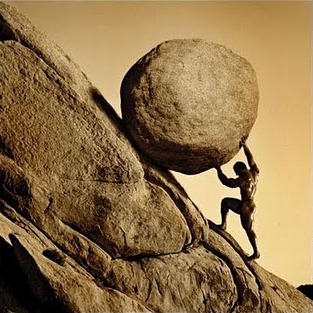
The result is like someone who is distracted whilst trying to push a boulder uphill. They have worked tirelessly to get it higher and higher up the hill. But the instant they relax their effort, or take their eye off the ball, the boulder starts back down to the bottom again.

In the same way, the trust and relationship you have worked so hard to nurture can suddenly takes a U turn and you can find yourself back where you were. Not only is that disappointing, but it’s quite possible that the damage caused could change things forever.

So be mindful. If you are putting yourself in a position where your support is important, be aware of the responsibility it entails. Be self-aware, show determination, compassion and resilience and be prepared to keep on giving, no matter what the circumstances.

What Is It About Gherkins?

What Is It About Those Gherkins?When life is beginning to feel a bit like swimming in treacle, the only key to success is to draw on your own determination. Sometimes things don’t go the way you wish and that can be for a number of reasons. But if you can remain calm, suppress your frustrations and stay focused, things will change.

Like taking the lid off a particularly tenacious jar of gherkins, it’s all about getting a proper grip on the problem, and once battle is joined, keeping the pressure on in a dogged manner. Of course the struggle may go on for some time, but there can only be one outcome if you refuse to quit, and that is victory.

And don’t forget that wonderful feeling of success when the lid finally turns. That comes with all manner of problems, and is the reward for all your effort and determination.

But what is it with those gherkins? They always seem to present a challenge, don’t they?

Flying Free

Little Owl ChickVisiting our local Owl and Raptor centre yesterday, and seeing the birds flying around so effortlessly, reminded me of this lesson from Nichiren Daishonin in which he uses the metaphor of us as caged birds, striving to be free …

Nichiren writes: “Myoho-renge-kyo is the Buddha nature of all living beings…. The Buddha nature that all these beings possess is called by the name Myoho-renge-kyo” (wnd, 131). Regarding how to manifest one’s innate Buddha nature, Nichiren explains: “When we revere Myoho-renge-kyo inherent in our own life as the object of devotion, the Buddha nature within us is summoned forth and manifested by our chanting of Nam-myoho-renge-kyo. This is what is meant by ‘Buddha.’ To illustrate, when a caged bird sings, birds who are flying in the sky are thereby summoned and gather around, and when the birds flying in the sky gather around, the bird in the cage strives to get out. When with our mouths we chant the Mystic Law, our Buddha nature, being summoned, will invariably emerge” (wnd, 887).

In Nichiren’s metaphor, our innate Buddha nature, whose name is Nam myoho renge kyo, is a bird trapped in the cage of ignorance. In other words, our deluded minds create this cage that imprisons our Buddha nature. But when we chant Nam myoho renge kyo to the Gohonzon, which expresses Nichiren’s enlightened life and the potential of all people, our dormant Buddha nature becomes activated.

The singing of the caged bird is our chanting, and the birds flying in the sky are the Buddha nature in our environment, particularly as it is expressed in the Gohonzon. Through our chanting, the Buddha nature within our lives and the Buddha nature inherent in the universe begin their dynamic interaction.

For Nichiren’s metaphor to work, however, it is necessary for the caged bird to recognize the birds in the sky as being its own kind. In other words, when we pray to the Gohonzon, rather than thinking of it as an external power or deity, we must think of it as the mirror image of our own Buddha nature. If the caged bird thinks of itself as an elephant, it is unlikely to give the slightest thought to flying.

Nichiren Buddhism clarifies that the teaching of the Buddha nature is a teaching of faith and practice. All people have it, but not many can believe in it. Furthermore, some of those who believe in their Buddha nature may not practice to manifest it, erroneously thinking-I’m already a Buddha, so I don’t have to do anything. One’s faith in the Buddha nature must be expressed in one’s actions to manifest it.

Those who see the universal Buddha nature of oneself and others, and work to awaken it in all people are already Buddhas, for such actions belong to none other than a Buddha. As we cultivate our inherent Buddha nature through our conviction and actions to manifest it no matter our circumstances, we begin to see it and experience it. In our everyday lives, seeing may be believing. But in the world of Buddhism, believing in the Buddha nature is the first step toward seeing it.

(from Living Buddhism – February 2005)

New Beginnings

LilyThe funeral of a loved one marks the final chapter in The Wheel of Life.

Whilst being a very sad and solemn ceremony, it is the human ritual where we say goodbye to the earthly body of the person we knew and loved, and as every religion has its own way of saying goodbye, so does Buddhism.

There is a moving chapter in The Buddha, Geoff and Me, which covers the ritual of a Buddhist funeral and that is how I would like my final chapter in this life to end.

At my Father’s funeral I read the following poem by Henry Scott Holland …

Death is Nothing At All
Death is nothing at all,
I have only slipped into the next room
I am I and you are you
Whatever we were to each other, that we are still.
Call me by my old familiar name,
Speak to me in the easy way which you always used
Put no difference in your tone,
Wear no forced air of solemnity or sorrow
Laugh as we always laughed at the little jokes we enjoyed together.
Play, smile, think of me, pray for me.
Let my name be ever the household word that it always was,
Let it be spoken without effect, without the trace of shadow on it.
Life means all that it ever meant.
It it the same as it ever was, there is unbroken continuity.
Why should I be out of mind because I am out of sight?
I am waiting for you, for an interval, somewhere very near,
Just around the corner.
All is well.

It was one of the hardest things I have ever had to do, and it brings tears to my eyes reading it now. I feel however, that it embraces the Buddhist idea that death is not the end, it is merely a new beginning.

The Law Of Cause And Effect

Causing RipplesWe all have the ability to feel sorry for ourselves. Sometimes it seems we have problem after problem, and think the world is against us. But we can all take a step back and look at our situation compared to others, and be honest enough to see that there are other people in much worse circumstances.

In Buddhist terms, the effects in our lives are caused by the causes we make along our way, it’s called Karma. Whilst it is difficult sometimes, to reconcile ourselves with the fact that we have in some way, caused our own problems, it is important to remember that we are not being punished. It is simply the law of cause and effect playing out.

So when you have had enough of your troubles, and are ready to throw in the towel, just take time to look around and realise that there is always someone worse off somewhere.

Be grateful for what you have, and concentrate on making causes for the effects you need to improve the situation. To do anything else is to lack Courage and Wisdom and that doesn’t help anyone, least of all yourself.

Have Patience

Have PatienceIt is said that patience is a virtue, and indeed that is a fact.

Having patience with someone, something, or with a situation can make the difference between causing, or solving problems.

When you are just about to run out of patience you should take a deep breath and carry on trying to be understanding.

Sometimes when our patience runs out, it is because we don’t have the full picture. Having a partial understanding of a situation leads us all to try to fill in the missing parts from our imagination. Our fundamental darkness will relish the chance to invent the details for us.

As anyone who has been to the dentist, and I guess that’s pretty much all of us, the waiting room, the fear of what might be in store, is often far worse than the reality when we finally sit in the chair.

So it is with most situations in life. So stop imagining, take that deep breath, and find a little more patience. It will be worth it in the end as we turn yet more poison into medicine

Previous Older Entries Next Newer Entries