Is It You?

Radiators And DrainsThere are two types of people in this world, and no not those who say ‘There are two types of people’ and those who don’t. The two types are those who are Radiators and those who are Drains.

A Radiator is the kind of person who leaves you feeling more energetic and enthused, after you meet or speak to them, than before. They radiate positive energy and are happy to share their life-energies with others. They appear to have a permanent smile on their faces, as though they know something others do not. In fact they do, they know that the secret path to a happy life is to pass on their happiness to others.

Drains are the complete opposite. They have the unfortunate knack of being able to sap energy and enthusiasm from other people, leaving them feeling unhappy or flat. When you meet one, and there are plenty around, the conversation is hard work, they are negative about things when you ask about how they are. In fact, you probably walk away wishing you hadn’t met them in the first place.

Our life-state can dictate whether we are a Radiator or a Drain if we let it, but concentrating on the positive side of life can change all that. When we are in Heaven we tend to Radiate energy to other people, when we are in Hell we Drain energy from others.

So think of all the good things in your life, walk around with a smile and a cheerful disposition, be a Radiator and see how people react positively towards you.

We all know a Drain when we meet one, and if you don’t, then it’s you.

Splish Splash

Causing RipplesOne of the principles of Nichiren Buddhism concerns the Oneness of Self and the Environment and how that connection affects all of us in ways we sometimes fail to grasp.

If you drop a pebble, no matter how small, into a pond, the ripples generated spread out in all directions and interact with everything in their path.

This principle states that there is a connection between the person and others around him or her. It is therefore clear that changes in our life-state, the way we relate or react to others and changes due to our Practice will affect those whose lives we interact with.

Some of these affects are very obvious. If we walk around with a happy demeanour, we find that people are more likely to be pleasant towards us. If, on the other hand, we walk around in a bad mood, with a scowl on our face, we find that people are less friendly and may try to avoid us completely.

Ok, so no rocket science there then, but there are more subtle ways in which changes can be felt. In my own case, my Practice has allowed me to stabilise my life-state, generally I am now more often in higher Worlds (see The Ten Worlds) than lower ones. The result of that is that I am better placed to create value, for myself and those around me.

I think it is also important to be aware that the ripples, whilst being generally well accepted, can also rock the boat in some circumstances. The idea of getting a teaching certificate with the idea of going off to far away lands to teach others to speak English may cause such ripples.

No man is an island. Family, friends and acquaintances will all be affected to some degree if I up sticks and wander off to the far side of the planet. That’s why it is so important for me to ensure that if and when I do go ahead with plans, that my Wisdom, Courage and Compassion are used in equal measure, so I can make sure the ripples are all good ones.

Life Deals Us All Sorts

Life Deals Us All SortsYou know the saying about taking the rough with the smooth? Well life generally consists of a mixture of good times and bad times, happiness and sadness, health as well as sickness. In general, it is the ratio of these opposites that makes us feel that life is going well, or going badly.
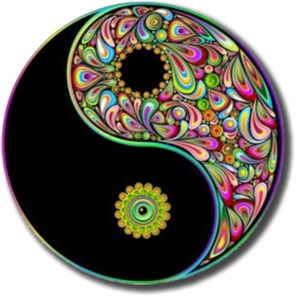
Buddhism teaches us that human life is endowed simultaneously with both good and evil. The human mind is interpreted as partaking of ten different conditions, or states, the Ten Worlds, including, at one end of the scale, hell, which is filled with suffering; hunger, dominated by greed; and animality, characterized by fear of the strong and contempt for the weak.

At the other end are the worlds of Bodhisattva and Buddhahood – states of mind in which people strive to help others by eliminating suffering and imparting happiness. Buddhism further teaches us that it is the nature of life for good and evil to be essentially inseparable.

As we have seen previously, all ten worlds contain, and are contained within the other worlds. This explains how we can be flying high one second and down in the dumps the next, generally at the whim of some external cause.

By realising that the worlds are so interconnected, we can learn to exercise more control over our changing life-states, or mood swings as they are commonly known. The result of greater self-awareness, brought about by the self-improvement that our practice brings, is that we can maintain a more stable, happier state of mind, and isn’t that the whole point?

Two Parts Of The Whole

Yin and Yang, Good and Bad, two parts of the wholeSo many things in life, although they may seem very different, are actually the opposite sides of the same coin. Good and evil, love and hate, passion and obsession are so close to one another when we look at the causes behind each of them.
Buddhism teaches that our lives are endowed with both good and bad aspects simultaneously. The human mind switches between ten individual conditions, The Ten Worlds, and as we know, each World contains the other nine.

The lowest three Worlds are those of Hell, filled with suffering, Hunger, which is dominated by greed, and Animality, characterised by fear of the strong or powerful and contempt of the weak. The two highest worlds are those of Bodhisattva and Buddhahood, states of mind in which people strive to help others to eliminate their suffering and attain happiness.

Good and bad, happiness and sadness exist together, they cannot be separated and are integral parts of life. In fact it could be said that to try to describe one without the other would be meaningless.

Buddhist practice cannot remove bad things from our life nor the sadness, but it can help us deal with them (Poison into Medicine), and by doing so, help us and those around us promote the good and the happy aspects.

Nam Myoho Renge Kyo.

Cracks Appearing?

Cracks Appearing?Looking back at the events of the past few weeks, I have issued myself a warning not to rest on my laurels. Buddhist practice is like a dog, for life, not just for Christmas, and must be part of your very being.

I have not shirked my practice, but my tolerance of people has waned, so I know I must do more towards my goal. The difficulty is getting the balance right, treading a line between regular practice and learning, and an obsession with the challenges in life, like losing weight and getting fit.

Given the fact that the whole point of adopting Buddhism as a way of life is to gain a happier existence for me and those around me, I need to get this right.

Those of you who know me, know that I have an addictive nature and throw myself into new ventures wholeheartedly. The problem, in the past, has been keeping that going. I have been, I admit openly, in the World of Hunger, for most of my life, always looking for the next new thing.

I am certain that I am addressing that and making some headway, but self criticism is always healthy in this respect.

The reason for keeping this blog, apart from sharing the joy, is to prove to myself that I have changed, and that I have the drive and desire to keep my practice strong. You have my permission to tell me if you see cracks appearing, and I know a certain someone who will.

Nam Myoho Renge Kyo, Nam Myoho Renge Kyo, Nam Myoho Renge Kyo.

The Wall – Actual Proof

Looking At A WallWith ever increasing mindfulness, our own feelings will change as we reflect on the causes for those feelings.

We know that acting in haste, motivated by anger, disappointment or desperation will result in the causes of unwanted effects.

So when you encounter what appears to be an insurmountable challenge, a wall if you will, you should tell yourself, “Since there is a wall here, a wide open expanse must lie on the other side.”

Rather than becoming discouraged, you should realise that the very fact you are encountering this wall is actual proof of the progress that you have made so far.

So if you find yourself facing such a wall, prepare to strive with all your heart, and you will surely find a way to get to the other side.

So That’s That For Another Week

That's All FolksLet’s just think back to Friday evening. The anticipation of a couple of days away from the office, maybe big plans, maybe just looking forward to the chance to recharge the batteries.

But where is that time now? Of course you can remember what you got up to, at least most of it I hope, but it’s time that has gone and you can never get it back.

It’s just a simple example of the unending passage of time, something we take so much for granted we often fail to remember how important it is. Because, although we have all the time in world through the process of reincarnation, to waste a single second it is to lack Wisdom.

If there is something you have been meaning to do, someone you intended to phone, but keep putting it off for any reason you can lay your hands on, you might have found the world of Tranquillity. It’s maybe not the worst of the Lower Worlds (Hell, Hunger, Animality, Anger, Tranquillity, Heaven) but can mean that you lack the life-energy to drive you get things done.

Get chanting, raise your life-energy and hence your life-state, after all, the weekend is over for another week.

Reaching The Realm Of Understanding

Ichinen Sanzen - Three Thousand RealmsLet’s talk about Ichinen Sanzen for a moment, about how each of the Ten Worlds contain all of the other Worlds, meaning we can move from one to another in an instant.

Ichinen Sanzen means Three Thousand Realms in One Instant. The maths is simple, Ten Worlds each containing all the others makes one hundred Worlds.

Multiply them by the Ten Factors gives us one thousand ‘states’ of existence, giving us three thousand when we take the Three Realms into account.

Here is a list of The Ten Worlds, The Ten Factors and the Three Realms.

The Ten Worlds  
Buddhahood Enlightenment
Bodhisattva Helping others
Realisation Absorption and understanding
Learning Self reflection and study
Heaven Rapture
Humanity Tranquillity
Anger Self righteousness
Animality Instinct
Hunger Insatiability
Hell Extreme suffering
   
The Ten Factors  
Appearance Physical aspect
Nature Mental aspect
Entity Substance, life itself
Power Inherent energy
Influence Influence or power
Inherent Cause Habit or karma
Relation External cause
Latent Effect Potential effect
Manifest Effect Visible outcome
Consistency Connected nature of all
   
The Three Realms  
The Self Form, perception and consciousness
Living Beings Society, community, people
The Land The natural environment

I hope this helps you understand the concept of Ichinen Sanzen and the true nature of Life at any given instant. It shows us why, in any particular situation, there are so many factors that will influence our actions, reactions and the eventual outcome.

Maybe we should now grasp the reason why being mindful of all things, and reacting to the situations of daily life, in a controlled manner, is such a challenge.

One Coin, Two Sides

Good and BadBuddhism teaches that our lives are endowed with both good and bad aspects simultaneously. The human mind switches between ten individual conditions, The Ten Worlds, and as we know, each World contains the other nine.

The lowest three Worlds are those of Hell, filled with suffering, Hunger, which is dominated by greed, and Animality, characterised by fear of the strong or powerful and contempt of the weak.

The two highest worlds are those of Bodhisattva and Buddhahood, states of mind in which people strive to help others to eliminate their suffering and attain happiness.

Good and bad, happiness and sadness exist together, they cannot be separated and are integral parts of life. In fact it could be said that to try to describe one without the other would be meaningless.

Buddhist practice cannot remove bad things from our life nor the sadness, but it can help us deal with them (Poison into Medicine), and by doing so, help us and those around us promote the good and the happy aspects.

Nam Myoho Renge Kyo.

Testing Times

Testing TimesEach day brings us joys and challenges, all of which have the potential to alter our life-state in some manner. Joys tend to raise our life-state, challenges may lower it if we let them, and there lies the conundrum. We need to be vigilant, to observe our life-state from moment to moment, but in doing so, we affect that life-state.

Just as in quantum physics, the mere act of observation affects the phenomenon being observed, self observation of our life-state can, and most likely will affect that too. Imagine a situation where you become angry because something has not gone the way you would like. Initially you may be reacting instinctively, in an animalistic fashion. But as soon as you realise that you are reacting in such a manner, in other words, you observe your life-state, there is a fair chance that you will change to that of a more calm and reflective mood, even into a state of tranquillity.

So we have this little test for ourselves. We must be, as far as possible, aware of our life-state. Ideally we want to be in one of the higher states, not grubbing around in the worlds of Hell, Hunger, Animality or Anger, but in Learning, Realisation, Bodhisattva or even Buddhahood. The act of testing can help us raise our life-state through awareness, which is a good thing. But be warned, when the results come back, and you find you are in one of the lower worlds, that can be a sobering moment, when you realise that you are not as far along the path to enlightenment as you would like to be.

Previous Older Entries Next Newer Entries