 Each day, at least twice a day, I chant Nam Myoho Renge Kyo. It is this phrase that encapsulates the very essence of The Lotus Sutra, which itself contains the teachings of Shakyamuni Buddha as refined during his time sitting under the Bodhi tree.
So much philosophy, encompassed in a single phrase, requires some explanation.
The teachings of Shakyamuni, the historical founder of Buddhism, are recorded in an enormous body of texts, known as sutras. The manner in which the philosophy of Buddhism is presented within the sutras varies widely.
This can be explained by a number of factors. During the 50 odd years over which Shakyamuni shared his teachings with the people of his day, he travelled widely throughout India.
Rather than expounding his philosophy in a systematic manner, his teaching mainly took the form of dialogue. Meeting with people from a wide range of backgrounds–from ministers of state to unlettered men and women–he sought to respond to their questions and doubts. Most of all, he sought to provide answers to the fundamental questions of human existence: Why is it that we are born and must meet the inevitable sufferings of illness, aging and death?
The sutras were compiled in the years following the death of Shakyamuni; it is thought that the Lotus Sutra was compiled between the first and second century C.E. In Sanskrit it is known as the Saddharmapundarika-sutra (lit. “correct dharma white lotus sutra”). Like many Mahayana sutras, the Lotus Sutra spread through the “northern transmission” to Central Asia, China, Korea and Japan.
Originally entering China in the third century C.E., the Lotus Sutra is said to have been translated into several different versions of the Chinese, of which three complete versions are extant. The fifth-century translation of Kumarajiva (344-413 C.E.) is considered to be particularly outstanding; its philosophical clarity and literary beauty are thought to have played a role in the widespread veneration of this sutra throughout East Asia.
The title of the Lotus Sutra in Kumarajiva’s translation, Myoho-renge-kyo, contains the essence of the entire sutra, and it was on the basis of this realization that Nichiren (1222-1282 C.E.) established the invocation of Nam-myoho-renge-kyo as his core Buddhist practice.
The Lotus Sutra is considered the sutra that fulfils the purpose for Shakyamuni’s advent in the world, expressed in these words: “At the start I took a vow, hoping to make all persons equal to me, without any distinction between us.” In other words, the purpose of Shakyamuni’s advent was to enable all people to attain the same state of perfect enlightenment that caused him to be known as “Buddha,” or “awakened one.”
The Lotus Sutra contains a number of concepts that were revolutionary both within the context of Buddhist teachings and within the broader social context of the time. Many of these are not stated explicitly but are implied or materialized in the dramatic and even fantastic-seeming events portrayed in the text. Much of the genius of later scholars of the sutra, such as T’ien-t’ai (538-597 C.E.), lay in their ability to extract and systematize these principles.
A core theme of the sutra is the idea that all people equally and without exception possess the “Buddha nature.” The message of the Lotus Sutra is to encourage people’s faith in their own Buddha nature, their own inherent capacity for wisdom, courage and compassion. The universal capacity for enlightenment is demonstrated through the examples of people for whom this possibility had traditionally been denied, such as women and people who had committed evil deeds.
In many sutras a number of Shakyamuni’s senior disciples are condemned as people who have, through arrogant attachment to their intellectual abilities and their self-absorbed practice, “scorched the seeds of their own enlightenment.” The profundity of Shakyamuni’s teachings in the Lotus Sutra, however, awakens in them the spirit of humility and compassion. They realize that all people are inextricably interlinked in their quest for enlightenment, and that if we desire happiness ourselves, it is imperative that we work for the happiness of others.
In this sutra, moreover, Shakyamuni demonstrates that he actually attained enlightenment in the infinite past, not in his current lifetime as had been assumed by his followers. This illustrates, through the concrete example of his own life, that attaining enlightenment does not mean to change into or become something one is not. Rather, it means to reveal the inherent, “natural” state that already exists within.
As President Daisaku Ikeda has said, “The Lotus Sutra is ultimately a teaching of empowerment. It teaches us that the inner determination of an individual can transform everything; it gives ultimate expression to the infinite potential and dignity inherent in each human life.”
 Sometimes we need to wipe the slate clean, take a deep breath, and start anew. With my decision to change career, this might just be the perfect time to do so. Having new goals, new horizons and renewed vigour is just the ticket.
 One of the principles of Nichiren Buddhism concerns the Oneness of Self and the Environment and how that connection affects all of us in ways we sometimes fail to grasp.
 With my recently announced redundancy still five months away, time is not yet of the essence to find alternative employment.
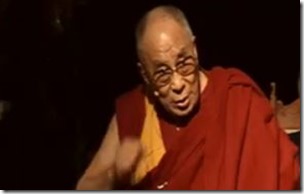 I was privileged to be able to listen to a talk and a Q&A session from His Holiness The Dalai Lama today, live on “The Culture of Compassion” from Ebrington Plaza in Derry, Northern Ireland. His Holiness, who is patron of the Children in Crossfire charity, showed his abundance of compassion and humility in a most moving gathering of like minded people.
 The Search For Enlightenment
Recents Comments