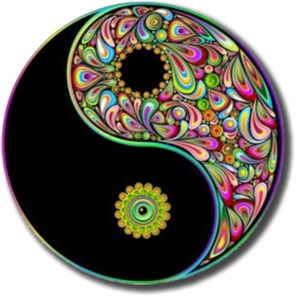
Two Parts Of The Whole

Yin and Yang, Good and Bad, two parts of the wholeSo many things in life, although they may seem very different, are actually the opposite sides of the same coin. Good and evil, love and hate, passion and obsession are so close to one another when we look at the causes behind each of them.

Buddhism teaches that our lives are endowed with both good and bad aspects simultaneously. The human mind switches between ten individual conditions, The Ten Worlds, and as we know, each World contains the other nine.

The lowest three Worlds are those of Hell, filled with suffering, Hunger, which is dominated by greed, and Animality, characterised by fear of the strong or powerful and contempt of the weak. The two highest worlds are those of Bodhisattva and Buddhahood, states of mind in which people strive to help others to eliminate their suffering and attain happiness.

Good and bad, happiness and sadness exist together, they cannot be separated and are integral parts of life. In fact it could be said that to try to describe one without the other would be meaningless.

Buddhist practice cannot remove bad things from our life nor the sadness, but it can help us deal with them (Poison into Medicine), and by doing so, help us and those around us promote the good and the happy aspects.

Nam Myoho Renge Kyo.

Centred, Anchored, Simply Rock Solid

The GohonzonOver the life of this blog, you will have seen that my Buddhist Practice has become, more and more, the basis of my life.

Having my Practice as the centre, as my Honzon, as my anchor is a very liberating state of affairs. At the centre of that Practice is my recently enshrined Gohonzon making it the absolute centre and the pivot, around which, my whole life now revolves.

Of course, the centre of many people’s lives are their partners, their children, their families and that is perfectly acceptable, but does mean that their anchor is not fixed, it is ever changing. These changes can be a major source of unhappiness. How often have we seen the elderly couple, totally devoted to each other, that when one of them dies, the other goes soon after.

Having Buddhism and my Practice as my Honzon doesn’t mean that my family and friends mean any less to me, but it does mean that as situations change, as problems arise, my anchor remains firm and I can cope with those challenges all the better.

Maybe that’s not for everyone, it does take a conscious effort to make the change, but for me, the effort is repaid many, many times over by the feeling of constancy in my life.

Back To Basics

During morning Gongyo we say four Prayers, the first out loud, the last three silently to ourselves. During evening Gongyo, the first prayer is omitted.

The First Prayer – Appreciation for Life’s Protective Forces (spoken – morning Gongyo)

lotusI offer appreciation to the Shoten Zenjin, the functions in life and in the environment that serve to protect us, and prey that these protective powers may be further strengthened and enhanced through my practice of the Law.
The Second Prayer – Appreciation for the Gohonzon (silent)

lotusI offer my deepest praise and most sincere gratitude to the Dai-Gohonzon of the Three Great Secret Laws, which was bestowed upon the entire world.
I offer my deepest praise and most sincere gratitude to Nichiren Daishonin, the Buddha  of the Latter Day of the Law.

I offer my deepest praise and most sincere gratitude to Nikko Shonin.

I offer sincere gratitude to Nichimoku Shonin.

The Third Prayer – For the attainment of kosen-rufu (silent)

lotusI pray that the great desire for kosen-rufu is fulfilled, and that the Soka Gakkai International develops eternally in this endeavour.

I offer my most sincere gratitude to the three founding presidents – Tsunesaburo Makiguchi, Josei Toda and Daisaku Ikeda – for their eternal example of selfless dedication to the propagation of the Law.

The Fourth Prayer – Personal prayers and prayer for the deceased (silent)

lotusI pray to bring forth Buddhahood from within my life, change my karma and to fulfil my wishes in the present and the future.
(we may offer additional prayers here)

I pray for my deceased relatives and for all those who have passed away, particularly for these individuals:

(we name our relatives and friends here)

I pray for peace throughout the world and for the happiness of all humanity.

Nam Myoho Renge Kyo

Are You Prepared?

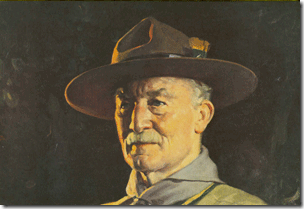
Be Prepared For LifeNo this isn’t a question about the motto of the Boy Scout movement. It is about being ready to face whatever life may throw at you. Life challenges us daily. There are joyous days and days of suffering. Sometimes really unpleasant things happen, but this variety is actually what makes life so interesting. The dramas we encounter are part and parcel of being human.

If we went through life without change or drama, if nothing unexpected ever happened, we could simply live like robots, and our lives would be unbearably dull and monotonous. We must therefore develop an inner strength, so we can enact the dramas of our lives with confidence and poise, in the face of whatever challenges we may encounter.

Just as a footnote, my day today is rather joyous, how about yours?

Solid Foundations

Bomb ProofThe true victors in life are those who, having endured repeated challenges and setbacks, have sent the roots of their spiritual being to such a depth, that nothing can ever shake them loose.

Practicing Nichiren Buddhism, with all our heart and mind, on a daily basis, can allow us to grow our own spiritual roots to a great depth. Whilst our practice takes us along the road to enlightenment, this is a powerful side-effect that makes us able to defeat anything that life throws at us.

Give Me Strength

Strength When times are easy and things go our way, it is deceptively easy to stick to the plan. It is when things go wrong, problems arise or we are distracted from our Practice that we need to summon up our inner strength.

Practicing Nichiren Buddhism is rewarding and fulfilling. Chanting and praying before the Gohonzon becomes part of the everyday routine, and wavering makes us feel that we are letting ourselves and our mentor down.

But we have to remember that being constant takes effort and that allowing ourselves to back slide can be the easiest of things. Nichiren Daishonin wrote to Shinjo Kingo on this very topic way back in 1275 ad, so it’s not a new problem.

This is in regard to the passage “This sutra is hard to uphold.” According to Acharya Ben, you said to him: “I have been practicing the Lotus Sutra correctly since last year, when you told me that those who embrace this sutra will ‘enjoy peace and security in their present existence and good circumstances in future existences.’ Instead, however, great hardships have showered down on me like rain.” Is this true, or did he give me a false report? In either case, I will take advantage of this opportunity to resolve any doubts you may have.

A passage from the Lotus Sutra reads that it is “the most difficult to believe and the most difficult to understand.” Many hear about and accept this sutra, but when great obstacles arise, just as they were told would happen, few remember it and bear it firmly in mind. To accept is easy; to continue is difficult. But Buddhahood lies in continuing faith. Those who uphold this sutra should be prepared to meet difficulties. It is certain, however, that they will “quickly attain the unsurpassed Buddha way.” To “continue” means to cherish Nam-myoho-renge-kyo, the most important principle for all the Buddhas of the three existences. The

sutra reads, “We will protect and uphold what the Buddha has entrusted to us.” The Great Teacher T’ien-t’ai stated, “One accepts because of one’s power of faith and continues because of one’s power of constant thought.” Another part of the sutra reads, “This sutra is hard to uphold; if one can uphold it even for a short while I will surely rejoice and so will the other Buddhas.”

A fire burns higher when logs are added, and a strong wind makes a kalakula grow larger. The pine tree lives for ten thousand years, and therefore its boughs become bent and twisted. The votary of the Lotus Sutra is like the fire and the kalakula, while his persecutions are like the logs and the wind. The votary of the Lotus Sutra is the Thus Come One whose life span is immeasurable; no wonder his practice is hindered, just as the pine tree’s branches are bent or broken. From now on, always remember the words “This sutra is hard to uphold.”

With my deep respect, Nichiren

So when times get tough, or distractions occur, be strong and maintain a strong practice. It will help you through the bad times and being constant will help sustain your faith.

Nam Myoho Renge Kyo

The Benefit Of Chanting

CapsulesA few people have asked how chanting Nam Myoho Renge Kyo actually works, how it raises my life-energy and puts me in a higher life-state, irrespective of the circumstances.

So how can chanting the title of The Lotus Sutra, without the need for reading or studying it, help me make contact with my Buddha nature?

Well chanting whilst keeping a problem or question in mind brings forth a certain clarity of thought, which has, on occasion, provided solutions or at least peace of mind.

So why don’t we need to understand The Lotus Sutra, chapter and verse, in order to benefit from it’s wisdom? Well, apart from the fact that we do study the major principles that it encompasses, there are a fair number of similarities with complex things in life.

I imagine you have taken painkillers like ibuprofen, a highly complex molecule that took many years to perfect, test and approve. Unless you are a pharmacist or a pharmaceutical chemist, I doubt that you have the slightest idea of how the shape of the molecule blocks the pain receptors in your nervous system. But the tablets work, whether you know, or whether you don’t.

Another good example is the humble motor car. You can drive from Land’s End to John O’Groats without having any knowledge of how an internal combustion engine works or how the friction linings of the brake pads slow the car by turning the kinetic energy into heat in the brake disks.

My point is, that some very clever people have spent many, many years developing complicated medicines or machines. Being able to benefit from them is simple, simply because they are so well thought out. So it is with The Lotus Sutra and chanting Nam Myoho Renge Kyo. Shakyamuni Buddha and Nichiren Daishonin spent many, many years perfecting the Lotus Sutra and Nichiren Buddhism.

The benefit of chanting can be ours simply by chanting the title, studying the sutra is not necessary, but is certainly enlightening.

Right Thinking

Right ThinkingOne of the most difficult things to do, personally speaking, is to remain in a constant life-state when confronted by the highs and lows of life.
One of the aims of Nichiren Practice is to smooth out the emotional highs and lows in life. through right thinking.

A Buddhist quotation says that “The Wise Man is neither elated by success nor deflated by failure”.

That is not to say that you cannot be happy when you succeed, or sad when you fail, it’s about the intensity of those feelings and trying to stay nearer the mid-point.

I find it tough at times, but I’m getting better.

Living In Rhythm With The Law

The BuddhaThe very reason for my Buddhist Practice is to bring me a little closer to Buddhahood each and every day.
That is to say, to emulate as closely as possible, the Buddha himself in the way he was able to see life and all things in a pure clarity through his enlightened state.

Siddhārtha Gautama was a man, albeit a prince, who forsaking his life of comfort and position, went out into the world to meditate on the causes of, and ways to reduce or remove, the suffering of life.

In Nichiren Buddhism we speak about the Ten Worlds, Hell, Hunger, Animality, Anger, Humanity, Heaven, Learning, Realisation, Bodhisattva and Buddhahood. Each World containing, and being contained by, the other nine.

The Buddha state originates from the very depths of life, called the amala consciousness, meaning the fundamentally pure life force or consciousness. The function of the Buddha state is to bring out the positive side of the other nine worlds.

This principle of the Ten Worlds shows that the Buddha state is a naturally occurring condition of life in every living being. The purpose of Buddhist practice is to enable us to cause the Buddha state to appear; to have it working strongly in us.

In Nichiren Buddhism, therefore, the Buddha is not some perfect ideal being, but is rather an ordinary person living in rhythm with the law of the universe, taking wise, courageous and compassionate action for the benefit of others, through the functioning of the nine worlds in daily life.

The more I practice, the longer I practice, the closer I come to Buddhahood, a very positive thought for today.

Attaining Buddhahood

Attaining BuddhahoodWhat does attaining Buddhahood mean for us? It does not mean that one day we suddenly turn into a Buddha or become magically enlightened. In a sense, attaining Buddhahood means that we have securely entered the path, or orbit, of Buddhahood inherent in the cosmos.

Rather than a final static destination at which we arrive and remain, achieving enlightenment means firmly establishing the faith needed to keep advancing along the path of absolute happiness limitlessly, without end.

To this end, we practice and chant Nam Myoho Renge Kyo

Previous Older Entries Next Newer Entries