
Inner Communication

Inner CommunicationI hear myself once again having to explain, that unlike almost every other religion, Nichiren Buddhism sees things differently.

Not that I feel I am apologising for that, just that because it is a philosophy for life and living, rather than a religion in the more generally accepted sense, the meaning and purpose of prayer are in my opinion, fundamentally different.

As with all the deity based religions, prayer is a conduit of communication, a method for getting a message, or request heard. However, in Buddhism, prayer is a communication to the inner self, rather than to an external being, and in that respect, it is more about focussing the conscious and sub-conscious on a task or topic at hand.

Prayer in Nichiren Buddhism is an integral part of our daily practice. We say, or think, as three of the prayers are silent, four prayers during Gongyo and these are they:

First Prayer – for the appreciation of life’s protective forces:

I offer appreciation to the Shoten Zenjin, the functions in life and in the environment that serve to protect us, and pray that these protective powers may further be strengthened and enhanced through my practice of the Law.

Second Prayer – for the appreciation for the Gohonzon:

I offer my deepest praise and most sincere gratitude to the Dai-Gohonzon of the Three Great Secret Laws, which was bestowed upon the entire world.

I offer my deepest praise and most sincere gratitude to Nichiren Daishonin, the Buddha of the Latter Day of the Law.

I offer my deepest praise and most sincere gratitude to Nikko Shonin.

I offer sincere gratitude to Nichimoku Shonin.

Third Prayer – for the attainment of kosen-rufu:

I pray that the great desire for kosen-rufu is fulfilled, and that the Soka Gakkai International develops eternally in this endeavour.

I offer my most sincere gratitude to the three founding presidents – Tsunesaburo Makiguchi, Josei Toda and Daisaku Ikeda – for their eternal example of selfless dedication to the propagation of the Law.

Fourth Prayer – personal prayers and prayers for the deceased:

I pray to bring forth Buddhahood from within my life, change my karma and to fulfil my wishes in the present and the future.

* Prayers for specific outcomes are brought to mind here.

I pray for my deceased relatives and for all those who have passed away, particularly for these individuals:

* Here we bring to mind the names of those we particularly wish to remember

I pray for peace throughout the world and for the happiness of all humanity.

I think you can see that the prayers are mainly intended to bring to mind the subjects they contain, rather than being any form of communication with a third party. They focus the mind on the desired effect, and are intended to remind us that we need to make the causes ourselves, for the effects we wish to see.

We remember the dedication and sacrifices that the founding presidents have made in order to keep the faith alive and the efforts they have made in promoting the religion in the past decades. I feel it is important to mention that although the third prayer mentions the development of the Soka Gakkai International, it is more important that the aim of the SGI to promote peace for all on earth, rather than the organisation itself, is the desired outcome.

Personally, during the forth prayer, where we bring to mind specific outcomes, I remind myself of personal goals, self-improvement, human revolution and the like, as well as thinking of others who are struggling with challenges such as ill health, difficult situations and so on.

By bring these things into my consciousness means that I can focus on ways I may resolve my own challenges, or help others resolve theirs. There is no concept of me asking any third party to intervene in the outcome, the responsibility for that is all my own.

In that respect, I find Nichiren Buddhism to be a very empowering philosophy. I am taking responsibility for the events occurring in my life, myself. Whilst this puts the onus squarely on my own shoulders, it also gives me control, rather than handing it to any third party  whatsoever.

Far from being an all-knowing, all-seeing deity, I am, like you, a simple human being. So I make mistakes in the decisions and thoughts, words and deeds I perform each and every day. Because I take full responsibility for all those mistakes, I am free to learn from them, rather than ask forgiveness for them.

Prayers form a large part in that learning process. By purposefully bringing these erroneous issues into my consciousness, I am able to analyse, evaluate and modify my thinking. By doing this as part of my daily regime, I am forced to constantly confront my failings, and that improves my chances to improve and to increase the scope of  my enlightened nature.

So I hope you can see the contrast between Buddhist prayers and those of other theistic religions. Far from being a form of communication between the person praying and his or her god, it is communication between me and my consciousness. Furthermore, because I accept responsibility for everything that happens in my life, I am forced to search for the causes of the effects I am experiencing, rather than asking ‘why is this happening to me?’.

I am tempted to suggest that Nichiren Buddhists do not actually pray at all, in the accepted definition of that word. But although the intended recipient of our prayers could not be more different, the intention behind those prayers can be seen to be very much the same.

Happiness, What Is Happiness?

Happiness, What Is Happiness?What do we mean by happiness? There may be as many answers to that as there are stars in the night sky, everyone has their own idea of what makes them happy, and equally what doesn’t.
Maybe it is the love of a partner, being part of a family, the pay cheque at the end of the month or that new car you had always promised yourself. Whatever your idea of happiness, we all crave more of it.

We can probably agree that it is all too often a transitory state, punctuated by periods where we are unhappy, or at least a bit glum. So what would you give to have more of this illusive life-state, and how can you go about achieving a happier life?

Well speaking personally, I can almost guarantee happiness from my Buddhist practice. That might sound a little trite or even rather far-fetched, but for me it is true. My practice helps me see life from all angles, the ups and downs, from my view-point and from that of others, and it ‘smoothes’ out the emotional bumps we encounter each and every day.

The idea at the very core of Buddhism is the removal of suffering, and that in itself helps us to be happier. Seeing the beauty in nature, the best facets of another’s personality, the joy in helping others, happiness is there for us all, all of the time and all around us. Living a life that is more concerned with others than ourselves, giving more than we take, and so on, will also bring feelings of happiness. All we have to do is look out for it.

Living in a society that is more concerned about what we own, than who we really are, we all struggle to put those ideas into action. We hear about people earning ridiculous sums, whilst providing little by way of return, and wonder how they can live with the guilt. If society valued the good in people more than the goods of people, the world would be a much fairer, happier place.

Whatever flavour your own happiness comes in, I wish you more of it, now and in the future. And when it arrives, please make sure that you share it around. That way you will find it grows and grows, and that it lasts just that little bit longer.

Nichiren Buddhism – Buddhahood In This Lifetime

Nichiren Buddhism - Buddhahood In This LifetimeNichiren Buddhists, I am told, consider their faith to be the purest of all the Buddhist sects. Although this did stir a vague memory, and an explanation about Nichiren Buddhism being based on The Lotus Sutra and not having any gods, demons and hungry ghosts, such as are part of the New Kadampa Tradition, I thought I should investigate further.

Nichiren Shonin, as he was known in the early years, gave his first sermon to commemorate the completion of his studies to his master and fellow monks. In this sermon he shocked his audience by criticising the then popular form of Buddhism known as Pure Land. The Pure Land movement taught that Buddhahood could only be attained, after death in a heavenly pure land, by chanting the name of the Buddha of Infinite Light.

In place of this practice, Nichiren taught the practice of chanting the “Great Title” (daimoku) of the Lotus Sutra, which is Nam Myoho Renge Kyo. He taught the chanting of daimoku as a practical and accessible way in which all people can realise the deepest truths of Buddhism.

He argued that, just as the name of a country can bring to mind all the characteristics of that country, so the title of the Lotus Sutra embodies all the merits and virtues of the Buddha expounded in the sutra. Nichiren taught that by chanting the daimoku, we can directly receive the ultimate truth of the Lotus Sutra from Shakyamuni Buddha and attain Buddhahood within our lifetime.

So maybe the claim about Nichiren Buddhists having the purest of faiths stems from the manner in which Nichiren stripped away all the embellishments of the other sects, to get back to Shakyamuni Buddha’s original teachings. This is not to say that these embellishments are without worth, but more that the simpler (purer) practice was accessible to many more people of lower status.

Thinking of our practice as purer, truer, better even, is not a very Buddhist way of looking at things. We should look at all aspects of all matters from all angles and without bias or preconceived ideas, in an enlightened manner you might say.

To use a modern idiom, we might say that Nichiren Buddhism is Buddhism Lite. It has all the core beliefs and the fundamentals of the philosophy without the adornments, the bells and whistles, that others sects have incorporated into their practice.

Before any argument or criticism ensues, I am not putting this idea forward as any form of value judgement, just my thoughts and ideas, from my mostly unenlightened view point. I have seen other sects from inside and out, I simply prefer the atheistic approach and the simple and accessible practice.

Nam Myoho Renge Kyo

Why A Nichiren Buddhist?

Nam Myoho Renge KyoIf you research Buddhism, you will find, as with Christianity, that there are many schools or sects, believing much the same basic principles, but with their own embellishments or focus.

When I first became a Buddhist, I was rather naive about the different schools and followed the Kadampa tradition practiced at the Shantideva Buddhist centre in Maidenhead, later moving to Reading.

Kadampa Buddhism focuses on the teachings of Geshe Kelsang Gyatso and the centre of the practice is concentrated on clearing the mind through meditation. The cause of much unhappiness and suffering is due to desirous attachment to property, people or situations, according to Kelsang Gyatso. The way to remove suffering is therefore to break the links of desirous attachment and accept the principle of impermanence.

This is all very well in an eastern third world country, where possessions are few, life is lived at a different pace and everyone, or at least the majority, hold the same beliefs. Here in the west, where Judaeo Christianity is the predominant religion, Kadampa Buddhism only works if you can remove yourself from the mainstream society and immerse yourself in study within one of their centres.

I also felt that the worship of gods within the temple was wrong. Shakyamuni was a man, he never proclaimed to be, or to be connected with, any deity. So where did all these gods spring from. I believe they are the manifestation of the metaphorical gods of The Lotus Sutra, made real by man’s need for a focus of worship. Not for me, this went against my atheist beliefs and lost the focus of the practice in my eyes.

Over time I drifted away from the practice, and it was only when I was suffering because of the breakdown of my marriage, that I sought Buddhism once again. This time, I was lucky, or fortunate as we would say in Buddhism (not such thing as luck), to find Jason Jarrett’s podcasts, and through that, William Woollard’s Reluctant Buddhist.

Immediately, the sense that my own life would be put back in my own hands, that belief was in the self and one’s ability to achieve Buddhahood in this lifetime, struck a chord. At last, a Practice that worked with real life, that answered questions instead of posing several more. A Practice that has helped me more over the best part of a year, than any other practice has done in the past fifty years.

I wish I was like Ken, Jayne, William, Eddy and many, many others, who found Nichiren Buddhism ten, fifteen, twenty or more years ago. My life would have been completely transformed, and I believe, entirely for the better. There is a letter from Nichiren Daishonin to the wife of the late Matsuno, which describes how unlikely, and difficult it is to meet the Practice in a lifetime, it is well worth reading and explains just how lucky I have been to find my faith at last.

Seek Within Yourself

The GohonzonI often get asked about the Gohonzon, by people interested to know what the inscriptions mean. Although it is revered and forms the object of devotion for our Practice, it has no magical properties and will not achieve anything for us in isolation. So let us learn a little more about it from the man who first inscribed it.

Nichiren Daishonin said …

‘Never seek the Gohonzon outside yourself. The Gohonzon exists only within the mortal flesh of us ordinary people who embrace the Lotus Sutra and chant Nam-Myoho-Renge-Kyo .’

But this letter, from Nichiren to Nichinyo, explains more completely the significance of the Gohonzon.

I have received your offerings to the Gohonzon of five thousand coins, one horse load of polished rice, and fruit. To begin with, this Gohonzon was revealed in the last eight years of the fifty that the Buddha preached in this world, and in this period of eight years, in eight chapters [of the Lotus Sutra], from the “Emerging from the Earth” chapter through the “Entrustment” chapter. Now, during the three periods following the Buddha’s passing, in the two thousand years of the Former and Middle Days of the Law, not even the term “object of devotion of the essential teaching” yet existed. How then could the object of devotion have been revealed? Moreover, there was no one who was able to give it expression. T’ien-t’ai, Miao-lo, and Dengyo perceived it in their hearts, but for some reason never put it into words, just as Yen Yüan realized the true meaning of Confucius’s teaching, but never gave it expression. Yet the sutra itself and the commentaries of T’ien-t’ai and Miaolo explicitly state that the Gohonzon will appear after two thousand years have elapsed following the Buddha’s passing, in the first five hundred years of the Latter Day of the Law.

How wondrous it is that, around two hundred years and more into the Latter Day of the Law, I was the first to reveal as the banner of propagation of the Lotus Sutra this great mandala that even those such as Nagarjuna and Vasubandhu, T’ien-t’ai and Miao-lo were unable to express. This mandala is in no way my invention. It is the object of devotion that depicts Shakyamuni Buddha, the World-Honoured One, seated in the treasure tower of Many Treasures Buddha, and the Buddhas who were Shakyamuni’s emanations as perfectly as a print matches its woodblock. Thus the five characters of the Lotus Sutra’s title are suspended in the centre, while the four heavenly kings are seated at the four corners of the treasure tower. Shakyamuni, Many Treasures, and the four leaders of the Bodhisattvas of the Earth are side by side at the top. Seated below them are the bodhisattvas, including Universal Worthy and Manjushri, and the voicehearers, including Shariputra and Maudgalyayana. [Beside them are] the gods of the sun and moon, the devil king of the sixth heaven, the dragon king, and an asura. In addition, the wisdom kings Immovable and Craving-Filled take up their stations to the south and north. The evil and treacherous Devadatta and the ignorant dragon king’s daughter form a group. Not only the Mother of Demon Children and the ten demon daughters, who are evil demons that sap the lives of people throughout the major world system, but also the Sun

Goddess, Great Bodhisattva Hachiman, and the seven reigns of the heavenly gods and five reigns of the earthly gods, who are the guardian deities of Japan— all the various great and small gods, that is, the main gods, are ranged in rows. How then could the remaining subordinate gods be left out? The “Treasure Tower” chapter states, “[Shakyamuni Buddha used his transcendental powers to] lift all the members of the great assembly up into the air.”

Without exception, all these Buddhas, bodhisattvas, great sages, and, in general, all the various beings of the two worlds and the eight groups who appear in the “Introduction” chapter of the Lotus Sutra dwell in this Gohonzon. Illuminated by the light of the five characters of the Mystic Law, they display the dignified attributes that they inherently possess. This is the object of devotion.

This is what is meant when the sutra says “the true aspect of all phenomena.” Miao-lo stated: “The true aspect invariably manifests in all phenomena, and all phenomena invariably manifest in the ten factors. The ten factors invariably manifest in the Ten Worlds, and the Ten Worlds invariably manifest in life and its environment.” It is also stated that the profound principle of the true aspect is the originally inherent Myoho-Renge-Kyo. The Great Teacher Dengyo said, “A single moment of life comprising the three thousand realms is itself the Buddha of limitless joy; this Buddha has forsaken august appearances.” Therefore, this Gohonzon shall be called the great mandala never before known; it did not appear until more than 2,220 years after the Buddha’s passing.

A woman who makes offerings to such a Gohonzon invites happiness in this life, and in the next, the Gohonzon will be with her and protect her always. Like a lantern in the dark, like a strong guide and porter on a treacherous mountain path, the Gohonzon will guard and protect you, Nichinyo, wherever you go. Therefore, you should take every care to ward off slanderers of the Law in the same way that you would never wish a courtesan even to come near your home. This is the meaning of “Thrust aside evil friends and associate with good companions.”

Never seek this Gohonzon outside yourself. The Gohonzon exists only within the mortal flesh of us ordinary people who embrace the Lotus Sutra and chant Nam-Myoho-Renge-Kyo. The body is the palace of the ninth consciousness, the unchanging reality that reigns over all of life’s functions. To be endowed with the Ten Worlds means that all ten, without a single exception, exist in one world. Because of this it is called a mandala. Mandala is a Sanskrit word that is translated as “perfectly endowed” or “a cluster of blessings.” This Gohonzon also is found only in the two characters for faith. This is what the sutra means when it states that one can “gain entrance through faith alone.”

Since Nichiren’s disciples and lay supporters believe solely in the Lotus Sutra, honestly discarding expedient means and not accepting even a single verse of the other sutras, exactly as the Lotus teaches, they can enter the treasure tower of the Gohonzon. How reassuring! Make every possible effort for the sake of your next life. What is most important is that, by chanting Nam-Myoho-Renge-Kyo alone, you can attain Buddhahood. It will no doubt depend on the strength of your faith. To have faith is the basis of Buddhism. Thus the fourth volume of Great Concentration and Insight states, “Buddhism is like an ocean that one can only enter with faith.” The fourth volume of The Annotations on “Great Concentration and Insight” explains this: “With regard to the phrase ‘Buddhism is like an ocean that one can only enter with faith,’ even Confucius taught that faith is first and foremost. How much more so is this true of the profound doctrines of Buddhism! Without faith, how could one possibly enter? That is why the Flower Garland Sutra defines faith as the basis of the way and the mother of blessings.” The first volume of Great Concentration and Insight says, “How does one hear, believe in, and practice the perfect teaching to attain perfect enlightenment?” The first volume of On “Great Concentration and Insight” says, “To ‘believe in the perfect teaching’ means to awaken faith through doctrine and to make faith the basis of practice.”

A non-Buddhist document relates that, because the emperor of Han believed his aide’s report, the waters of a river froze on the spot. Another tells how Li Kuang, because he was eager to revenge his father, shot an arrow all the way up to its feathers into a boulder hidden in the grass. The commentaries of T’ien-t’ai and Miao-lo make it perfectly clear that faith is the cornerstone. Because the Han emperor believed completely in his retainer’s words, the river froze over. And Li Kuang was able to pierce a rock with his arrow because he fully believed it to be the tiger that had killed his father. How much more so is this true in Buddhism!

Embracing the Lotus Sutra and chanting Nam-Myoho-Renge-Kyo in itself encompasses the five practices. It was this matter, the wonderful practice that includes the immediate completion of the five practices, that was transmitted to the Great Teacher Dengyo when he journeyed to T’ang China and met the Reverend Tao-sui. No other teaching is more important for Nichiren’s disciples and lay supporters. It is referred to in the “Supernatural Powers” chapter. I will write again in detail.

Respectfully, Nichiren

The twenty-third day of the eighth month in the third year of Kenji (1277)

BuddhahoodEnlightenment is achievable by us all in this lifetime, and the life-state of Buddhahood is present within each and every one of us. There is no need to go looking for it elsewhere, all we need to do is to chant Nam-Myoho-Renge-Kyo and to seek it within.

Steady Lads, Steady

Steady As She GoesThere are times when we need to be reminded of the important things in life. When distractions come along it’s all too easy to get side tracked and let our focus slip. It isn’t that we forget that our Practice is the centre of our lives, it’s just that sometimes life itself can get in the way, albeit temporarily.

When everything comes along at once, it can all be a little too much to cope with. But being reminded that our practice is the one constant that keeps us on the straight and narrow is a very good thing. When we remember that everything pivots around our honzon, that our faith is central and the very thing that makes us who we are, we can take steps to realign ourselves.

Take a frim grip of the wheel, get your ship back on your desired heading, feel the wind of change at your back and focus on the horizon. Chant Nam Myoho Renge Kyo, and it’s steady as she goes captain !!!

Inner Strength

Inner StrengthWe are very similar, in many ways, to steel reinforced concrete, in that much of our strength comes from within. The pillars of motorway bridges are immensely strong because, apart from the toughness of the concrete itself, they have a rigid steel structure embedded within them.

In the same way, we have an inner strength, an emotional structure that allows us to handle the rigours of daily life. The strength of that structure is different in each one of us, indeed it can change depending on the strain that life is exerting at any given point in time. But the important thing is that we can increase it through some very simple practices.

Generally speaking, we are stronger, mentally, when we see problems as challenges, and stronger still when we feel we can overcome those challenges and come out the other side unscathed. So how do we improve our resilience to the bumps and knocks that life delivers?

Well in my own case, I find that chanting raises my life-state and allows me to tackle challenges more positively. By chanting about a particular issue, I find that I see the details more clearly and hence have more ideas regarding the possible solutions to solve it.

Of course, other people have their own way to deal with challenges. Some meditate, some pray to their God for guidance or divine intervention, some in fact are so grounded that they seem to have a built in ability to cope.

However you go about it, the most important thing to remember is that confidence and determination are key factors in winning the battle. Sitting and cogitating the fluff in your navel, getting depressed, or feeling that the challenge is just far too great to tackle, will undoubtedly result in failure, so don’t do it.

One really good tip, whatever you are facing, is to try to break down the task at hand into bite sized pieces. As Geoff says to Ed, in The Buddha, Geoff and Me, ‘How do you eat an elephant?’ … ‘One bite at a time’. So take it bit by bit, deal with each day as it arrives, and remember to stay strong and above all positive. If you believe you will win, then you are already half way there.

Practice Makes Perfect Sense

Practice Makes PerfectFor me, my Buddhist Practice is a way of life. A routine that I go through every day, Gongyo, Daimoku, even writing this blog. But routine is also another word for boring, mundane or even hum-drum, so it’s important to keep in mind why we Practice.
We Practice for several reasons …

  • To raise our life-energy levels …
  • To chant for certain outcomes …
  • To move us along the road to Buddhahood …
  • To give a stable anchor in our lives …

and there are many others, often different for every individual.

As a relative novice, I find that I can learn a little more each day Let’s face it, Buddhism has been around for well over two thousand years, so there’s plenty to learn about. I can improve or seek to perfect my Practice and to maintain a more focussed attention to the subject of my chanting.

I look forward to the feeling I get during and after Gongyo. I often find that I am quite warm when I finish chanting and in a really good mood, despite any problems I am facing.

I never cease to be amazed by the effectiveness of chanting either. To start with, the word coincidence came into my mind when I saw results, but not any more. But I do get surprised by the way the Universe solves the problems with which I have asked it to help. Not always the way I expected, and often in better, more subtle ways than I could have  ever imagined.

So my Practice is a pleasure, not a chore. It’s something I enjoy and never something I feel I have to do.

As Nichiren Daishonin said, ‘If you practice something, you must test it’s validity with the results you see’. In other words, if it doesn’t work, stop doing it.

For me, it is working wonders and I think the World would be a better place if more people were to discover those wonders.

Prepared For Life

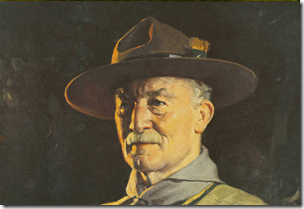
Be Prepared For LifeThis is nothing about the motto of the Boy Scout movement. It is about being ready to face whatever life may throw at you. Life challenges us daily. There are joyous days and days of suffering. Sometimes really unpleasant things happen, but this variety is actually what makes life so interesting. The dramas we encounter are part and parcel of being human.

If we went through life without change or drama, if nothing unexpected ever happened, we could simply live like robots, and our lives would be unbearably dull and monotonous. We must therefore develop an inner strength, so we can enact the dramas of our lives with confidence and poise, in the face of whatever challenges we may encounter.

Just as a footnote, my day today has been rather joyous, how about yours?

A Question Of Purity

MirrorsNichiren said,

“If the minds of living beings are impure, their land is also impure, but if their minds are pure, so is their land.

There are not two lands, pure or impure in themselves. The difference lies solely in the good or evil of our minds. It is the same with a Buddha and an ordinary being.

While deluded, one is called an ordinary being, but when enlightened, one is called a Buddha. This is similar to a tarnished mirror that will shine like a jewel when polished.”

We can all purify our minds, follow the path to enlightenment and strive towards Buddhahood.

Get polishing those mirrors folks!

Previous Older Entries Next Newer Entries