The Love Of Learning

The Reluctant BuddhistWith the weather being the way it is, I spent much of the morning finishing The Water Road, a great book about a four month, event filled, narrowboat odyssey around the extensive British canal network. I then started re-reading William Woollard’s The Reluctant Buddhist, a superb book if you are looking for a good grounding in Nichiren Buddhism.

The great thing about William’s book, is that he explains his own path into Buddhism in such a way that you can easily relate it to your own journey. Sixteen chapters of beautifully explained Buddhism principles, all annotated with his own feelings of doubt and reticence as he slowly grows into the philosophy.

My own path started with many years of Buddhist study into New Kadampa Buddhism. Although the ideas of quietening the mind and removing feelings of desirous attachment were very interesting, the deities never sat well in my mind. It was only when I discovered, if that is the right term, Nichiren Buddhism through Jason and Karen Jarrett’s A Buddhist Podcast and the serialisation of William’s book, that I realised I had found the right life philosophy for me.

Every time I read, or listen to The Reluctant Buddhist, I get a little more from the book. Of course, many of the aspects covered are common with those in The Buddha, Geoff and Me or The Buddha in Daily Life, but each book covers them in a slightly different way. I think that by comparing and contrasting the different views gives me a better and more complete understanding of the principles.

I love reading and the World of Learning. It gives me a great feeling of academic satisfaction as well as the joy of expanding my knowledge of the anchor of my life, my own Practice.

Nichiren Buddhism – The Gohonzon

What is the Gohonzon?
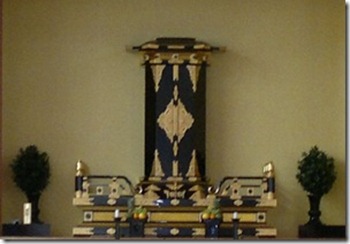
The Butsudan At Taplow Court - SGI-UK HeadquartersThe Gohonzon is the prime point of faith, practice and study in Nichiren Buddhism.

It provides us with a correct model or standard of faith and practice for our time. It usually takes the form of a paper scroll, with Chinese and Sanskrit characters printed on it in black ink.

It is kept in a protective box, or butsudan. The area around the Gohonzon often has offerings of light (in the form of candles), evergreen, incense, water, and fruit. You may also see other offerings, and items like a bell around the butsudan.

In Reply to Kyo’o the Daishonin writes,

“I, Nichiren, have inscribed my life in sumi ink, so believe in the Gohonzon with your whole heart.”

Although the Gohonzon takes the form of a paper scroll, it is vital that when we are chanting to it, it is not seen as outside one’s life. It is through our chanting to the ‘external’ Gohonzon in the butsudan, that we activate all the forces and functions within our own lives.

Nichiren Daishonin began to inscribe the Gohonzon for his followers around the time of his exile to Sado in 1271. He wanted to establish an object of fundamental respect which would enable anyone chanting to it to awaken the Buddhahood in their lives, and to experience the same life state as he did. Nichiren Daishonin provided us with the means to draw out the state of Buddhahood inherent in life.

The word ‘Gohonzon’ is translated into English as ‘object of fundamental respect’. ‘Go’ is an honorific prefix, and ‘honzon’ means what it is that we base our lives on.

Nichiren Daishonin was aware of the difficulty people had in believing that the life state of the Buddha could exist in their lives, and then how hard it is to manifest it. His writing The Object of Devotion for Observing the Mind [WND p354] is in the form of a dialogue which strives to persuade the listener that if all the other nine worlds can be perceived in one’s life, then Buddhahood must be too. He inscribed the Gohonzon for individuals so that they would have a constant reminder of the eternal law, the cause for this life state, and which would serve as a focus for their daily practice, as well as functioning as the external cause for drawing out Buddhahood and revealing their greater self.

It is not necessary to be able to read or understand the characters on the Gohonzon in order to experience benefit from chanting to it. The Daishonin used script or calligraphy for the Gohonzon because he wanted the Gohonzon to be a universal mirror, free of the connotations of race and gender inherent in pictures or images.

The Calligraphy on the Gohonzon

The Gohonzon is sometimes described as a ‘mandala’, a word used in the East to describe an object in which Buddhas and bodhisattvas are depicted or on which a philosophical doctrine is expressed. Originally it meant a circle drawn in the earth around the place where a religious ceremony was to take place. The circle embraced all the people who participated in the ceremony, and was believed to protect them from negative influences. The word mandala was rendered in Chinese as ‘perfectly endowed’ or ‘cluster of blessings’.

Using Chinese calligraphy, Nichiren Daishonin put the characters Nam-myoho-renge-kyo Nichiren boldly down the centre of the Gohonzon. This represents the oneness of the Person and the Law. In other words, the ordinary person is the Buddha, and the Mystic Law is inherent in each living being. He then surrounded these characters with the names of people referred to in the Lotus Sutra, such as Shakyamuni Buddha and Many Treasures and others. All the characters represent an aspect of life, whether as a protective function, or as a representative of the ten worlds, and all are illuminated by the Law of Nam-myoho-renge-kyo.

In the writing The Real Aspect of the Gohonzon Nichiren Daishonin explains why he placed the particular characters where he did. The blueprint for the Gohonzon was the description in the Lotus Sutra of the Ceremony in the Air, when a great jewelled Treasure Tower emerged out of the earth, and many Buddhas and bodhisattvas gathered to hear the Buddha Taho (or Many Treasures) confirm the truth that Shakyamuni had taught – that we all have the potential to reveal our Buddha nature in our daily life, as we are. This story in the Lotus Sutra represented the emergence of the state of Buddhahood in countless peoples’ lives, called Bodhisattvas of the Earth (the people who promised to propagate Nam-myoho-renge-kyo at the time we now live).

Shakyamuni described the dramatic events of the Tower emerging from out of the ground and reaching high into the sky. It was encrusted with precious gems and was intended to represent life with all its mystic and wonderful qualities. As it halted, floating in the air, the doors of the Tower opened and the Buddha Many Treasures was seen sitting inside. This Buddha invited Shakyamuni to enter and sit in the place of honour on Many Treasures’ right hand side. As we look at the Gohonzon, then, it is as if Shakyamuni and Many Treasures are in the Tower looking out at us and all the other characters on the Gohonzon. Then the Buddhas lifted the tower and the assembled company into the air, in what is known as the Ceremony in the Air, an event not limited to any particular time or place. When we look at the Gohonzon in this way, we realize that we are among the Bodhisattvas of the Earth. Through chanting to the Gohonzon, we are participating in the Ceremony in the Air, just as described in the Lotus Sutra.

The Gohonzon is said to contain all aspects of life, so it includes not just the positive and value creating qualities of life represented by the Buddha’s good disciples, but also examples of evil and destruction. For instance the representative of fundamental darkness, the Devil King of the Sixth Heaven is also included on it, although he too is bathed in the transforming power of Nam-myoho-renge-kyo and revealing his enlightened rather than his negative aspects.

The four corners of the Gohonzon each contain a Heavenly King, a character that represents the protective forces of the universe. Between these, in the middle of each side, and written in Sanskrit calligraphy are the characters Aizen (or Craving Filled) on the left as we look at the Gohonzon and Fudo (or Immovable) on the right, who represent the principles that `earthly desires are enlightenment` and `the sufferings of birth and death are nirvana`, respectively. Nichiren Daishonin’s teachings enable us to transform our desires and our sufferings into enlightenment, rather than having to deny them.

Practising with the Gohonzon

Nichiren Daishonin teaches that the Gohonzon enables us to see the ten worlds in our lives, in other words, that we have Buddhahood, and can use it. It is easy to see the lower life states, and to have the illusion that we can never be like the Buddha. The Gohonzon is described as a clear mirror which shows the law of Nam-myoho-renge-kyo and all its manifestations in the different life states, revealing their enlightened qualities.

The way to practise is to have the attitude while we are chanting that we are in no way different or separate from the eternal Law of Nam-myoho-renge-kyo, or the Buddhas who are enlightened to that Law. The key is to praise one’s inherent Buddhahood and then go out into the world and practise as a bodhisattva, treasuring others, encouraging them to experience their Buddhahood too.

Through studying Nichiren Daishonin’s writings and awakening the wisdom we have within our lives, we become alive with the qualities of the Buddha state that are embodied in the Gohonzon. At the same time, we develop a natural desire to change our lives so that we bring out more and more consistently the condition of Buddha revealed by the Gohonzon. The more we practise with this desire to change, the more our lives and Nichiren Daishonin’s life-state embodied in the Gohonzon become as one.

This is a gradual process. When we practise to the Gohonzon, Nichiren Daishonin said we are simultaneously in the state of Buddhahood or enlightenment, but we cannot easily discern that life condition with our minds; therefore we do not always act accordingly. However, through our constant relationship with the Gohonzon, we gradually challenge and overcome the influence of negativity arising from our karma. As we open up our hearts we can begin to experience all those qualities of Buddhahood working naturally and vibrantly inside us and affecting everything that we think and say and do.

President Ikeda has recently described the process as this:

“When we chant Nam-myoho-renge-kyo while practising for ourselves and others, with the Gohonzon of Nam-myoho-renge-kyo manifested by the Buddha as our clear mirror, and with deep confidence in the Gohonzon existing in our own lives, Myoho-renge-kyo within us resonates with the Myoho-renge-kyo outside us, and the world of Buddhahood emerges within us.”

[World of Nichiren Daishonin’s Writings Part 12]

It’s Prayer Jim, But Not As We Know It

Prayer in Nichiren BuddhismNot for the first time, and rather like a scratched record, I hear myself once again explaining, that unlike almost every other religion, Nichiren Buddhism sees things differently. Not that I feel I am apologising for that, just that because it is a philosophy for life and living, rather than a religion in the more generally accepted sense, the meaning and purpose of prayer are in my opinion, fundamentally different.

As with all the deity based religions, prayer is a conduit of communication, a method for getting a message, or request, heard. However, in Buddhism, prayer is a communication to the inner self, rather than to an external being, and in that respect, it is more about focussing the conscious and sub-conscious on a task or topic at hand.

Prayer in Nichiren Buddhism is an integral part of our daily practice. We say, or think, as three of the prayers are silent, four prayers during Gongyo and these are they:

First Prayer – for the appreciation of life’s protective forces:

I offer appreciation to the Shoten Zenjin, the functions in life and in the environment that serve to protect us, and pray that these protective powers may further be strengthened and enhanced through my practice of the Law.

Second Prayer – for the appreciation for the Gohonzon:

I offer my deepest praise and most sincere gratitude to the Dai-Gohonzon of the Three Great Secret Laws, which was bestowed upon the entire world.

I offer my deepest praise and most sincere gratitude to Nichiren Daishonin, the Buddha of the Latter Day of the Law.

I offer my deepest praise and most sincere gratitude to Nikko Shonin.

I offer sincere gratitude to Nichimoku Shonin.

Third Prayer – for the attainment of kosen-rufu:

I pray that the great desire for kosen-rufu is fulfilled, and that the Soka Gakkai International develops eternally in this endeavour.

I offer my most sincere gratitude to the three founding presidents – Tsunesaburo Makiguchi, Josei Toda and Daisaku Ikeda – for their eternal example of selfless dedication to the propagation of the Law.

Fourth Prayer – personal prayers and prayers for the deceased:

I pray to bring forth Buddhahood from within my life, change my karma and to fulfil my wishes in the present and the future.

* Prayers for specific outcomes are brought to mind here.

I pray for my deceased relatives and for all those who have passed away, particularly for these individuals:

* Here we bring to mind the names of those we particularly wish to remember

I pray for peace throughout the world and for the happiness of all humanity.

I think you can see that the prayers are mainly intended to bring to mind the subjects they contain, rather than being any form of communication with a third party. They focus the mind on the desired effect, and are intended to remind us that we need to make the causes ourselves, for the effects we wish to see.

We remember the dedication and sacrifices that the founding presidents have made in order to keep the faith alive and the efforts they have made in promoting the religion in the past decades. I feel it is important to mention that although the third prayer mentions the development of the Soka Gakkai International, it is more important that the aim of the SGI to promote peace for all on earth, rather than the organisation itself, is the desired outcome.

Personally, during the forth prayer, where we bring to mind specific outcomes, I remind myself of personal goals, self-improvement, human revolution and the like, as well as thinking of others who are struggling with challenges such as ill health, difficult situations and so on.

By bring these things into my consciousness means that I can focus on ways I may resolve my own challenges, or help others resolve theirs. There is no concept of me asking any third party to intervene in the outcome, the responsibility for that is all my own.

In that respect, I find Nichiren Buddhism to be a very empowering philosophy. I am taking responsibility for the events occurring in my life, myself. Whilst this puts the onus squarely on my own shoulders, it also gives me control, rather than handing it to any third party  whatsoever.

Far from being an all-knowing, all-seeing deity, I am, like you, a simple human being. So I make mistakes in the decisions and thoughts, words and deeds I perform each and every day. Because I take full responsibility for all those mistakes, I am free to learn from them, rather than ask forgiveness for them.

Prayers form a large part in that learning process. By purposefully bringing these erroneous issues into my consciousness, I am able to analyse, evaluate and modify my thinking. By doing this as part of my daily regime, I am forced to constantly confront my failings, and that improves my chances to improve and to increase the scope of  my enlightened nature.

So I hope you can see the contrast between Buddhist prayers and those of other theistic religions. Far from being a form of communication between the person praying and his or her god, it is communication between me and my consciousness. Furthermore, because I accept responsibility for everything that happens in my life, I am forced to search for the causes of the effects I am experiencing, rather than asking ‘why is this happening to me?’.

I am tempted to suggest that Nichiren Buddhists do not actually pray at all, in the accepted definition of that word. But although the intended recipient of our prayers could not be more different, the intention behind those prayers can be seen to be very much the same.

How NMRK Works

The Ibuprofen MoleculePeople have often asked me, how chanting Nam Myoho Renge Kyo actually works, how it raises my life-energy and puts me in a higher life-state, helps me win, irrespective of the circumstances.

So how can chanting the title of The Lotus Sutra, without the need for reading or studying it, help me enhance the everyday contact with my Buddha nature?

Well chanting, whilst keeping a problem or question in mind, brings forth a certain clarity of thought, which has, on occasion, provided solutions or at least peace of mind.

So why don’t we need to understand The Lotus Sutra, chapter and verse, in order to benefit from it’s wisdom? Well, leaving aside the fact that we do study the major principles that it encompasses, there are a fair number of similarities with complex things in life.

I imagine you have taken painkillers like ibuprofen, a highly complex molecule that took many years to perfect, test and approve. Unless you are a pharmacist or a pharmaceutical chemist, I doubt that you have the slightest idea of how the shape of the molecule blocks the pain receptors in your nervous system. But the tablets work, whether you know, or whether you don’t.

Another good example is the humble motor car. You can drive from Land’s End to John O’Groats without having any knowledge of how an internal combustion engine works or how the friction linings of the brake pads slow the car by turning kinetic energy into heat in the brake disks.

My point is, that some very clever people have spent many, many years developing complicated medicines or machines. Being able to benefit from them is easy, simply because they are so well thought out. So it is with The Lotus Sutra and chanting Nam Myoho Renge Kyo. Shakyamuni Buddha and Nichiren Daishonin spent many, many years perfecting the Lotus Sutra and Nichiren Buddhism.

The benefit of chanting is ours simply by chanting the title, studying the Lotus Sutra is not necessary, but is certainly enlightening.

It Works For Me

God And Man - Not For Me Thank YouSo many World Religions base their beliefs on a God, a Supreme Being, a Creator or an Entity whose existence is the focus of the religion’s belief. That God, or the followers of him (it’s usually a male god) have set down the laws or rules to tell the followers how to live their lives. The God is almost always the only true god, whose word is law and whose actions and will are unquestionable.

As a confirmed Atheist, that focus never sat comfortably in my psyche. I don’t think anyone really believes in a white haired old man sitting in the clouds these days, but there are millions of people who base their faith on a Being whose existence cannot be proven. In fact, many religions actively seek to dissuade followers from even trying to prove that existence.

I was schooled in the Sciences, Mathematics, Physics, Chemistry and Biology as well as Psychology, and those sciences demand proof for each and every hypothesis. So when I stumbled, and that is the right way to describe it, upon Nichiren Buddhism, I was overjoyed to find that there was no supreme being and that every part of Practice demands we examine the results of that Practice as proof of it’s validity.

Nichiren Daishonin said that we should seek proof of the effectiveness of our Practice in the results it brings. He also says that if the results do not support the practice, that we should desist.

I don’t want anyone to think that I am putting Nichiren Buddhism above or before any other religion, I am only saying that, for me, it fits my thinking and for me, it works. I have been practicing a little while now, but I’m still learning new things every day, and the results have been amazing so the proof is there for me, and others to see.

Changes Make Us Better

Q&AGoing back over your mistakes, asking yourself painful questions and giving honest answers is a difficult, but cathartic experience.
We’ve all made mistakes in life, some more serious than others, but thinking them through, trying to explain why you made that decision at that point in time, makes you re-examine your own values. In my case, having changed through my Buddhist Practice, it also becomes clear that I would have made different decisions in many cases.

Our history is set in stone, we cannot go back and make those decisions anew. But we can try to make amends, apologise for any hurt we have caused, and, above all, be honest with ourselves and others.

The changes in myself, that I see and feel, the way I view life, and my responsibility for events affecting me and people around me, have come about through my Practice and my study of Nichiren Buddhism.

As I have said before, once you see things in a different light, you cannot undo that change. Nor would I want to, because even though I know I will make other mistakes in the future, I know that those mistakes will be made despite honourable intentions, and with a great deal more Wisdom, Courage and Compassion.

A Book To Change The World

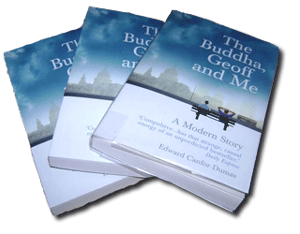
A Book To Change The WorldI know, I know, I know, I keep banging on about Edward Canfor-Dumas’ The Buddha, Geoff and Me. I must have read it half a dozen times and listened to the podcasts twenty or thirty times at least. But having recently given a copy to a friend, I am thoroughly enjoying hearing the positive feedback about the book.
It’s not just a really good story, written beautifully, in convenient bite sized chapters, it covers pretty much every aspect of Nichiren Buddhism at least once. I love hearing about my good friends, Ed, Geoff, Dora and Piers weaving their way through the story, the ups, the downs and every time I hear or read it, I take in a little bit more.

I truly believe that the book should be a compulsory read for every school kid, and every parent and adult too actually. It’s a modern classic, in my opinion, and could change the whole world given the chance. It changed my life, and it might just change yours.

It’s not for everyone, my mom doesn’t like the ‘modern’ language and I must admit that there’s a bit too much to take it all in with a single read, but I implore you, listen to one chapter and give it a chance. Chapter seven is my favourite, but that’s just me.

Chop, Chop

Getting The ChopBefore I became a Nichiren Buddhist I found disappointments very difficult to handle, so today, being told that my services are no longer required at work, I was inwardly pleased with the manner in which I handled the fall of the axe.

I have always been prone to setting my expectations too high, and that leads to disappointment when the expectation isn’t met. My Dad, on the other hand, always seemed to be a little pessimistic, he never appeared to have very high expectations, never got overexcited about anything, so didn’t allow himself to feel disappointment, or that was the way it looked to me.

Since I have been practicing Nichiren Buddhism I have an inner strength that helps me through difficult times. It is a great comfort and I would recommend it to anyone who is struggling with issues or problems.

The strange thing is that Buddhism doesn’t always make the problems go away, although that does sometimes happen, but it gives me a different way of looking at the situation and a focus that makes the problems more easy to understand and to bear.

In general, my life has been very easy. I have a very loving family, great parents and had a very stable home life in my formative years. I’ve been through a few troughs, the usual things like losing my grandparents, my father and failed relationships, the same as every one else. I’m not looking to test my practice, but I truly believe that my inner strength is helping me cope with such times much better now.

If I were to try to pinpoint the single most important reason for this, I would say it was a new found mental calm. I’ve never been a fighter. At school I used to use humour to get out of the usual scrapes all kids get into. But I was prone to letting my feeling show, particularly when disappointment was involved.

Now, because I can see the situation from all angles, just like those reviews on the web, where you can spin the item around and look at it every which way, I can rationalise more easily. Being able to see a situation from other peoples perspective allows me to make sense of how things appear to them, and understand why they are reacting in the way they are.

It has changed my life, or at least the way I look at it, and it can help anyone. Maybe it could help you.

The Law Is Central

The Lotus SutraWhen we are sick, or the challenges of everyday life are coming thick and fast, it is all too easy to concentrate on ourselves, forgetting about those around us. To stop this happening takes mindfulness and courage, as noted by Sensei in today’s encouragement.

Buddhism is not about leading a self-centred existence. If we do not base our lives on the Law, we are not practicing Buddhism.

The German writer Friedrich von Schiller writes, “The brave man thinks upon himself the last.”

This is analogous to the spirit of not begrudging one’s life taught in the Lotus Sutra.

This means treasuring the Law more highly than one’s life.

The Law and kosen-rufu are central.

The old adage that ‘No Man is an island’ is very true. It is our family, friends and those we meet each day in our communities, who make our lives meaningful, and it is The Law that shows us the way we are to conduct ourselves and how we should relate to them.

Tell me, what do you think you would do then?

And Then There Were Three ~ GenesisWhen life gets a little messy, I tend to go for familiar things from life, things that help me feel more comfortable. While working from home today, I took the opportunity to listen to some classic, and very familiar music, the Genesis album, And Then There Were Three, released in 1978.

I have loved Genesis since seeing their inaugural tour way back in 1969 and can still remember the dismay when Peter Gabriel left the band. He was such a figurehead, being the lead singer, we wondered whether the band could survive. And Then There Were Three answered that question, and is still one of my favourite albums.

Maybe because of my heightened sense of awareness, maybe because I am looking for meaning in events, I don’t know, but suddenly a set of lyrics that I have known for thirty five years, seemed more relevant than they had ever been before …

Undertow

The curtains are drawn
Now the fire warms the room.
Meanwhile outside
Wind from the north-east chills the air,
It will soon be snowing out there.

And some there are
Cold, they prepare for a sleepless night.
Maybe this will be their last fight.

But we’re safe in each other’s embrace,
All fears go out as I look on your face –

Better think awhile
Or I may never think again.
If this were the last day of your life, my friend,
Tell me, what do you think you would do then?

Stand up to the blow that fate has struck upon you,
Make the most of all you still have coming to you,
Lay down on the ground and let the tears run from you,
Crying to the grass and trees and heaven finally on your knees

Let me live again, let life come find me wanting.
Spring must strike again against the shield of winter.
Let me feel once more the arms of love surround me,
Telling me the danger’s past, I need not feel the icy blast again.

Laughter, music and perfume linger here
And there, and there,
Wine flows from flask to glass and mouth,
As it soothes, confusing our doubts.

And soon we feel,
Why do a single thing to-day,
There’s tomorrow sure as I’m here.

So the days they turn into years
And still no tomorrow appears.

Better think awhile
Or I may never think again.
If this were the last day of your life, my friend,
Tell me, what do you think you would do then?

Stand up to the blow that fate has struck upon you,
Make the most of all you still have coming to you,
Lay down on the ground and let the tears run from you,
Crying to the grass and trees and heaven finally on your knees

Let me live again, let life come find me wanting.
Spring must strike again against the shield of winter.
Let me feel once more the arms of love surround me,
Telling me the danger’s past, I need not feel the icy blast again.

~ Tony Banks 1978

Genesis have provided much of the soundtrack for my life, sometimes happy, sometimes not so happy. Now Nichiren Buddhism is providing the anchor, the Honzon of my life and between the two, I am striving to pull things back together again and move forward.

Previous Older Entries Next Newer Entries