More Happiness Anyone?

More Happiness Anyone?What do we mean by happiness? There may be as many answers to that as there are stars in the night sky, everyone has their own idea of what makes them happy, and equally what doesn’t.

Maybe it is the love of a partner, being part of a family, the pay cheque at the end of the month or that new car you had always promised yourself. Whatever your idea of happiness, we all crave more of it.

We can probably agree that it is all too often a transitory state, punctuated by periods where we are unhappy, or at least a bit glum. So what would you give to have more of this illusive life-state, and how can you go about achieving a happier life?

Well speaking personally, I can almost guarantee happiness from my Buddhist practice. That might sound a little trite or even rather far-fetched, but for me it is true. My practice helps me see life from all angles, the ups and downs, from my view-point and from that of others, and it ‘smoothes’ out the emotional bumps we encounter each and every day.

The idea at the very core of Buddhism is the removal of suffering, and that in itself helps us to be happier. Seeing the beauty in nature, the best facets of another’s personality, the joy in helping others, happiness is there for us all, all of the time and all around us. Living a life that is more concerned with others than ourselves, giving more than we take, and so on, will also bring feelings of happiness. All we have to do is look out for it.

Living in a society that is more concerned about what we own, than who we really are, we all struggle to put those ideas into action. We hear about people earning ridiculous sums, whilst providing little by way of return, and wonder how they can live with the guilt. If society valued the good in people more than the goods of people, the world would be a much fairer, happier place.

Whatever flavour your own happiness comes in, I wish you more of it, now and in the future. And when it arrives, please make sure that you share it around. That way you will find it grows and grows, and that it lasts just that little bit longer.

Maintain Your Faith, Become Enlightened

Nichiren DaishoninThe title and the very purpose of this blog, is to record events that accompany me along my path to enlightenment. Far from being a pipe dream or vague wistful notion, Nichiren Daishonin set out the very simple, practical method for attaining enlightenment, and hence Buddhahood, within this lifetime.

This letter was written to Toki Jonin in the seventh year of Kencho (1255).

“If you wish to free yourself from the sufferings of birth and death you have endured since time without beginning and to attain without fail unsurpassed enlightenment in this lifetime, you must perceive the mystic truth that is originally inherent in all living beings. This truth is Myoho-Renge-Kyo. Chanting Myoho-Renge-Kyo will therefore enable you to grasp the mystic truth innate in all life.

The Lotus Sutra is the king of sutras, true and correct in both word and principle. Its words are the ultimate reality, and this reality is the Mystic Law (Myoho). It is called the Mystic Law because it reveals the principle of the mutually inclusive relationship of a single moment of life and all phenomena. That is why this sutra is the wisdom of all Buddhas.

Life at each moment encompasses the body and mind and the self and environment of all sentient beings in the Ten Worlds as well as all insentient beings in the three thousand realms, including plants, sky, earth, and even the minutest particles of dust. Life at each moment permeates the entire realm of phenomena and is revealed in all phenomena. To be awakened to this principle is itself the mutually inclusive relationship of life at each moment and all phenomena. Nevertheless, even though you chant and believe in

Myoho-Renge-Kyo, if you think the Law is outside yourself, you are embracing not the Mystic Law but an inferior teaching. “Inferior teaching” means those other than this [Lotus] sutra, which are all expedient and provisional. No expedient or provisional teaching leads directly to enlightenment, and without the direct path to enlightenment you cannot attain Buddhahood, even if you practice lifetime after lifetime for countless kalpas. Attaining Buddhahood in this lifetime is then impossible. Therefore, when you chant Myoho and recite Renge, you must summon up deep faith that Myoho-Renge-Kyo is your life itself.

You must never think that any of the eighty thousand sacred teachings of Shakyamuni Buddha’s lifetime or any of the Buddhas and bodhisattvas of the ten directions and three existences are outside yourself. Your practice of the Buddhist teachings will not relieve you of the sufferings of birth and death in the least unless you perceive the true nature of your life. If you seek enlightenment outside yourself, then your performing even ten thousand practices and ten thousand good deeds will be in vain. It is like the case of a poor man who spends night and day counting his neighbour’s wealth but gains not even half a coin.

That is why the T’ien-t’ai school’s commentary states, “Unless one perceives the nature of one’s life, one cannot eradicate one’s grave offenses.” This passage implies that, unless one perceives the nature of one’s life, one’s practice will become an endless, painful austerity. Therefore, such students of Buddhism are condemned as non-Buddhist. Great Concentration and Insight states that, although they study Buddhism, their views are no different from those of non-Buddhists.

Whether you chant the Buddha’s name, recite the sutra, or merely offer flowers and incense, all your virtuous acts will implant benefits and roots of goodness in your life. With this conviction you should strive in faith. The Vimalakirti Sutra states that, when one seeks the Buddhas’ emancipation in the minds of ordinary beings, one finds that ordinary beings are the entities of enlightenment, and that the sufferings of birth and death are nirvana. It also states that, if the minds of living beings are impure, their land is also impure, but if their minds are pure, so is their land. There are not two lands, pure or impure in themselves. The difference lies solely in the good or evil of our minds.

It is the same with a Buddha and an ordinary being. When deluded, one is called an ordinary being, but when enlightened, one is called a Buddha. This is similar to a tarnished mirror that will shine like a jewel when polished. A mind now clouded by the illusions of the innate darkness of life is like a tarnished mirror, but when polished. it is sure to become like a clear mirror, reflecting the essential nature of phenomena and the true aspect of reality. Arouse deep faith, and diligently polish your mirror day and night. How should you polish it? Only by chanting Nam-Myoho-Renge-Kyo.

What then does Myo signify? It is simply the mysterious nature of our life from moment to moment, which the mind cannot comprehend or words express. When we look into our own mind at any moment, we perceive neither colour nor form to verify that it exists. Yet we still cannot say it does not exist, for many differing thoughts continually occur. The mind cannot be considered either to exist or not to exist. Life is indeed an elusive reality that transcends both the words and concepts of existence and nonexistence. It is neither existence nor nonexistence, yet exhibits the qualities of both.

It is the mystic entity of the Middle Way that is the ultimate reality. Myo is the name given to the mystic nature of life, and Ho, to its manifestations. Renge, which means lotus flower, is used to symbolize the wonder of this Law. If we understand that our life at this moment is Myo, then we will also understand that our life at other moments is the Mystic Law. This realization is the mystic Kyo, or sutra. The Lotus Sutra is the king of sutras, the direct path to enlightenment, for it explains that the entity of our life, which manifests either good or evil at each moment, is in fact the entity of the Mystic Law.

If you chant Myoho-Renge-Kyo with deep faith in this principle, you are certain to attain Buddhahood in this lifetime. That is why the sutra states, “After I have passed into extinction, [one] should accept and uphold this sutra. Such a person assuredly and without doubt will attain the Buddha way.” Never doubt in the slightest.

Respectfully.

As the Daishonin said, “Maintain your faith and attain Buddhahood in this lifetime. Nam-Myoho-Renge-Kyo, Nam-Myoho-Renge-Kyo.”

Clearing Our Karmic Legacy

Clearing The WayFollowing on from my post about change yesterday, I thought this may help us to make the changes we wish to see in our lives.

The Nichiren Buddhist teaching of changing karma restores the original Buddhist emphasis on the role of present action changing negative karma. Furthermore, the Nichiren Buddhist concept of karma is unique because it focuses on the fundamental cause of negative karmic retribution and provides the concrete means to change that cause, instead of focusing on the ultimately unknowable negative causes accumulated over one’s infinite past.

Nichiren writes: “The Nirvana Sutra teaches the principle of lessening one’s karmic retribution. If one’s heavy karma from the past is not expiated within this lifetime, one must undergo the sufferings of hell in the future, but if one experiences extreme hardship in this life [because of the Lotus Sutra], the sufferings of hell will vanish instantly. And when one dies, one will obtain the blessings of the human and heavenly worlds, as well as those of the three vehicles and the one vehicle” (WND, 199).

In this passage, Nichiren teaches that our karmic retribution can “vanish instantly” rather than us having to undergo many lifetimes of austerities. In addition, he makes it clear that eradicating our karmic retribution is in itself the “blessing of the one vehicle”, the attainment of Buddhahood.

Chanting With a Fighting Spirit

Nichiren Buddhism teaches that the essential way to change karma is to chant Nam Myoho Renge Kyo with confidence in all people’s potential for Buddhahood. In The Record of the Orally Transmitted Teachings, Nichiren states: “This word ‘belief ‘ is a sharp sword that cuts off fundamental darkness or ignorance… It is through the one word ‘belief ‘ that we are able to purchase the wisdom of the Buddhas of the three existences. That wisdom is Nam myoho renge kyo”.

When we chant Nam myoho renge kyo with the resolve to challenge our fundamental darkness, with confidence in the existence of the sun, we can quickly remove the clouds and reveal the sun. Once the sun of Buddhahood rises in our lives, all of our karmic suffering is reduced to seeming nonexistence. With Nam myoho renge kyo, Nichiren teaches, delusion is transformed into wisdom, unwholesome actions into wholesome actions, and suffering into a source of growth and genuine fulfilment. This transformation of life’s causation from delusion to suffering into wisdom to joy is the meaning of changing karma in Nichiren Buddhism. The key to this fundamental change in the chain of cause and effect within our lives is chanting Nam Myoho Renge Kyo with confidence, with a fighting spirit, creating powerful winds to blow away the dark clouds of delusion and reveal the sun of Buddhahood.

Never Disparaging and Soka Spirit

The Soka Spirit movement is the SGI-USA’s collective and individual efforts to challenge the distortion of Nichiren Buddhism, as seen in the Nichiren Shoshu priesthood, and encourage both self and others to awaken to life’s true potential.

The method and aim of Soka Spirit are the same as those of Never Disparaging, reconfirming people’s dignity through respecting their innate Buddhahood and helping them challenge their fundamental darkness. Both Soka Spirit and the actions of Never Disparaging aim to establish a humanistic religion by challenging authoritarianism, to establish respect for each person by challenging disrespect for ordinary believers perpetrated by religious authority. While the doctrinal importance of the Lotus Sutra is found in the “Expedient Means” and “Life Span” chapters, its importance in terms of Buddhist practice lies in “Never Disparaging,” the twentieth chapter. Nichiren, therefore, writes: “The heart of the Buddha’s lifetime of teachings is the Lotus Sutra, and the heart of the practice of the Lotus Sutra is found in the ‘Never Disparaging’ chapter. What does Bodhisattva Never Disparaging’s profound respect for people signify? The purpose of the appearance in this world of Shakyamuni Buddha, the lord of teachings, lies in his behaviour as a human being” (WND, 851-52).

Proclaiming respect for humanity in the abstract is easy, but to show sincere respect for the person confronting you is difficult, especially if the person is hostile. But this is exactly what Bodhisattva Never Disparaging did. In each person he met, he saw the Buddha nature and expressed his utmost respect through his words and behaviour. His practice, at the same time, was a direct challenge to the great authority and power of arrogant monks in an age of religious corruption.

In the end, respect triumphed over disrespect, as did the Buddha nature over the fundamental darkness. Never Disparaging’s negative karma gave way to the joy of living, and the name given to demean this nameless man became a name of honour in Buddhist history.

(excerpt taken from September 2005 Living Buddhism)

Have A Heart

Have A HeartIn his writings, regarding Buddhist practice, Nichiren repeatedly emphasized the importance of the heart.

While teaching that faith and courage are the powers and functions of the heart that enable us to open the world of Buddhahood in our lives, he also cautioned us against the heart’s negative functions, such as disbelief and cowardice, which close us off to our potential for Buddhahood.

So when we say that we chant with all our heart, we must ensure that we are indeed doing so. Our fundamental darkness lives deep in our hearts and minds, and will, if left unchecked, promote disbelief and cowardice, under the disguise of self protection in some instances.

Confront your fears, examine the thoughts that your Dark Passenger will bring. Be determined to resolve the issues and with a focused mind and a strong heart, chant to increase your faith and courage, ever onward towards enlightenment.

Nam Myoho Renge Kyo

Chant And Be Strong

Chant And Be StrongWhen life doesn’t go quite as smoothly as we would like, we might be tempted to feel that we are being singled out, or being forced to suffer unduly. Taking a different view point, we see that everyone is subject to similar trials and challenges at one time or another.

Sensei puts this all into context …

“Life is an everlasting struggle with ourselves. It is a tug of war between moving forward and regressing, between happiness and unhappiness. Outstanding individuals didn’t become great overnight. They disciplined themselves to overcome their weaknesses, to conquer their lack of caring and motivation until they became true victors in life.

One reason Buddhists chant Nam-myoho-renge-kyo each day is to develop strong will and discipline and, along with those, the ability to tackle any problem seriously and with the determination to overcome it.”

~ Daisaku Ikeda

Keeping On Keeping On

Check out this super eco-friendly coffin“It isn’t the cough that carries you off, it’s the coffin they carry you off in” so says the quaint old saying, but right at this moment I would like to argue that the cough should have a little more acknowledgement in the ditty.

Not that my current ailment is really that serious, but it is the constant nagging wheeze and occasional uncontrollable hacking cough that is wearing me down. Fortunately, way beyond time, I took some very wise advice and visited the doctor a couple of weeks ago. Although the cough has changed from a deep chesty hack, it still isn’t defeated.

With nights of broken sleep, not to mention days of coughing and spluttering my way around the office, I’m feeling a bit depleted energy-wise. Being unable to physically chant is also making a huge difference, the life-energy that long and loud chanting brings is being sadly missed.

So I apologise to the folks who follow TSFE if I have been a little less provocative, incisive, educational or thought provoking of late. I have another appointment with Dr Paine (how apt) on Monday evening, so I’m hoping she will have some magic potion for me, that will clear this up once and for all.

In the meantime, your kind thoughts and chanting is very gratefully received.

Namaste

Steady As She Goes

Steady As She GoesThere are times when we need to be reminded of the important things in life. When distractions come along it’s all too easy to get side tracked and let our focus slip. It isn’t that we forget that our Practice is the centre of our lives, it’s just that sometimes life itself can get in the way, albeit temporarily.

When everything comes along at once, it can all be a little too much to cope with. But being reminded that our practice is the one constant that keeps us on the straight and narrow is a very good thing. When we remember that everything pivots around our honzon, that our faith is central and the very thing that makes us who we are, we can take steps to realign ourselves.

Take a frim grip of the wheel, get your ship back on your desired heading, feel the wind of change at your back and focus on the horizon. Chant Nam Myoho Renge Kyo, and it’s steady as she goes captain !!!

One Step Back

One Step BackSince starting the medication prescribed by my doctor on Monday, my cough seems to have been getting better day by day. But as with many things in life, with a little progress also comes the odd setback, and so it was today.

I was looking forward to the Men’s meeting this morning. The chance to see Ken, Jack, Boots and the others after much too long an absence. But settling down to sleep last night was fraught with problems from the start.

To begin with, the communal light in the stairway of the apartments, that is supposed to turn itself off after five minutes, refused to do so and shone in persistently through the skylights above the front door and my bedroom door.

I made myself respectable, and went up and down the stairs, trying to find a switch that was either jammed, or taped in the on position. It has happened before, but usually only when someone is moving in or out of one of the other apartments. There were no signs, so I went back to bed, tried to shield my eyes and sleep.

It must have worked, because the next thing I remember was waking up with a choking coughing fit. Sitting on the edge of the bed has worked in past, but it took ages for the coughing to subside, heaven knows what the neighbours thought.

Throughout the night I got a succession of interruptions, though nothing as bad as the first, but by morning I was feeling like I hadn’t slept at all. Chanting didn’t help either, each time I tried, another coughing fit ensued, so I ended Gongyo in a silent mental chant.

I know we have to expect setbacks on our journey back to health and fitness, but it is rather disappointing that it happens to have coincided with the weekend, and particularly the meeting. I will chant for more progress and to ensure that I am hail and hearty in good time for the next.

Persistent Little Blighter

Poison Into MedicineDespite having the best antibiotics money can buy, and upping the chanting to levels barely covered by the latest health and safety directives, this flippin’ cough is hanging on in a most tenacious manner.
I think the mere fact we are taking a pill, or drinking some potion, fools our body into feeling better, the placebo effect if you will. But the illusion never lasts and making the causes and seeing the effects  are not necessarily so closely connected. We already know that causes made in past lives are still having effects in this, so I hope the medicine works a bit quicker than that.

But despite the fact that I am still feeling less than tickety-boo, I know that I am making the right causes to see the effect I desire. So now it is a matter of trusting in the doctor, trusting in my practice, and being patient, as opposed to being a patient. Sadly it seems that although the drugs are working on the cough, they are not doing much for my jokes, but you had already worked that bit out for yourselves.

NMRK Explored

The Lotus FlowerAfter the initial question “do you chant?” we are then asked “what do you chant?” followed closely by “how long do you chant?” and almost certainly “what does it mean?“. After a little practice, no pun intended, most people can master the phrase Nam-myoho-renge-kyo, but explaining why we chant it, and what it means may take a little longer.

Here is how the SGI website describes the meaning of the individual parts …

Nichiren Daishonin established the chanting of Nam-myoho-renge-kyo as the way to awaken one’s Buddha nature and tap into the deepest levels of our existence, on which our own lives and that of the universe are one. He first taught the invocation of the phrase to a small group at Seicho-ji temple in Awa province, Japan, on April 28, 1253.

Myoho-renge-kyo is the name of the Lotus Sutra in Japanese pronunciation of classical Chinese characters, and so the literal meaning of Nam-myoho-renge-kyo is “I devote myself to the Lotus Sutra.” As the following explanation shows, there are deeper levels of meaning attached to each element of the phrase.

Nam

Nam derives from the Sanskrit word namu, meaning “to devote oneself.” Nichiren established the practice of chanting Nam-myoho-renge-kyo as a means to enable all people to put their lives in harmony or rhythm with the law of life, or Dharma. In the original Sanskrit, namu indicates the elements of action and attitude, and refers therefore to the correct action one needs to take and the attitude one needs to develop in order to attain Buddhahood in this lifetime.

Myoho

Myoho literally means the Mystic Law–the underlying truth or principle which governs the mysterious workings of the universe and our life from moment to moment. Myo refers to the very essence of life, which is “invisible” and beyond intellectual understanding. This essence always expresses itself in a tangible form (ho) that can be apprehended by the senses. Phenomena (ho) are changeable, but pervading all such phenomena is a constant reality known as myo. Myo also means to open, to revive, and to be fully endowed with the qualities we need to develop our lives.

Renge

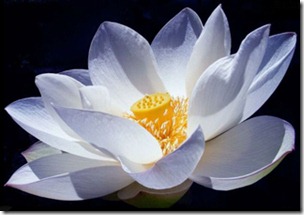
Renge means lotus flower. The lotus blooms and produces seeds at the same time, and thus represents the simultaneity of cause and effect. The circumstances and quality of our individual lives are determined by the causes and effects, both good and bad, that we accumulate (through our thoughts, words and actions) at each moment. This is called our “karma.” The law of cause and effect affirms that we each have personal responsibility for our own destiny. We create our destiny and we have the power to change it. The most powerful positive cause we can make is to chant Nam-myoho-renge-kyo; the effect of Buddhahood is simultaneously created in the depths of our life and will definitely manifest in time.

The lotus flower grows and blooms in a muddy pond, and yet remains pristine and free from any defilement, symbolizing the emergence of Buddhahood from within the life of an ordinary person in the midst of the struggles of day-to-day existence.

Kyo

Kyo literally means sutra, the voice or teaching of a Buddha. In this sense, it also means sound, rhythm or vibration. In a broad sense, kyo conveys the concept that all things in the universe are a manifestation of the Mystic Law.

Further explanation of the meaning of Nam-myoho-renge-kyo can be found here.

Previous Older Entries Next Newer Entries