Purity Of Mind

MirrorsNichiren said,

“If the minds of living beings are impure, their land is also impure, but if their minds are pure, so is their land.

There are not two lands, pure or impure in themselves. The difference lies solely in the good or evil of our minds. It is the same with a Buddha and an ordinary being.

While deluded, one is called an ordinary being, but when enlightened, one is called a Buddha. This is similar to a tarnished mirror that will shine like a jewel when polished.”

We can all purify our minds, follow the path to enlightenment and strive towards Buddhahood. Get polishing those mirrors!

Cowards Cannot Become Buddhas

BuddhaThis challenging and inspiring piece came from last night’s Gosho Study.

The direct route to uncovering your enlightenment is by challenging negativity. You don’t call out your Buddhahood by running away from your problems. Change your way of thinking. Obstacles, negativity, adversity, whatever words you want to attach to it – think instead – opportunity, opportunity, opportunity! This is the means by which you can call out your Buddhahood and become in charge of your life.

Every time that you think that you are powerless to change a problem in your life; you have reverted to being non Buddhist. You must chant out of the conviction that you will win. It is not mindless Nam-myoho-renge-kyo, it is not half hearted. It is a deep conviction that Nam-myoho-renge-kyo is more powerful than anything else and you must attack your negativity with this conviction. You can’t do it if you won’t become a fighter. Buddhism is win or lose. And, for those of us practising Buddhism, victory is the only option. We must become masters at life by mastering negativity.

You learn that after challenging negativity, negativity, negativity, day after day, over many years, that what you were always looking for all of your life you always had; it’s always been there within you. What you learn is that your life is the greatest dream that you could ever dream. It is within your grasp and control at this moment and every moment.

So create a life for yourself that is beyond your wildest dreams. Buddhism is about winning. Buddhism is about not stopping until all people become happy. It’s about becoming mad at fundamental darkness that takes away peoples’ souls so that they become hopeless, when in fact; inside them they have the greatest seed to change anything.

The reason we have faith is to do what you cannot do already with your own human effort. You don’t need faith to do what you can already do. But how can you ever know your limitless potential of the power of Nam-myoho-renge-kyo unless you have the courage to fight for that which is illogical in your mind. Challenge the impossible. The more you have the courage to challenge the impossible, the more you will come to understand YOU ARE MAGNIFICENT!

(Source unknown)

Awakening Our Intrinsic Value

Intrinsic ValueOne way to overcome our tendency to compare ourselves with others is through learning how to praise ourselves for our unique, intrinsic value.

A common concern about self-praise is that it may cause arrogance, probably due to our Judeo-Christian tradition in which self-humiliation is often regarded as a necessary virtue to praise God, while self-praise is deemed as a sign of pride, which is one of the seven deadly sins. It should be noted, however, that arrogance is a defensive posture caused by a tendency to assume a sense of superiority or inferiority by comparing oneself with others. Therefore, so long as we praise ourselves solely for who we are and for our innate Buddhahood, we will never become arrogant, though we may at times seem arrogant to arrogant people.

Indeed, the greatest way to praise ourselves is prayer that sincerely affirms our supreme potential as the Daishonin states, When you chant Myoho and recite Renge, you must summon up deep faith that Myoho-renge-kyo is your life itself (WND, 3).

As we praise ourselves in this way, we will grow confident yet humble because we start to recognize the same quality of Buddhahood in others as well. Appreciation for oneself leads to appreciation for others, which further strengthens self-esteem. The way we see ourselves is not only the way we live our lives, but also the way we relate to others.

(from the November 9, 2001 World Tribune)

The Good, The Bad, And The Explanation

Good and BadBuddhism teaches that our lives are endowed with both good and bad aspects simultaneously. The human mind switches between ten individual conditions, The Ten Worlds, and as we know, each World contains the other nine. The lowest three Worlds are those of Hell, filled with suffering, Hunger, which is dominated by greed, and Animality, characterised by fear of the strong or powerful and contempt of the weak.

The two highest worlds are those of Bodhisattva and Buddhahood, states of mind in which people strive to help others to eliminate their suffering and attain happiness.

Good and bad, happiness and sadness exist together, they cannot be separated and are integral parts of life. In fact it could be said that to try to describe one without the other would be meaningless.

Buddhist practice cannot remove bad things from our life nor the sadness, but it can help us deal with them (Poison into Medicine), and by doing so, help us and those around us promote the good and the happy aspects.

Nam Myoho Renge Kyo.

Why Buddhahood?

BuddhahoodEven if you are born into the most affluent circumstances, or enjoy a spectacular marriage, that is the envy of others, there is no guarantee that you will be happy.

Happiness does not depend on wealth or personal appearance, nor does it hinge on fame or recognition. If your heart is empty, you cannot build genuine happiness.

There is an expansive life-state of profound, secure happiness that transcends any material or social advantage, it is called the life state of Buddhahood.

This is why we chant, it is why we strive daily to grow ever nearer to that life-state. This is not a selfish or exclusive goal, as we learn the Wisdom, Courage and Compassion needed to achieve our aim, we willingly take our family, friends and colleagues along with us.

Happiness

HappinessHappiness is a matter of the heart.

This is not mere spiritualism. Our hearts are precious vessels, endowed with the treasure of Buddhahood. When we strive earnestly, in faith and practice, and reveal our Buddhahood, we can walk along the sure and steady path to happiness, and attain a state of fulfilment and satisfaction.

Nichiren writes …

“Fortune comes from one’s heart and makes one worthy of respect.”

Practice To Shine

The World of BuddhahoodNichiren Buddhists believe that, not only does everyone hold the World of Buddhahood within them, but that it can be achieved within this lifetime.

Think about that, everyone you know has the potential to reach Buddhahood, your family, friends, work colleagues, everyone. And not only those people you like, but those you don’t like too.

But how do we achieve this state of Buddhahood? The Daishonin had this to say …

“When deluded, one is called an ordinary being, but when enlightened, one is called a Buddha.  This is similar to a tarnished mirror, that will shine like a jewel when polished.

A mind now clouded by the illusions of the innate darkness of life is like a tarnished mirror, but when polished, it is sure it become like a clear mirror, reflecting the essential nature of phenomena, and the true aspect of reality.

Arouse deep faith, and diligently polish your mirror day and night. How should you polish it? Only by chanting Nam Myoho Renge Kyo.”

So there you have it, a simple Practice, so easy to learn that, when applied with faith and diligence, will allow you to reveal the Buddha in each and every one of us.

Buddhahood In This Lifetime

Buddhahood In This LifetimeReligion must teach an ‘attitude to life’.

To live a life of true human dignity is certainly difficult. Life is change, it is continuous change. Nothing is constant. The  four sufferings of birth, old age, sickness and death are an eternal theme that no one can escape.

Amid harsh reality, people yearn, from the depths of their beings, to live with dignity, and for their lives to have meaning, and they make efforts towards that end. The product of these human yearnings, these prayers, is religion. Religion was born from prayer.

What is Nichiren’s response to these prayers of human beings? What attitude towards life does he teach? The answer, in short, is the principle of attaining Buddhahood in this lifetime.

Nam Myoho Renge Kyo.

Crisis, What Crisis?

Crisis - Danger + OpportunityWith the huge cuts in public spending, there are thousands of jobs in jeopardy. I know of several people who are busy looking for new work after losing their jobs and it is easy to feel that a personal crisis might be looming.

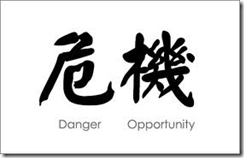
But there is hope in such situations. The Chinese spell the word crisis with two characters. The first means danger. The second, opportunity. So we can all look upon a crisis in two ways.

Obviously, any crisis can be a source of danger. The very word conjures up a sense of foreboding, a situation that is out of control. But with that danger comes the opportunity to make something better with the energy that comes to us all when put in a dangerous position.

The natural rise in adrenalin when we face danger, the classic fight or flight reaction, gives us superhuman levels of energy. We have all heard of stories of incidents where someone has lifted a car off a trapped friend or family member or run incredibly fast to rescue a child from danger. It’s a natural reaction, it’s nothing superhuman at all.

When we couple this energy with the Buddhist principle of turning Poison into Medicine, there can be a very real opportunity to use the situation to our own advantage. How often have you heard about people who turn an impossible situation into a an amazing success story. J.K. Rowling reportedly wrote the first Harry Potter book whilst in sheltered accommodation. Duncan Bannatyne built his business empire from scratch after coming from a less than privileged background.

Many of us need a short sharp shock to bring us out of a state of lethargy, something that sparks us into life and gives us the impetus to make huge positive changes to our lives. My own interest in Nichiren Buddhism was sparked by a sudden change in family situation, so I know that good things can come from a painful event.

If you find you are facing a crisis, take heart, remember that opportunity comes along as well as the danger, good fortune comes to those who seek it.

The Ultimate Role Model

BuddhaThe purpose for, or the idea behind, my Buddhist Practice is to bring me closer to Buddhahood, each and every day.

That is to say, to emulate, as closely as possible, the Buddha himself in the way he was able to see life and all things in a pure clarity.

Siddhārtha Gautama was a man, albeit a prince, who forsaking his life of comfort and position, went out into the world to meditate on the causes of, and ways to reduce or remove, the suffering of life.

In Nichiren Buddhism we learn about the Ten Worlds, from Hell to Buddhahood.

The Buddha state originates from the very depths of life, called the amala consciousness, meaning the fundamentally pure life force or consciousness. The function of the Buddha state is to bring out the positive side of the other nine worlds.

This principle of the Ten Worlds shows that the Buddha state is a naturally occurring condition of life in every living being. The purpose of Buddhist practice is to enable us to cause the Buddha state to appear; to have it working strongly in us.

In Nichiren Buddhism, therefore, the Buddha is not some perfect, ideal being, but is rather an ordinary person living in rhythm with the law of the universe, taking wise, courageous and compassionate action for the benefit of others, through the functioning of the nine worlds in daily life.

The more I practice, the closer I come to Buddhahood, a very positive thought for today.

Next Newer Entries