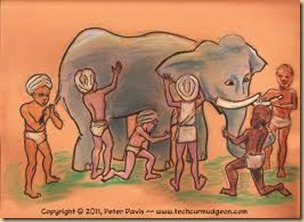
 We all see things in very different ways, mainly because we tend to be restricted by our own viewpoint.
The Buddha used to tell an amusing parable about six blind men and an elephant to explain how the differing views are come by.
Each man has a different idea of what the elephant is, each being able to touch a different part of the animal.
This poem, by John Godfrey Saxe, sums up the scene and explains the moral behind the tale …
| It was six men of Indostan To learning much inclined, Who went to see the Elephant (Though all of them were blind), That each by observation Might satisfy his mind.The First approach’d the Elephant, And happening to fall Against his broad and sturdy side, At once began to bawl: “God bless me! but the Elephant Is very like a wall!”The Second, feeling of the tusk, Cried, -“Ho! what have we here So very round and smooth and sharp? To me ’tis mighty clear This wonder of an Elephant Is very like a spear!”The Third approached the animal, And happening to take The squirming trunk within his hands, Thus boldly up and spake: “I see,” quoth he, “the Elephant Is very like a snake!” The Fourth reached out his eager hand, The Fifth, who chanced to touch the ear, The Sixth no sooner had begun And so these men of Indostan MORAL. So oft in theologic wars, |
|
|
John Godfrey Saxe ( 1816-1887) |
 A man once came to see the Buddha to get help with his problems.
 There is the temptation, whilst continuing to practice, to wonder whether we will ever become a Buddha or doubt whether Buddhahood even resides within us. With his usual wisdom, Nichiren showed us the truth of the matter in his simple words.
 In the true reality of life as viewed from the enlightened state of a Buddha, one who has broken free of all delusion, all things are equal, transcending distinctions and differences between subject and object, self and others, mind and body, the spiritual and the material.
 The Sanskrit word Buddha means “One who is awakened [to the truth].” While the term was widely employed by various schools of the time, it eventually came to be used exclusively in reference to Shakyamuni. At the same time, the word Buddha implies “to bloom.”
 A Buddhist scripture states that “the voice does the Buddha’s work.” The voice has the power to convey one’s compassion for another.
 The Sanskrit word Buddha means “One who is awakened [to the truth].”
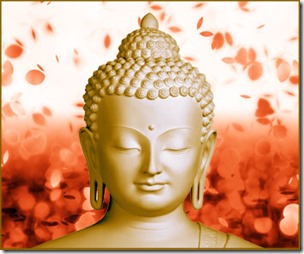 May 6th was celebrated as always, the world over, as the birthday of Shakyamuni Buddha. The Sanskrit word Buddha means “One who is awakened [to the truth].” While the term was widely employed by various schools of the time, it eventually came to be used exclusively in reference to Shakyamuni. At the same time, the word Buddha implies “to bloom.”
 The Search For Enlightenment
Recents Comments