Careful Setting Those Expectations

Careful Setting Those ExpectationsWe all set expectations, of ourselves, of others and of the outcome of situations in our lives.

So it is very easy to be disappointed when those expectations are not met.

What you must remember, is that your happiness is in your own hands, so being unhappy when your hopes and expectations are dashed is your own decision.

In my case, I find that taking some quiet time to examine why I am disappointed solves a lot of these problems. Sometimes my own expectations are set too high, unrealistic even, sometimes the simple acceptance that those expectations are not those of others explains the outcome.

Allowing your expectations of others to be, even in part, the basis of your happiness shows a lack of Wisdom, so learn from the pain, don’t repeat the mistake, and move on.

This is, of course, far easier to say than to do. But to help maintain your happiness, set realistic expectations for yourself and accept that failing to meet those expectations does not mean failing completely.

It’s All About Your Viewpoint

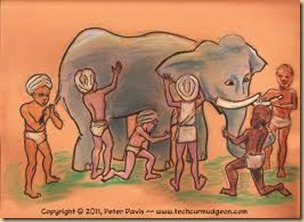
The Blind Men and The ElephantWe all see things in very different ways, mainly because we tend to be restricted by our own viewpoint.

The Buddha used to tell an amusing parable about six blind men and an elephant to explain how the differing views are come by.

Each man has a different idea of what the elephant is, each being able to touch a different part of the animal.

This poem, by John Godfrey Saxe, sums up the scene and explains the moral behind the tale …

It was six men of Indostan
To learning much inclined,
Who went to see the Elephant
(Though all of them were blind),
That each by observation
Might satisfy his mind.
The First approach’d the Elephant,
And happening to fall
Against his broad and sturdy side,
At once began to bawl:
“God bless me! but the Elephant
Is very like a wall!”
The Second, feeling of the tusk,
Cried, -“Ho! what have we here
So very round and smooth and sharp?
To me ’tis mighty clear
This wonder of an Elephant
Is very like a spear!”
The Third approached the animal,
And happening to take
The squirming trunk within his hands,
Thus boldly up and spake:
“I see,” quoth he, “the Elephant
Is very like a snake!”

The Fourth reached out his eager hand,
And felt about the knee.
“What most this wondrous beast is like
Is mighty plain,” quoth he,
“‘Tis clear enough the Elephant
Is very like a tree!”

The Fifth, who chanced to touch the ear,
Said: “E’en the blindest man
Can tell what this resembles most;
Deny the fact who can,
This marvel of an Elephant
Is very like a fan!”

The Sixth no sooner had begun
About the beast to grope,
Then, seizing on the swinging tail
That fell within his scope,
“I see,” quoth he, “the Elephant
Is very like a rope!”

And so these men of Indostan
Disputed loud and long,
Each in his own opinion
Exceeding stiff and strong,
Though each was partly in the right,
And all were in the wrong!

MORAL.

So oft in theologic wars,
The disputants, I ween,
Rail on in utter ignorance
Of what each other mean,
And prate about an Elephant
Not one of them has seen!

John Godfrey Saxe ( 1816-1887)

The 84th Problem

Buddhist WisdomA man once came to see the Buddha to get help with his problems.

After the man had told the Buddha one of his problems and asked for help, the Buddha replied: “I cannot help you get rid of that problem.”

The man was surprised that the Buddha could not help him in this regard, but he told the Buddha about another problem; he thought to himself that the Buddha should at least be able to help him with that problem. But the Buddha told him “I cannot help you with that problem either.”

The man started to get impatient. He said: “How can it be that you are the perfectly Enlightened Buddha, when you can’t even help people get rid of their problems?” The Buddha answered: “You will always have 83 problems in your life. Sometimes a problem will go, but then another problem will come. I cannot help you with that.”

The baffled man asked the Buddha: “But, what can you help me with, then?” The Buddha replied: “I can help you get rid of your 84th problem.” The man asked: “But what is my 84th problem?” The Buddha replied: “That you want to get rid of your 83 problems.”

We all have problems of one nature or another. Buddhism will not remove those problems, but it will help you come to terms with, and solve them by giving you wisdom and allowing you to see those problems in a different light.

Winning, But With The Right Goals

Winning, But With The Right GoalsI had a resounding victory today, and my future will not be the same for it. But we must all take care to set the right goals for ourselves.

Set your goals with care. Whether they are big or small, work towards realising them.

You must be serious and dedicated to your goals – you will never get anywhere if you set them on a whim, or just treat them like a joke.

An earnest, dedicated spirit shines like a diamond and moves the hearts of people. That is because a brilliant flame burns within.

If we are sincere, people will understand our intentions, and our positive qualities will shine forth. It is pointless and destructive to be overly conscious about outward appearances.

As the German poet Johann Wolfgang von Goethe wrote,

“How may one get to know oneself?

Never by contemplation, only indeed by action

Seek to do your duty, and you will know at once how it is with you”

Goals are at the heart of our success, in fact they are the Kyo, and indeed the very basis of Kyo Chi Gyo I. Set your goals with care, and once they are set, aim for them with vigour passion and determination in equal measure.

All It Needs Is Practice

All It Needs Is PracticeNichiren Buddhists believe that, not only does everyone have the World of Buddhahood within them, but that it can be achieved within this lifetime.

Think about that, everyone you know has the potential to reach Buddhahood, your family, friends, work colleagues, everyone. And not only those people you like, but those you don’t like too.

But how do we achieve this state of Buddhahood? The Daishonin had this to say …

“When deluded, one is called an ordinary being, but when enlightened, one is called a Buddha.  This is similar to a tarnished mirror, that will shine like a jewel when polished.

A mind now clouded by the illusions of the innate darkness of life is like a tarnished mirror, but when polished, it is sure it become like a clear mirror, reflecting the essential nature of phenomena, and the true aspect of reality.

Arouse deep faith, and diligently polish your mirror day and night. How should you polish it? Only by chanting Nam Myoho Renge Kyo.”

So there it is, such a simple Practice, so easy to learn, that when applied with faith and diligence, will allow us to reveal the Buddha in each and every one of us.

Your Happiness Is Within You

Your Happiness Is Within YouAnother blissfully happy weekend is nearly over, but let’s not get complacent.

Being happy is not something that we can take for granted, problems can derail our happiness at any time.

But we can take steps to ensure that we are aware of the causes and take steps to resolve and correct the effects.

Sensei summed it up perfectly …

Buddhism teaches that we are each responsible for our own happiness or unhappiness. Our vitality—the amount of energy or “life-force” we have—is in fact the single most important factor in determining whether or not we are happy.

True happiness is to be found within, in the state of our hearts. It does not exist on the far side of some distant mountains. It is within you, yourself. However much you try, you can never run away from yourself. And if you are weak, suffering will follow you wherever you go.

You will never find happiness if you don’t challenge your weaknesses and change yourself from within.

So if you are happy with life at present, be mindful of where that happiness comes from. If you are unhappy, challenge the causes of that unhappiness and make the changes you need to make.

On The Limitation Of Changes

The Limitation Of ChangesMy Buddhist practice has changed the way I interact with everything and everyone in my own personal Universe.

The change is difficult to explain, and even more difficult to prove over the short term to others within that Universe.

Those difficulties are still further compounded by the fact that no matter how radical the change, nothing can change the past.

Like karma, my past was formed from the past causes I made. What I can do, is to try to make better causes now, and in the future. What I can not do, is influence the past.

That limitation is a very real sadness on this journey towards a happier and more enlightened future. But we must always look forward and not let our past get in the way of our path through the present into a brighter future.

Be Determined To Speak Out

The Lotus SutraIt may be amusing listening to the tittle tattle about people, at work or in the pub, but we should all remember that this is a real person we are discussing.

Particularly with Facebook, Twitter and the other social networks in mind, we are all likely to be held to account should we slander someone in public.

Nichiren Daishonin, in his writings to Soya Jiro Hyoe-no-jo Kyoshin, said this about speaking out in defence of slander of The Lotus Sutra …

To hope to attain Buddhahood without speaking out against slander is as futile as trying to find water in the midst of fire or fire in the midst of water.

No matter how sincerely one believes in the Lotus Sutra, if one is guilty of failing to rebuke slander of the Law, one will surely fall into hell, just a single crab leg will ruin a thousand pots of lacquer.

This is the meaning of the passage in the sutra, “Because the poison has penetrated deeply and their minds no longer function as before.”

Nichiren was referring specifically of The Lotus Sutra, but we should speak out against all manner of slander, the likes of which appear to be on the increase in modern life.

Change Can Make Us Better

Life is made of funny stuffLife is made of funny stuff, isn’t it?

I’m currently going through major changes in my life, in my job, where I live, everything.

Now I have been very careful to scrutinise each and every situation, and make educated guesses at what these changes might encompass.

But we can never be sure of the outcome, no matter how carefully we plan. That’s the excitement that life provides, the not knowing.

Going back over your mistakes, asking yourself painful questions and giving honest answers is a difficult, but cathartic experience.

We’ve all made mistakes in life, some more serious than others, but thinking them through, trying to explain why you made that decision at that point in time, makes you re-examine your own values. In my case, having changed through my Buddhist Practice, it also becomes clear that I would have made different decisions in many cases.

Our history is set in stone, we cannot go back and make those decisions anew. But we can try to make amends, apologise for any hurt we have caused, and, above all, be honest with ourselves and others.

The changes in myself, that I see and feel, the way I view life, and my responsibility for events affecting me and people around me, have come about through my Practice and my study of Nichiren Buddhism.

As I have said before, once you see things in a different light, you cannot undo that change. Nor would I want to, because even though I know I will make other mistakes in the future, I know that those mistakes will be made despite honourable intentions, and with a great deal more Wisdom, Courage and Compassion.

Life Changes With Time

Nam Myoho Renge Kyo

Just when you think life is going along smoothly, something, or somebody comes along and upsets the apple cart. Sometimes that can be a bad thing, sometimes, it is exactly what you need to get you out of that rut you feel so comfortable following.

If you research Buddhism, you will find, as with Christianity, that there are many schools or sects, believing much the same basic principles, but with their own embellishments or focus.

When I first became a Buddhist, I was rather naive about the different schools and followed the Kadampa tradition practiced at the Shantideva Buddhist centre in Maidenhead, later moving to Reading.

Kadampa Buddhism focuses on the teachings of Geshe Kelsang Gyatso and the centre of the practice is concentrated on clearing the mind through meditation. The cause of much unhappiness and suffering is due to desirous attachment to property, people or situations, according to Kelsang Gyatso. The way to remove suffering is therefore to break the links of desirous attachment and accept the principle of impermanence.

This is all very well in an eastern third world country, where possessions are few, life is lived at a different pace and everyone, or at least the majority, hold the same beliefs. Here in the west, where Judaeo Christianity is the predominant religion, Kadampa Buddhism only works if you can remove yourself from the mainstream society and immerse yourself in study within one of their centres.

I also felt that the worship of gods within the temple was wrong. Shakyamuni was a man, he never proclaimed to be, or to be connected with, any deity. So where did all these gods spring from. I believe they are the manifestation of the metaphorical gods of The Lotus Sutra, made real by man’s need for a focus of worship. Not for me, this went against my atheist beliefs and lost the focus of the practice in my eyes.

Over time I drifted away from the practice, and it was only when I was suffering because of the breakdown of my marriage, that I sought Buddhism once again. This time, I was lucky, or fortunate as we would say in Buddhism (no such thing as luck), to find Jason Jarrett’s podcasts, and through that, William Woollard’s The Reluctant Buddhist and Eddy Canfor-Dumas’ The Buddha, Geoff and Me.

Immediately, the sense that my own life would be put back in my own hands, that belief was in the self and one’s ability to achieve Buddhahood in this lifetime, struck a chord. At last, a Practice that worked with real life, that answered questions instead of posing several more. A Practice that has helped me more over the last few years, than anything else has done in the past sixty.

There is a letter from Nichiren Daishonin to the wife of the late Matsuno, which describes how unlikely, and how difficult it is to meet the Practice in a lifetime, it is well worth reading and explains just how lucky I have been to find my faith at long last.

Previous Older Entries Next Newer Entries