Instant 80’s Kutai

SiouxsieIn a vain attempt to block out the distractions of the office, I’ve been listening to an 80’s compilation album this morning. Some of the tracks are fillers with no special meaning for me, but some are kutai-tastic and have all the memories flooding back.

Bands like Culture Club, New Order, Bronski Beat, Thompson Twins, Siouxsie and the Banshees, Blondie, Billy Idol, The Stranglers, the list goes on and on and on, and so do the memories.

All sorts of memories came flooding back as the lyrics and notes unlocked them, some good, some not so good.

Only I could see them, but they were as real as were the original experiences. So they exist and they don’t exist all at the same time, and Nichiren Buddhism calls this Ku, short for Kutai. All they need are the right conditions to become manifest, in exactly the same way as our own innate potential does.

Now the morning itself has been consigned to history, as indeed has typing this sentence, but all those memories will remain forever.

November 2013 – Global Meltdown?

Radiation Effects - Click for detailsIn March 2011 I wrote a post asking for thoughts and prayers for Japan in the wake of the huge earthquake. Today I am asking for you to offer prayers for the team of experts who will, at the beginning of November, attempt the clean-up of the Fukushima nuclear plant.

In a horrific ‘damned if we do, damned if we don’t’ scenario, there is a pressing need to remove the spent fuel rods from the cooling pond of reactor no. 4 before another earthquake occurs. The task is unbelievably complex and dangerous and involves moving 400 tonnes of highly irradiated and damaged fuel rods.

The rods, of which there are over 1300, are 4.5 metres long, weigh about 300kg and contain Plutonium, amongst other highly radioactive components. Ordinarily, the process would be monitored by a sophisticated computer controlled safety system, but since the disaster destroyed this, it will have to be done using machines controlled by hand.

When you consider that the total radiation of the rods is equivalent to around 14,000 times that released by the Hiroshima atomic device used in WWII, the scale of the problem becomes clear. Coupled with the fact that there is no form of containment vessel to stop radiation escaping into the atmosphere, this becomes a truly global issue.

Whilst not trying to create any form of panic, I urge you to read an article describing the situation, and maybe share the information contained within it with your friends and families. It is important that the facts about the gravity of this challenging task are widely known. Our thoughts and prayers should be with all those concerned, for all our sakes.

Have Faith

The Lotus SutraBe resolved to summon forth the great power of faith, and chant Nam-Myoho-Renge-Kyo with the prayer that your faith will be steadfast and correct at the moment of death.

Never seek any other way to inherit the Ultimate Law of life and death, and manifest it in your life.

Only then will you realise that earthly desires are enlightenment, and that the sufferings of birth and death are nirvana.

Even embracing the Lotus Sutra would be useless without the heritage of faith.

~ Nichiren

The Wall – Actual Proof

Looking At A WallWith ever increasing mindfulness, our own feelings will change as we reflect on the causes for those feelings.

We know that acting in haste, motivated by anger, disappointment or desperation will result in the causes of unwanted effects.

So when you encounter what appears to be an insurmountable challenge, a wall if you will, you should tell yourself, “Since there is a wall here, a wide open expanse must lie on the other side.”

Rather than becoming discouraged, you should realise that the very fact you are encountering this wall is actual proof of the progress that you have made so far.

So if you find yourself facing such a wall, prepare to strive with all your heart, and you will surely find a way to get to the other side.

Remember To Breathe

BreatheThere will be people reading this, who remember me saying to them, in times of stress, ‘just remember to breathe’. It’s good advice, stopping breathing has been scientifically proven to be bad for us. But seriously, it is all too easy to forget to breathe properly.

When I’m out riding (and I can hear the groans from here) I can actually slow my heart rate at will by moderating my breathing. When you are working at, or close to, your maximum it is easy to start panting. Short sharp breaths into the top of your lungs are rather inefficient.

The trick is to be mindful of this, to slow your breathing, but to take deep full breaths and allow the oxygen to be absorbed into your bloodstream. Your body will have more oxygen at its disposal, your heart will recognise this and will slow accordingly and this is a much more efficient state in which to continue.

I found this poem while I was browsing the subject …

Breathe

If you feel overwhelmed, breathe. It will calm you and release the tensions.

If you are worried about something coming up, or caught up in something that already happened, breathe. It will bring you back to the present.

If you are moving too fast, breathe. It will remind you to slow down, and enjoy life more.

Breathe, and enjoy each moment of this life. They’re too fleeting and few to waste.

~ Leo Babauta

Being mindful of our thoughts or, in this case, our bodies and their processes is an important part of the Buddhist practice. If we are to control our emotions, restrain our darker thoughts, or even supress a propensity to hyper-ventilate, we must be mindful.

Creating some form of trigger, by which we force ourselves to look at our behaviour, will allow us to have more control. How we create that trigger is an individual choice, but it could be visual, audible or simply mental. Whatever you choose, stick with it, you will be rewarded in the fullness of time.

Another Point Of View

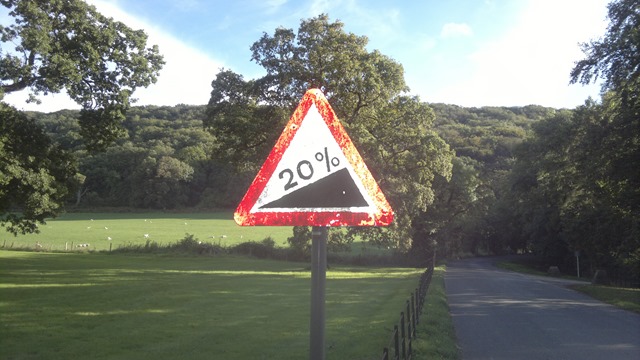
Warning Sign With Creech Hill In The Background - Click For A Larger ImageI am a big believer in trying to see challenges and situations from as many points of view as possible. It is so easy, when involved in situations, to be so preoccupied by our own agenda, that we miss the bigger picture, maybe even the truth of what is really happening.

Now this principle of trying to get a 360° view of things doesn’t have to apply only to emotional challenges, it can apply to any challenge. So today, in order to take a different look at the challenge I set myself yesterday, I decided to ride roughly the same route, but in the opposite direction.

Despite having my legs reminding me that they had undertaken a tough test yesterday, I set off towards Upton and Lychett Minster in the mid afternoon. The sun was warm and the breeze had a welcome cooling effect as I started the slow rise along Grange Road.

It’s a beautiful route, farms and woodland line either side of the road. You pass under a railway bridge, which is the continuation of the Swanage Steam Preservation Society line, though the trains don’t come this far at present.

As I reached Creech Grange, the dreaded 20% incline sign loomed into sight and I knew that the challenge of Creech Hill was just around the corner. Yesterday, travelling in the opposite direction, I had reached a speed of just over 60kph, so maybe that gives a better indication of just how steep the hill becomes.

Anyway, I had set the challenge, the main focus of the challenge was upon me, and I was ready to confront it head on. Most roads, even little B roads like this, don’t usually go from being flat to being steep in one step, usually there is a gradual increase in the incline, but not this one.

Within a few metres I was clicking through my gears, trying to maintain what little momentum I still had, and resisting the temptation to stand on the pedals. Generally speaking, if you remain seated, you get better traction through the back wheel and you don’t have to support your own weight, saving your energy for turning the pedals.

As happened yesterday, a couple of cyclists came past in the opposite direction, shouting encouragement as they went. Metre by metre, step by step, I climbed the hill. Although the ascent is very similar to that from the other side, this is much steeper. Happily, because it is steeper, it is a great deal shorter, so the summit was reached quite quickly.

My heart rate monitor was testament to effort expended, but as the road levelled out, and the amazing views either side revealed themselves, my beats per minute quickly dropped, as did my breathing. The challenge had again been conquered.

The rest of the trip was made in the company of a couple of guys on road bikes, and cycling in company always makes the kilometres fly by. I was home well before the sun had even thought about setting.

My idea to examine my challenge from a different viewpoint was, I feel, very worthwhile. Not only did I get a better impression of the effort involved, but I saw the views along the route from a different, and in some ways, better aspect.

This works for any situation we might find confronting us. More information is always preferable as we search for a solution and seeing things from a number of points of view gives us a better and more rounded understanding of how things really are.

Always Small Steps

The Climb To Grange HillMaking full use of the good weekend weather, I had decided to set myself a challenge and to ride up to the top of Creech Hill, via Old Harry Rocks, Swanage, Corfe Castle and Kimmeridge. On paper, or at least on the map, it looks very easy. On the road, it is a rather different matter.

I’m getting used to the undulations on my usual training route, so there were no surprises between home and the foot of the mount at Corfe Castle. But taking a left off towards Kimmeridge, instead of the right turn back towards Studland took me into a world of uncertainties.

The road to Church Knowle is very picturesque and does have a few ups and downs. St. Peters church, as you might expect, marks the high point of the village and The New Inn looked very inviting as I set off towards Steeple.

The real test, as I found out all too soon, was the climb out of Steeple towards the top of Creech Hill. It starts slowly, but gets steeper and steeper as you go on. I was encouraged on my way by a group of cyclists coming down the hill. They knew what the road had in store for me and urged me to press on.

The trick with tasks like this, for me at least, is to look at the next couple of metres before me. Looking up at the way ahead offers no real help, it simply serves to show you how much work is left to be done. Taking one step at a time is a far more productive method.

Although my legs will probably remind me of the trip in the morning, I completed the route at a reasonable pace and, of course, enjoyed the ride down the other side of Creech Hill, encouraging as I went, others who were making the reverse trip.

The title of this blog, The Search For Enlightenment, in so many ways, documents my own path to Buddhahood, a path that can be just as steep and difficult as the road up Creech Hill. The way to progress along this long and winding path is exactly the same as getting to the top of the hill, one step at a time.

The determination, perseverance and effort for both continue.

It All Happens By Chants

The Lotus SutraBeing a Buddhist in Western society makes you a ‘bit different’, and the curious like to ask questions about the philosophy.

After the initial question “do you chant?” we are then asked “what do you chant?” followed closely by “for how long do you chant?” and then almost certainly “what does it mean?”.

After a little practice, no pun intended, most people can master the phrase Nam-myoho-renge-kyo, but explaining why we chant it, what it means, and how it works may take a little longer.

Here is how the SGI website describes the meaning of the individual parts …

Nichiren Daishonin established the chanting of Nam-myoho-renge-kyo as the way to awaken one’s Buddha nature and tap into the deepest levels of our existence, on which our own lives and that of the universe are one. He first taught the invocation of the phrase to a small group at Seicho-ji temple in Awa province, Japan, on April 28, 1253.

Myoho-renge-kyo is the name of the Lotus Sutra in Japanese pronunciation of classical Chinese characters, and so the literal meaning of Nam-myoho-renge-kyo is “I devote myself to the Lotus Sutra.” As the following explanation shows, there are deeper levels of meaning attached to each element of the phrase.

Nam

Nam derives from the Sanskrit word namu, meaning “to devote oneself.” Nichiren established the practice of chanting Nam-myoho-renge-kyo as a means to enable all people to put their lives in harmony or rhythm with the law of life, or Dharma. In the original Sanskrit, namu indicates the elements of action and attitude, and refers therefore to the correct action one needs to take and the attitude one needs to develop in order to attain Buddhahood in this lifetime.

Myoho

Myoho literally means the Mystic Law–the underlying truth or principle which governs the mysterious workings of the universe and our life from moment to moment. Myo refers to the very essence of life, which is “invisible” and beyond intellectual understanding. This essence always expresses itself in a tangible form (ho) that can be apprehended by the senses. Phenomena (ho) are changeable, but pervading all such phenomena is a constant reality known as myo. Myo also means to open, to revive, and to be fully endowed with the qualities we need to develop our lives.

Renge

Renge means lotus flower. The lotus blooms and produces seeds at the same time, and thus represents the simultaneity of cause and effect. The circumstances and quality of our individual lives are determined by the causes and effects, both good and bad, that we accumulate (through our thoughts, words and actions) at each moment. This is called our “karma.” The law of cause and effect affirms that we each have personal responsibility for our own destiny. We create our destiny and we have the power to change it. The most powerful positive cause we can make is to chant Nam-myoho-renge-kyo; the effect of Buddhahood is simultaneously created in the depths of our life and will definitely manifest in time.

The lotus flower grows and blooms in a muddy pond, and yet remains pristine and free from any defilement, symbolizing the emergence of Buddhahood from within the life of an ordinary person in the midst of the struggles of day-to-day existence.

Kyo

Kyo literally means sutra, the voice or teaching of a Buddha. In this sense, it also means sound, rhythm or vibration. In a broad sense, kyo conveys the concept that all things in the universe are a manifestation of the Mystic Law.

Further explanation of the meaning of Nam-myoho-renge-kyo can be found here.

Back To The Very Basics

The Bodhi TreeEach day, at least twice a day, I chant Nam Myoho Renge Kyo. It is this phrase that encapsulates the very essence of The Lotus Sutra, which itself contains the teachings of Shakyamuni Buddha as refined during his time sitting under the Bodhi tree.

So much philosophy, encompassed in a single phrase, requires some explanation.

The teachings of Shakyamuni, the historical founder of Buddhism, are recorded in an enormous body of texts, known as sutras. The manner in which the philosophy of Buddhism is presented within the sutras varies widely.

This can be explained by a number of factors. During the 50 odd years over which Shakyamuni shared his teachings with the people of his day, he travelled widely throughout India.

Rather than expounding his philosophy in a systematic manner, his teaching mainly took the form of dialogue. Meeting with people from a wide range of backgrounds–from ministers of state to unlettered men and women–he sought to respond to their questions and doubts. Most of all, he sought to provide answers to the fundamental questions of human existence: Why is it that we are born and must meet the inevitable sufferings of illness, aging and death?

The sutras were compiled in the years following the death of Shakyamuni; it is thought that the Lotus Sutra was compiled between the first and second century C.E. In Sanskrit it is known as the Saddharmapundarika-sutra (lit. “correct dharma white lotus sutra”). Like many Mahayana sutras, the Lotus Sutra spread through the “northern transmission” to Central Asia, China, Korea and Japan.

Originally entering China in the third century C.E., the Lotus Sutra is said to have been translated into several different versions of the Chinese, of which three complete versions are extant. The fifth-century translation of Kumarajiva (344-413 C.E.) is considered to be particularly outstanding; its philosophical clarity and literary beauty are thought to have played a role in the widespread veneration of this sutra throughout East Asia.

The title of the Lotus Sutra in Kumarajiva’s translation, Myoho-renge-kyo, contains the essence of the entire sutra, and it was on the basis of this realization that Nichiren (1222-1282 C.E.) established the invocation of Nam-myoho-renge-kyo as his core Buddhist practice.

The Lotus Sutra is considered the sutra that fulfils the purpose for Shakyamuni’s advent in the world, expressed in these words: “At the start I took a vow, hoping to make all persons equal to me, without any distinction between us.” In other words, the purpose of Shakyamuni’s advent was to enable all people to attain the same state of perfect enlightenment that caused him to be known as “Buddha,” or “awakened one.”

The Lotus Sutra contains a number of concepts that were revolutionary both within the context of Buddhist teachings and within the broader social context of the time. Many of these are not stated explicitly but are implied or materialized in the dramatic and even fantastic-seeming events portrayed in the text. Much of the genius of later scholars of the sutra, such as T’ien-t’ai (538-597 C.E.), lay in their ability to extract and systematize these principles.

A core theme of the sutra is the idea that all people equally and without exception possess the “Buddha nature.” The message of the Lotus Sutra is to encourage people’s faith in their own Buddha nature, their own inherent capacity for wisdom, courage and compassion. The universal capacity for enlightenment is demonstrated through the examples of people for whom this possibility had traditionally been denied, such as women and people who had committed evil deeds.

In many sutras a number of Shakyamuni’s senior disciples are condemned as people who have, through arrogant attachment to their intellectual abilities and their self-absorbed practice, “scorched the seeds of their own enlightenment.” The profundity of Shakyamuni’s teachings in the Lotus Sutra, however, awakens in them the spirit of humility and compassion. They realize that all people are inextricably interlinked in their quest for enlightenment, and that if we desire happiness ourselves, it is imperative that we work for the happiness of others.

In this sutra, moreover, Shakyamuni demonstrates that he actually attained enlightenment in the infinite past, not in his current lifetime as had been assumed by his followers. This illustrates, through the concrete example of his own life, that attaining enlightenment does not mean to change into or become something one is not. Rather, it means to reveal the inherent, “natural” state that already exists within.

As President Daisaku Ikeda has said, “The Lotus Sutra is ultimately a teaching of empowerment. It teaches us that the inner determination of an individual can transform everything; it gives ultimate expression to the infinite potential and dignity inherent in each human life.”

Taking Time To Learn

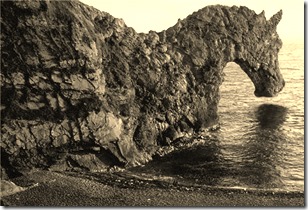
You can lead a horse to water, but you can’t make it drinkYou know the old adage, ‘you can lead a horse to water, but you can’t make it drink’. I believe it means that you can introduce an idea to someone, but you can’t make them accept the suggestion.

So it is with Nichiren Buddhism, or in fact any religion, but let’s talk about Buddhism in this instance.

I have many friends who show an interest in my Practice. They ask lots of questions, often offer their views and sometimes will join me in Daimoku or Gongyo.

I find that the most difficult thing about this, is to feed their inquisitive nature without allowing my own enthusiasm to take over. It is so easy to appear evangelical and that can be a most unattractive trait, particularly for someone who is just taking the first tentative steps.

If you were teaching a child to swim, you wouldn’t take them to the poolside, explain a little about how to do the breast stroke and then push them into the deep end to experience it for themselves. At best, they might flounder their way back to the side, never to ask you for guidance ever again, at worst they might get into real difficulties, need rescuing and develop such a phobia, that they would never go near deep water again.

And so it can be with Buddhism. Like learning to swim, Buddhist practice can open up amazing new vistas on the world and be a life-long pleasure, but it has to be introduced gently, wisely and at the right pace for each and every individual.

To try to rush someone into Buddhism, or swimming for that matter, may be depriving that person of a life-changing journey, so show some wisdom and let them go at their own pace.

Previous Older Entries Next Newer Entries