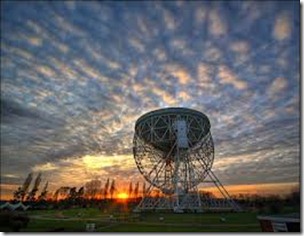
Universal Appeal

Stargazing Live - Jodrell BankWatching Stargazing Live on the BBC over the past three nights has left me feeling comfortable in the knowledge that we are all part of an incredibly beautiful Universe.

Whether the inane comments of David Baddiel left you saddened at the continued ‘dumbing down’ of science programs on the BBC, or not, you could not have failed to be in awe of the wonders on view.

The numbers involved in astronomy are are simply mind blowing, astronomical you might say. The Earth is our own very special piece of rock, orbiting a very ordinary star, but that star is one of billions that we know of up to now. So to imagine that we are the only life in that Universe is little short of preposterous. Just because we haven’t found it, or it found us, doesn’t mean life isn’t out there.

With the Buddhist view of the Wheel Of Life, the cycle of birth, life, death and rebirth, I believe we experience changes in external form, whilst remaining the same ‘packet’ of energy throughout eternity and across the entire Universe. The more science learns about the laws governing energy, be that by way of quantum physics or the nature of astronomical phenomenon, the better the fit with Buddhist teaching seems to become.

Dara O’Briain and the ever popular Professor Brian Cox have again brought us another excellent program about astronomy. Their enthusiasm is infectious, reminding us of the late great Sir Patrick Moore, who will be sadly missed by many viewers. I’ve been keen on astronomy for more than fifty years, and it never ceases to amaze me to see Buddhism and its principles, going hand in glove with a science I love.
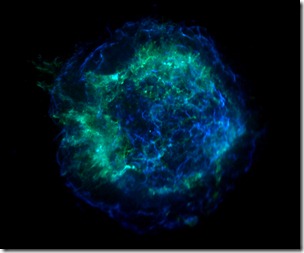
Made Of Stardust

SupernovaWatching the Seven Ages of Starlight on BBC HD tonight, apart from appealing to my enquiring scientific mind, reinforced my Buddhist belief that we are at one with the Universe, being literally made of stardust.

The elements of Hydrogen and Helium, that are involved in the fusion taking place in a star, such as our sun, are the building blocks of all other elements, created as the star collapses under the force of gravity.

This process sometimes creates what we now call a supernova, a huge, intensely bright, but very short lived source of light. This in fact may have been the source of the ‘star’ that guided the Three Wise Men in the Christian religion.

Our bodies are made of a collection of the same elements as those created in the stars, iron, carbon even a little gold, but in essence, we are all stardust. When we die, those elements are returned to the Universe and the cycle goes on.

The Universe is around 13.5 billion years old and the cycle of birth and death has been going on for much of that time. We have come from the Universe, we will go back into the Universe. Science facts for the last few years and Buddhist beliefs for more than two millennia. As I say, science is finally catching up with Buddhism.

A Proper British Bank Holiday

M51They do say that there is no such thing as bad weather, just a bad choice of clothing. But I do think it is a bit sad, that on the last public holiday before Christmas, the heavens decide to open in such a biblical fashion.

After yesterday’s ‘Hedge-gate’ incident, the weather made any further progress impossible. Records show that today was the second wettest day of a very, very wet August, and I can believe that. The rain actually woke us this morning.

So an enforced rest day, not that resting is in Bumble’s vocabulary, so she had to do some ironing. I finished reading ‘The End Of The Affair” by Graham Greene, a rather sad, if thought provoking book, recommended by my friend Jason Michael of Homophilosophicus.

We also managed to fit in a bit of educational telly, Horizon on mapping the universe, a very interesting subject. Whilst I talk about us all being part of the universe, it is difficult to get a mental grip on the astronomical (literally) distances involved.

Without meaning to overstate the obvious, the universe is a really, really big place. However, it does have an end, or rather a spherical outer limit, so what is on the other side of that limit. Well the answer, as far as we know today, is a whole set of other universes.

If you ever wanted a good example to show you just how insignificant, in astronomical terms, the Earth really is, I think we have found one here.

Stargazing

The Great Orion NebulaI love all things astronomical, so I was glued to Stargazing Live tonight with Professor Brian Cox and Dara O’Briain. It’s the second series, and tonight was a perfect star gazing night, cold, clear and moonless. I do feel it is slightly sad that they tend to dumb-down the science, but it’s in a good cause if it entices a few youngsters into the hobby, or even enthuses them enough to want to become a professional astronomer.

After it finished, I rushed out with my own telescope, to have a look around the sky. Venus and Jupiter had already moved past my viewing window, although they were both clearly visible earlier in the evening. However, the constellation of Orion, The Hunter, was almost exactly due south, over the darkest skies out towards Brownsea Island, so I decided to focus on it and take a peek at the Great Orion Nebula.

I’ve seen it before, that little patch in the centre of Orion’s sword, but tonight was so clear, and the sky so dark, that it was wondrous to behold. The gas clouds were clearly visible, and it was easy to pick out the dozens of individual stars that merge together with the gas clouds to form the ‘smudge’ you can see with the naked eye.

It is amazing to think, that the light we see from stars, the twinkle that we so easily take for granted, left those stars hundreds, thousands, even millions of years ago. When we realise the vast expanse of our own universe and the incomprehensible numbers of other universes, it really puts our own planet and lives into true perspective. We really are just a tiny speck in the vast expanse of space, and an almost insignificant part of the whole.

Eternal Faith

Buddha NatureWhen we are open and engaged, we experience the greater self. When we are closed off, we are exhibiting our lesser self. The lesser self is a deluded condition, whilst our greater self is synonymous with our Buddha nature.

To live for the greater self means to recognise the universal principle behind all things and, being awaked in this way, rise above the suffering caused by the awareness of impermanence. A belief in something eternal is needed to enhance our quality of life.

By believing that this world is the be-all and end-all of existence, we will miss out, we will not live a truly profound life. When our viewpoint expands beyond the boundaries of our present existence to include the entire, eternal universe, we can finally live deeply fulfilling lives.

Thunderbolt And Lightening …

Dorset FloodsVery, very frightening … well not really, but the weather today was truly awesome. I’m not quite sure how much rain fell on Ringwood today, but it sounded like most of it fell on our office roof. Our quiet little stream, so calm and idyllic, turned into a raging torrent of chocolate coloured power.
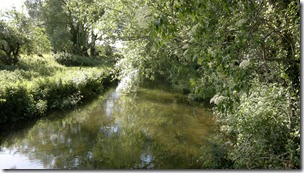
Dorset Floods… Earlier this year

So much for the British summer. Mid August and all day today it looked and felt like November. Dark, cold and threatening, raindrops crashing into the swimming pool we call the office car park. Thunder and lightening crashed all around and meanwhile, just down the road in Bournemouth, people were being rescued from their cars that had become trapped in flash floods.

Earlier today … Dorset Floods

Being part of the Universe, these events should never surprise us. Nature has it’s own way of sending us messages, and today’s was delivered by loud hailer.

Next Newer Entries