 Following on from my post about change yesterday, I thought this may help us to make the changes we wish to see in our lives.
The Nichiren Buddhist teaching of changing karma restores the original Buddhist emphasis on the role of present action changing negative karma. Furthermore, the Nichiren Buddhist concept of karma is unique because it focuses on the fundamental cause of negative karmic retribution and provides the concrete means to change that cause, instead of focusing on the ultimately unknowable negative causes accumulated over one’s infinite past.
Nichiren writes: “The Nirvana Sutra teaches the principle of lessening one’s karmic retribution. If one’s heavy karma from the past is not expiated within this lifetime, one must undergo the sufferings of hell in the future, but if one experiences extreme hardship in this life [because of the Lotus Sutra], the sufferings of hell will vanish instantly. And when one dies, one will obtain the blessings of the human and heavenly worlds, as well as those of the three vehicles and the one vehicle” (WND, 199).
In this passage, Nichiren teaches that our karmic retribution can “vanish instantly” rather than us having to undergo many lifetimes of austerities. In addition, he makes it clear that eradicating our karmic retribution is in itself the “blessing of the one vehicle”, the attainment of Buddhahood.
Chanting With a Fighting Spirit
Nichiren Buddhism teaches that the essential way to change karma is to chant Nam Myoho Renge Kyo with confidence in all people’s potential for Buddhahood. In The Record of the Orally Transmitted Teachings, Nichiren states: “This word ‘belief ‘ is a sharp sword that cuts off fundamental darkness or ignorance… It is through the one word ‘belief ‘ that we are able to purchase the wisdom of the Buddhas of the three existences. That wisdom is Nam myoho renge kyo”.
When we chant Nam myoho renge kyo with the resolve to challenge our fundamental darkness, with confidence in the existence of the sun, we can quickly remove the clouds and reveal the sun. Once the sun of Buddhahood rises in our lives, all of our karmic suffering is reduced to seeming nonexistence. With Nam myoho renge kyo, Nichiren teaches, delusion is transformed into wisdom, unwholesome actions into wholesome actions, and suffering into a source of growth and genuine fulfilment. This transformation of life’s causation from delusion to suffering into wisdom to joy is the meaning of changing karma in Nichiren Buddhism. The key to this fundamental change in the chain of cause and effect within our lives is chanting Nam Myoho Renge Kyo with confidence, with a fighting spirit, creating powerful winds to blow away the dark clouds of delusion and reveal the sun of Buddhahood.
Never Disparaging and Soka Spirit
The Soka Spirit movement is the SGI-USA’s collective and individual efforts to challenge the distortion of Nichiren Buddhism, as seen in the Nichiren Shoshu priesthood, and encourage both self and others to awaken to life’s true potential.
The method and aim of Soka Spirit are the same as those of Never Disparaging, reconfirming people’s dignity through respecting their innate Buddhahood and helping them challenge their fundamental darkness. Both Soka Spirit and the actions of Never Disparaging aim to establish a humanistic religion by challenging authoritarianism, to establish respect for each person by challenging disrespect for ordinary believers perpetrated by religious authority. While the doctrinal importance of the Lotus Sutra is found in the “Expedient Means” and “Life Span” chapters, its importance in terms of Buddhist practice lies in “Never Disparaging,” the twentieth chapter. Nichiren, therefore, writes: “The heart of the Buddha’s lifetime of teachings is the Lotus Sutra, and the heart of the practice of the Lotus Sutra is found in the ‘Never Disparaging’ chapter. What does Bodhisattva Never Disparaging’s profound respect for people signify? The purpose of the appearance in this world of Shakyamuni Buddha, the lord of teachings, lies in his behaviour as a human being” (WND, 851-52).
Proclaiming respect for humanity in the abstract is easy, but to show sincere respect for the person confronting you is difficult, especially if the person is hostile. But this is exactly what Bodhisattva Never Disparaging did. In each person he met, he saw the Buddha nature and expressed his utmost respect through his words and behaviour. His practice, at the same time, was a direct challenge to the great authority and power of arrogant monks in an age of religious corruption.
In the end, respect triumphed over disrespect, as did the Buddha nature over the fundamental darkness. Never Disparaging’s negative karma gave way to the joy of living, and the name given to demean this nameless man became a name of honour in Buddhist history.
(excerpt taken from September 2005 Living Buddhism)
 I offer appreciation to the Shoten Zenjin, the functions in life and in the environment that serve to protect us, and prey that these protective powers may be further strengthened and enhanced through my practice of the Law.
 I offer my deepest praise and most sincere gratitude to the Dai-Gohonzon of the Three Great Secret Laws, which was bestowed upon the entire world.
 I pray that the great desire for kosen-rufu is fulfilled, and that the Soka Gakkai International develops eternally in this endeavour.
 I pray to bring forth Buddhahood from within my life, change my karma and to fulfil my wishes in the present and the future.
 Being a member of the SGI (Soka Gakkai International) sometimes raises questions about who we are, what we do, and why. Soka Gakkai is Japanese for Value Creating Society, and the organisation is dedicated to helping communities and individuals to create value and happiness in their lives.

 “It starts with me! It starts from now!” was the subject of today’s Men’s Division Inspiration Day held at Taplow Court.
 After lunch and chance to talk amongst ourselves about the morning, we made our way to the Mentor-Disciple room in the Manor House. It was my first look at the inside of the house, and it is beautiful. It has been carefully restored and contains a number of period artefacts as well as a multitude of photos and memorabilia of Sensei and the history of the SGI in the UK. After a short period of group chanting, Ricky Baynes the SGI-UK Chief Advisor, who has been practicing for the best part of the fifty years of the SGI in Europe, gave us a history and explanation of the Mentor-Disciple relationship.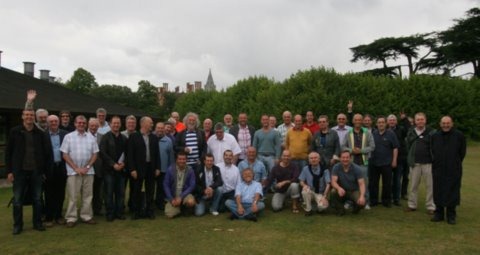



 The Search For Enlightenment
Recents Comments