Gongyo, Daily Respite

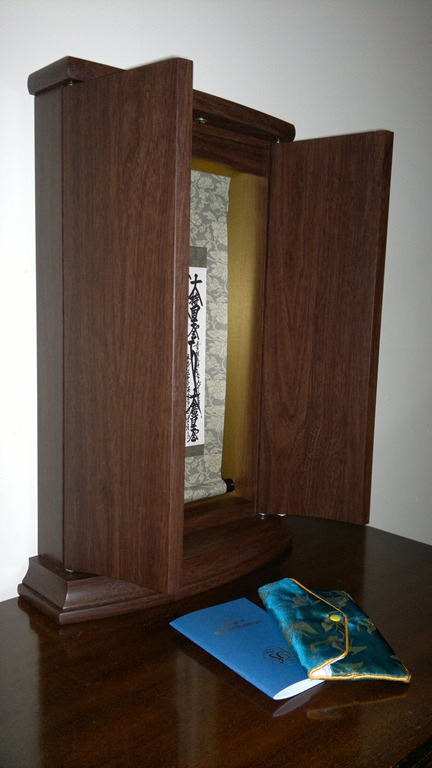
ButsudanThe twice daily chanting of Gongyo is the basis of Nichiren Buddhist Practice.

Reciting two chapters of the Lotus Sutra and chanting Nam Myoho Renge Kyo is my way of moulding my mind, my heart, my very life, towards Buddhahood.

The twice daily routine is not always easy. There are times in the morning when I would rather have a little more time in bed. In the evening, there are times when there are important things to get done, or I am tired. But I Practice all the same.

Before I chant I sometimes focus on a particular problem or situation. Then sitting in front of the Gohonzon I chant, and as I chant I detach myself from the stresses of everyday life and let the repetition of Diamoku still, cleanse, stir and stimulate my heart and mind.

Speaking personally, I look forward to Gongyo. The day hasn’t started till morning Gongyo has been done, and the day is only complete when evening Gongyo is complete.

If there are times when you don’t feel like chanting remember one thing, the only person who loses out if you skip it … is you.

Nam Myoho Renge Kyo.

Secret? What Secret?

Image078It is interesting how people react when they discover that I am a Buddhist.

Some immediately imagine that I wander around in saffron robes going “Om”, others seem to have an idea that Buddhism is a retreat from the reality of life.

Being a practicing Nichiren Buddhist is neither of those things, nor anywhere between the two. And there’s nothing secretive about any of it either. I guess that the only thing that people interested in becoming a Nichiren Buddhist is that, as I found out myself, you have to seek them out, they are unlikely to come looking for you.

One interesting thing about Nichiren Buddhism is that there are no rules, no do’s or don’ts, it is perfectly suited to fit into and around your life and lifestyle, because you make it fit the way you want. Personally, I chant morning and evening every day. If there is something on my mind, I’ll chant longer. or I’ll take myself off for a walk or a drive during the day and chant more often. I would bet there are many, many people who drive the route between Poole and Ringwood every day, who have seen me chanting away while negotiating the traffic. So there are no hard and fast rules, if it works for you, then you are doing it right.

If you follow my blog, you’ll know how much my Practice has changed my life, in so many ways. It is no secret, and anyone can benefit from it, the way I do. If you would like to know more, visit the SGI-UK website or go and take a listen to Jason Jarrett’s podcasts, that’s how I found this ‘secret’.

You Can Lead A Horse To Water

You Can Lead A Horse To WaterYou know the old adage, ‘you can lead a horse to water, but you can’t make it drink’. I believe it means that you can introduce an idea to someone, but you can’t make them accept the suggestion.

So it is with Nichiren Buddhism, or in fact any religion, but let’s talk about Buddhism in this instance.

I have many friends who show an interest in my Practice. They ask lots of questions, often offer their views and sometimes will join me in Daimoku or Gongyo.

I find that the most difficult thing about this, is to feed their inquisitive nature without allowing my own enthusiasm to take over. It is so easy to appear evangelical and that can be a most unattractive trait, particularly for someone who is just taking the first tentative steps.

If you were teaching a child to swim, you wouldn’t take them to the poolside, explain a little about how to do the breast stroke and then push them into the deep end to experience it for themselves. At best, they might flounder their way back to the side, never to ask you for guidance ever again, at worst they might get into real difficulties, need rescuing and develop such a phobia, that they would never go near deep water again.

And so it can be with Buddhism. Like learning to swim, Buddhist practice can open up amazing new vistas on the world and be a life-long pleasure, but it has to be introduced gently, wisely and at the right pace for each and every individual.

To try to rush someone into Buddhism, or swimming for that matter, may be depriving that person of a life-changing journey, so show some wisdom and let them go at their own pace.

Recharging The Batteries

Recharging The BatteriesI was musing today, about the fact that there are no Buddhist bank holidays in the UK. I’m not sure if they have banks in Tibet, but I’m sure if they do, that they have Buddhist bank holidays.

Anyway, with luck, we all have a short respite from work, a time to chant, take stock and to recharge our physical and spiritual batteries.

They have promised us nice weather, so it will probably rain, but even so, we’re at the seaside and because we’re British, we’ll jolly well enjoy ourselves, come rain or shine.

Have a nice break everyone.

Nuclear Energy – Your Choice

Ban The BombWe had a very lively and informative discussion this evening at Jayne and Ken’s.

After Gongyo, the topic under the spotlight was nuclear energy and nuclear weapons, whether either can be regarded as a good thing, and if not, how would we go about reducing and finally removing their use altogether.

Simon chaired the meeting, and came up with some very frightening figures in terms of the number of nuclear warheads still in existence. Some 25,000 by all accounts, enough to destroy all life on this beautiful planet of ours, several times over.

We also discussed the alternatives to nuclear power stations. In the light of the terrible situation in Japan, non of us were very happy with the prospect of building more nuclear power stations in this country, but what are the alternatives?

Wind, wave, solar, even hydrogen powered cars, all were mentioned, but I, playing devil’s advocate, wondered whether any, or all of these actually present a realistic alternative in terms of ‘on demand’ power generation. Of course, reducing our individual power needs would reduce the World’s need for energy. We must all ‘do our bit’.

We came to the conclusion that nuclear is a necessary evil at present, though weapons must go, and that must be accomplished through a change in the public psyche. The acceptance that killing thousands of citizens, whether of a different race, political idealism, or religion is totally wrong. We must show the politicians that we will no longer accept their feeble excuses and explain to them that they are our employees, rather than we, their pawns.

How Things Work

Complicated MoleculesA few people have asked how chanting Nam Myoho Renge Kyo actually works, how it raises my life-energy and puts me in a higher life-state, irrespective of the circumstances.

So how can chanting the title of The Lotus Sutra, without the need for reading or studying it, help me make contact with my Buddha nature?

Well chanting whilst keeping a problem or question in mind brings forth a certain clarity of thought, which has, on occasion, provided solutions or at least peace of mind.

So why don’t we need to understand The Lotus Sutra, chapter and verse, in order to benefit from it’s wisdom? Well, apart from the fact that we do study the major principles that it encompasses, there are a fair number of similarities with complex things in life.

I imagine you have taken painkillers like ibuprofen, a highly complex molecule that took many years to perfect, test and approve. Unless you are a pharmacist or a pharmaceutical chemist, I doubt that you have the slightest idea of how the shape of the molecule blocks the pain receptors in your nervous system. But the tablets work, whether you know, or whether you don’t.

Another good example is the humble motor car. You can drive from Land’s End to John O’Groats without having any knowledge of how an internal combustion engine works or how the friction linings of the brake pads slow the car by turning the kinetic energy into heat in the brake disks.

My point is, that some very clever people have spent many, many years developing complicated medicines or machines. Being able to benefit from them is simple, simply because they are so well thought out. So it is with The Lotus Sutra and chanting Nam Myoho Renge Kyo. Shakyamuni Buddha and Nichiren Daishonin spent many, many years perfecting the Lotus Sutra and Nichiren Buddhism.

The benefit of chanting is ours simply by chanting the title, studying the sutra is not necessary, but is certainly enlightening.

A Legend In My Own Lunchtime

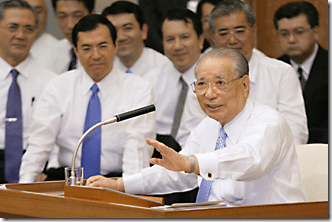
Daisaku IkedaToday was our HQ study meeting, around forty like minded people descended on the sleepy village of Durweston to chant, learn, chat and spend time together.

As usual there were lots of people who seemed to know me, or about me, whose names I instantly forget. I really must sort out some process to stop this happening.

Many familiar faces were there, Ken and Jayne, Boots, Simon and Jack, Thierry and a few of the folks from Salisbury and it’s always a pleasure to meet with them all.

After Gongyo we watched a couple of videos on Sensei’s lectures in Japan and his visit to Hong Kong. It is fifty years since he spread the message of Nichiren Buddhism to Hong Kong and Europe. It was noticeable how formal the lecture was in Japan, everyone dressed the same, responding in the same way and set times, very different to the way things are in the UK. Sensei is such an amazing man, a man who has dedicated his life to spreading the message of Buddhism and Kosen-Rufu.

Then came the nerve wracking bit. Ken had asked me to do a five minute talk on my experience of finding the Practice and a few thoughts on receiving the Gohonzon last week. I think it went ok, and standing in front of a group of friends is not the most daunting prospect. Everyone was very kind, laughed at my little jokes and clapped when it was over.

Later in the day, my initial thoughts were that the speed I have been so readily accepted into the SGI fold has surprised me. A month ago I had no Buddhist friends at all and yet here I am, the topic of conversation all over the area and having already received Gohonzon. Very humbling, but very nice to be part of such a friendly and dedicated group. I hope I can live up to expectations and, more importantly, give back to the group as much, or more, support as they have given me.

So the legend bit is obviously very tongue in cheek, but I would like to thank everyone for making me feel so welcome.

Nam Myoho Renge Kyo

Why A Nichiren Buddhist

Nam Myoho Renge KyoIf you research Buddhism, you will find, as with Christianity, that there are many schools or sects, believing much the same basic principles, but with their own embellishments or focus.

When I first became a Buddhist, I was rather naive about the different schools and followed the Kadampa tradition practiced at the Shantideva Buddhist centre in Maidenhead, later moving to Reading.

Kadampa Buddhism focuses on the teachings of Geshe Kelsang Gyatso and the centre of the practice is concentrated on clearing the mind through meditation. The cause of much unhappiness and suffering is due to desirous attachment to property, people or situations, according to Kelsang Gyatso. The way to remove suffering is therefore to break the links of desirous attachment and accept the principle of impermanence.

This is all very well in an eastern third world country, where possessions are few, life is lived at a different pace and everyone, or at least the majority, hold the same beliefs. Here in the west, where Judaeo Christianity is the predominant religion, Kadampa Buddhism only works if you can remove yourself from the mainstream society and immerse yourself in study within one of their centres.

I also felt that the worship of gods within the temple was wrong. Shakyamuni was a man, he never proclaimed to be, or to be connected with, any deity. So where did all these gods spring from. I believe they are the manifestation of the metaphorical gods of The Lotus Sutra, made real by man’s need for a focus of worship. Not for me, this went against my atheist beliefs and lost the focus of the practice in my eyes.

Over time I drifted away from the practice, and it was only when I was suffering because of the breakdown of my marriage, that I sought Buddhism once again. This time, I was lucky, or fortunate as we would say in Buddhism (not such thing as luck), to find Jason Jarrett’s podcasts, and through that, William Woollard’s Reluctant Buddhist.

Immediately, the sense that my own life would be put back in my own hands, that belief was in the self and one’s ability to achieve Buddhahood in this lifetime, struck a chord. At last, a Practice that worked with real life, that answered questions instead of posing several more. A Practice that has helped me more over the best part of a year, than any other practice has done in the past fifty years.

I wish I was like Ken, Jayne, William, Eddy and many, many others, who found Nichiren Buddhism ten, fifteen, twenty or more years ago. My life would have been completely transformed, and I believe, entirely for the better. There is a letter from Nichiren Daishonin to the wife of the late Matsuno, which describes how unlikely, and difficult it is to meet the Practice in a lifetime, it is well worth reading and explains just how lucky I have been to find my faith at last.

A Friend In Need

FallingSometimes we all need a little of bit of peace and quiet, a chance to get a few things straight in our mind. Tonight was one of those moments, so I took a stroll down to the beach and stood listening to the waves lapping over the sand. I say listened because it was pitch black, only a clear crescent moon and a billion stars lighting the scene.

I let the peace permeate my train of thought and waited.

Nothing. This nutty little problem obviously needs a fair bit more consideration, so I climbed the steps back to the quay and made my way slowly back to the apartment.

It’s very quiet around here and the lights are just bright enough to show the way home. Although the question was playing around my brain, I was relaxed and completely unprepared for what happened next.

The lobby is dark and as I opened the front door I had the shock of my life. There, lying face down at the foot of the stairs, was one of the neighbours. I think I let out a sort of startled squeak because it was so unexpected.

Anyway, enough of the dramatic preamble. The guy was in a bit of a state, he had clearly had a few drinks, but he had also had a nasty fall. His keys and his twisted sunglasses were lying on the carpet next to his head. His legs and feet were tucked up under him and although he was trying to get up, he was unable to do so.

I put the lights on and bent down and helped him to his feet. He was very shaken and had a nasty graze on his forehead. Having picked up the glasses and keys, I took his arm and helped him back up the stairs. He fumbled with his keys and finally opened his front door and having thanked me, over and over, for helping him, started to go inside.

I asked him, several times, whether he was ok, whether he wanted me to call a doctor, he had bumped his head quite badly. He said he was fine, but he was clearly shaken up. I really felt I should make sure he was ok, but also felt that pressing the point would further embarrass him, so I let him go. I’ll pop down to check on him in the morning.

The feeling of compassion for this fellow took me by surprise. I think it is yet another example of how my Practice is changing the way I am, the way I act, the way I feel.

P.S. I have checked today and he’s fine, apart from a bruise on his bonce and maybe dented pride.

Why The Gohonzon Is My Honzon

The Enshrined GohonzonOver the life of this blog, you will see that my Buddhist Practice has become, more and more, the centre of my life.

Having my Practice as the centre, as my Honzon, as my anchor is a very liberating state of affairs. At the centre of that Practice is my recently enshrined Gohonzon making it the absolute centre and the pivot, around which, my whole life now revolves.

Of course, the centre of many people’s lives are their partners, their children, their families and that is perfectly acceptable, but does mean that their anchor not fixed, it is ever changing. These changes can be a major source of unhappiness. How often have we seen the elderly couple, totally devoted to each other, that when one of them dies, the other goes soon after.

Having Buddhism and my Practice as my Honzon doesn’t mean that my family and friends mean any less to me, but it does mean that as situations change, as problems arise, my anchor remains firm and I can cope with those challenges all the better.

Maybe that’s not for everyone, it does take a conscious effort to make the change, but for me, the effort is repaid many, many times over by the feeling of constancy in my life.

Previous Older Entries Next Newer Entries