A Great Role Model

BuddhaThe purpose for, and the reason behind my Buddhist Practice is to bring me closer to Buddhahood, each and every day.

That is to say, to emulate, as closely as possible, the Buddha himself in the way he was able to see life and all things in a pure clarity.

Siddhārtha Gautama was a man, albeit a prince, who forsaking his life of comfort and position, went out into the world to meditate on the causes of, and ways to reduce or remove, the suffering of life.

In Nichiren Buddhism we learn about the Ten Worlds, from Hell to Buddhahood.

The Buddha state originates from the very depths of life, called the amala consciousness, meaning the fundamentally pure life force or consciousness. The function of the Buddha state is to bring out the positive side of the other nine worlds.

This principle of the Ten Worlds shows that the Buddha state is a naturally occurring condition of life in every living being. The purpose of Buddhist practice is to enable us to cause the Buddha state to appear; to have it working strongly in us.

In Nichiren Buddhism, therefore, the Buddha is not some perfect, ideal being, but is rather an ordinary person living in rhythm with the law of the universe, taking wise, courageous and compassionate action for the benefit of others, through the functioning of the nine worlds in daily life.

The more I practice, the closer I come to Buddhahood, a very positive thought for today.

The Meaning Of NMRK

Nam Myoho Renge KyoEvery day, twice a day, I chant Nam Myoho Renge Kyo. You see it on the headline banner of my blog and I mention it often. I thought it would be beneficial for me to revisit the meaning and I would like to share it with you. This explanation and definition comes from the Sokka Gakkai Dictionary of Buddhism.

[南無妙法蓮華経] Nam-myoho-renge-kyo

The ultimate Law or truth of the universe, according to Nichiren’s teaching. Nichiren first taught the invocation of Nam-myoho-renge-kyo to a small group of people at Seicho-ji temple in his native province of Awa, Japan, on the twenty-eighth day of the fourth month in 1253. It literally means devotion to Myoho-renge-kyo. Myoho-renge-kyo is the Japanese title of the Lotus Sutra, which Nichiren regards as the sutra’s essence, and appending nam (a phonetic change of namu ) to that phrase indicates devotion to the title and essence of the Lotus Sutra. Nichiren identifies it with the universal Law or principle implicit in the meaning of the sutra’s text.

The meaning of Nam-myoho-renge-kyo is explained in the opening section of The Record of the Orally Transmitted Teachings, the record of Nichiren’s lectures on the Lotus Sutra compiled by his disciple and successor, Nikko. It states that namu derives from the Sanskrit word namas and is translated as devotion, or as “dedicating one’s life.” What one should dedicate one’s life to, he says, are the Person and the Law. The Person signifies “Shakyamuni,” which means the eternal Buddha, and the Law is “the Lotus Sutra,” which means the ultimate truth, or Myoho-renge-kyo. According to Orally Transmitted Teachings, the act of devotion (namu) has two aspects: One is to devote oneself to, or fuse one’s life with, the eternal and unchanging truth; the other is that, through this fusion of one’s life with the ultimate truth, one simultaneously draws forth inexhaustible wisdom that functions in accordance with changing circumstances.

Orally Transmitted Teachings further states: “We may also note that the nam of Nam-myoho-renge-kyo is a Sanskrit word, while Myoho-renge-kyo are Chinese words. Sanskrit and Chinese join in a single moment to form Nam-myoho-renge-kyo. If we express the title [of the Lotus Sutra] in Sanskrit, it will be Saddharma-pundarika-sutra. This is Myoho-renge-kyo. Sad (a phonetic change of sat ) means myo, or wonderful. Dharma means ho, Law or phenomena. Pundarika means renge, or lotus blossom. Sutra means kyo, or sutra. The nine Chinese characters [that represent the Sanskrit title] are the Buddha bodies of the nine honoured ones. This expresses the idea that the nine worlds are none other than the Buddha world.”

Myo stands for the Dharma nature, or enlightenment, while ho represents darkness, or ignorance. Together as myoho, they express the idea that ignorance and the Dharma nature are a single entity, or one in essence. Renge stands for the two elements of cause and effect. Cause and effect are also a single entity.”

Kyo represents the words and voices of all living beings. A commentary says, ‘The voice carries out the work of the Buddha, and it is called kyo.’ Kyo may also be defined as that which is constant and unchanging in the three existences of past, present, and future. The Dharma realm is myoho, the wonderful Law; the Dharma realm is renge, the lotus blossom; the Dharma realm is kyo, the sutra.”

As Nichiren states, namu derives from Sanskrit, and Myoho-renge-kyo comes from Chinese. Nam-myoho-renge-kyo is, therefore, not simply a Japanese phrase, but a Japanese reading of a Sanskrit and Chinese phrase. In this sense, it contains aspects of the languages of three countries in which Mahayana Buddhism spread. According to Nichiren’s treatise The Entity of the Mystic Law, Nan-yüeh and T’ient’ai of China and Dengyoof Japan recited the invocation meaning devotion to the Lotus Sutra of the Wonderful Law, or Nam-myoho-renge-kyo, as their private practice, but they did not spread this practice to others.

In On the Three Great Secret Laws, Nichiren states that the daimoku Nichiren chants today in the Latter Day of the Law is different from that of the previous ages—the daimoku T’ient’ai and others chanted in the Former Day and Middle Day of the Law—because the practice of daimoku in the Latter Day of the Law involves chanting it oneself and teaching others to do so as well. Nichiren not only established the invocation (daimoku) of Nam-myoho-renge-kyo but embodied it as a mandala, making it the object of devotion called Gohonzon. In Reply to Kyo’o, he states, “I, Nichiren, have inscribed my life in sumi ink, so believe in the Gohonzon with your whole heart. The Buddha’s will is the Lotus Sutra, but the soul of Nichiren is nothing other than Nam-myoho-renge-kyo” (412).

Basics Of Buddhism

Basics Of BuddhismOn a glorious day, beautiful sunshine, it was perfect for a nice bit of learning. So often lately it has been pleasant all week and disappointing at the weekend, but not today, albeit that I’ve started mine a day early. So I’ve spent the majority of the the day out on the balcony, re-reading Pat Allwright’s ‘Basics Of Buddhism’. Much of it naturally reiterates what I already know, but it never hurts to go back over the basics. So much wisdom packed into such a little book.

To quote the opening page,

“If you wish to free yourself from the sufferings of birth and death you have endured through eternity and attain supreme enlightenment in this lifetime, you must awaken to the mystic truth which has always been within your life” -Nichiren Daishonin

It is quite a powerful statement with which to start a book, but as I know to my own benefit, the teachings within are just that powerful and could be the basis for a happier and more enlightened life for all of us.

We are, I believe, all Buddhists at heart, that is why, as Allwright says,

“People who hear about it [Buddhism] for the first time often remark ‘I always thought that anyway’. This is because ultimately, we all know the Universal Truths, but have become separated from them. The adventure into the inner self is an endless journey of discovery, insight and joy.”

I could not agree more.

And as if to prove that you must make the most of the positives while they present themselves, the heavens opened just as I packed everything away to come back inside. Well they do say that fortune favours the brave.

Namaste ~ Anupadin

Ke, Ku And Chu – The Middle Way

This Way, That Way, The Middle WayWe are all aware that life is made up of two components, the physical (ke or ketai) and the spiritual (ku or kutai).

They are separate, but joined, two, but not two (shikishin funi) and cannot exist one without the other.

The body or physical aspect becomes useless without the mind, or spiritual aspect, and the mind is helpless without the body.

The mind however, can continue to function without the body, when we sleep for example. We have all experienced dreams where we perform feats that would be totally impossible in the physical world, like being able to fly.

So we have two rather different components, maybe working in a way that is not necessarily harmonious, until chu (or chutai) takes control.

Chu is the harmonisation of ke and ku. It controls each aspect, making sure one or the other doesn’t drag us off course. This is known as The Middle Way (chudo).

Nichiren Buddhism – The Gohonzon

What is the Gohonzon?
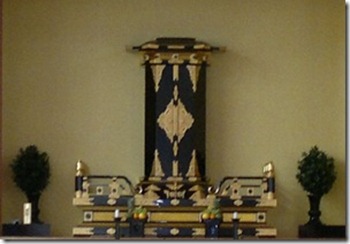
The Butsudan At Taplow Court - SGI-UK HeadquartersThe Gohonzon is the prime point of faith, practice and study in Nichiren Buddhism.

It provides us with a correct model or standard of faith and practice for our time. It usually takes the form of a paper scroll, with Chinese and Sanskrit characters printed on it in black ink.

It is kept in a protective box, or butsudan. The area around the Gohonzon often has offerings of light (in the form of candles), evergreen, incense, water, and fruit. You may also see other offerings, and items like a bell around the butsudan.

In Reply to Kyo’o the Daishonin writes,

“I, Nichiren, have inscribed my life in sumi ink, so believe in the Gohonzon with your whole heart.”

Although the Gohonzon takes the form of a paper scroll, it is vital that when we are chanting to it, it is not seen as outside one’s life. It is through our chanting to the ‘external’ Gohonzon in the butsudan, that we activate all the forces and functions within our own lives.

Nichiren Daishonin began to inscribe the Gohonzon for his followers around the time of his exile to Sado in 1271. He wanted to establish an object of fundamental respect which would enable anyone chanting to it to awaken the Buddhahood in their lives, and to experience the same life state as he did. Nichiren Daishonin provided us with the means to draw out the state of Buddhahood inherent in life.

The word ‘Gohonzon’ is translated into English as ‘object of fundamental respect’. ‘Go’ is an honorific prefix, and ‘honzon’ means what it is that we base our lives on.

Nichiren Daishonin was aware of the difficulty people had in believing that the life state of the Buddha could exist in their lives, and then how hard it is to manifest it. His writing The Object of Devotion for Observing the Mind [WND p354] is in the form of a dialogue which strives to persuade the listener that if all the other nine worlds can be perceived in one’s life, then Buddhahood must be too. He inscribed the Gohonzon for individuals so that they would have a constant reminder of the eternal law, the cause for this life state, and which would serve as a focus for their daily practice, as well as functioning as the external cause for drawing out Buddhahood and revealing their greater self.

It is not necessary to be able to read or understand the characters on the Gohonzon in order to experience benefit from chanting to it. The Daishonin used script or calligraphy for the Gohonzon because he wanted the Gohonzon to be a universal mirror, free of the connotations of race and gender inherent in pictures or images.

The Calligraphy on the Gohonzon

The Gohonzon is sometimes described as a ‘mandala’, a word used in the East to describe an object in which Buddhas and bodhisattvas are depicted or on which a philosophical doctrine is expressed. Originally it meant a circle drawn in the earth around the place where a religious ceremony was to take place. The circle embraced all the people who participated in the ceremony, and was believed to protect them from negative influences. The word mandala was rendered in Chinese as ‘perfectly endowed’ or ‘cluster of blessings’.

Using Chinese calligraphy, Nichiren Daishonin put the characters Nam-myoho-renge-kyo Nichiren boldly down the centre of the Gohonzon. This represents the oneness of the Person and the Law. In other words, the ordinary person is the Buddha, and the Mystic Law is inherent in each living being. He then surrounded these characters with the names of people referred to in the Lotus Sutra, such as Shakyamuni Buddha and Many Treasures and others. All the characters represent an aspect of life, whether as a protective function, or as a representative of the ten worlds, and all are illuminated by the Law of Nam-myoho-renge-kyo.

In the writing The Real Aspect of the Gohonzon Nichiren Daishonin explains why he placed the particular characters where he did. The blueprint for the Gohonzon was the description in the Lotus Sutra of the Ceremony in the Air, when a great jewelled Treasure Tower emerged out of the earth, and many Buddhas and bodhisattvas gathered to hear the Buddha Taho (or Many Treasures) confirm the truth that Shakyamuni had taught – that we all have the potential to reveal our Buddha nature in our daily life, as we are. This story in the Lotus Sutra represented the emergence of the state of Buddhahood in countless peoples’ lives, called Bodhisattvas of the Earth (the people who promised to propagate Nam-myoho-renge-kyo at the time we now live).

Shakyamuni described the dramatic events of the Tower emerging from out of the ground and reaching high into the sky. It was encrusted with precious gems and was intended to represent life with all its mystic and wonderful qualities. As it halted, floating in the air, the doors of the Tower opened and the Buddha Many Treasures was seen sitting inside. This Buddha invited Shakyamuni to enter and sit in the place of honour on Many Treasures’ right hand side. As we look at the Gohonzon, then, it is as if Shakyamuni and Many Treasures are in the Tower looking out at us and all the other characters on the Gohonzon. Then the Buddhas lifted the tower and the assembled company into the air, in what is known as the Ceremony in the Air, an event not limited to any particular time or place. When we look at the Gohonzon in this way, we realize that we are among the Bodhisattvas of the Earth. Through chanting to the Gohonzon, we are participating in the Ceremony in the Air, just as described in the Lotus Sutra.

The Gohonzon is said to contain all aspects of life, so it includes not just the positive and value creating qualities of life represented by the Buddha’s good disciples, but also examples of evil and destruction. For instance the representative of fundamental darkness, the Devil King of the Sixth Heaven is also included on it, although he too is bathed in the transforming power of Nam-myoho-renge-kyo and revealing his enlightened rather than his negative aspects.

The four corners of the Gohonzon each contain a Heavenly King, a character that represents the protective forces of the universe. Between these, in the middle of each side, and written in Sanskrit calligraphy are the characters Aizen (or Craving Filled) on the left as we look at the Gohonzon and Fudo (or Immovable) on the right, who represent the principles that `earthly desires are enlightenment` and `the sufferings of birth and death are nirvana`, respectively. Nichiren Daishonin’s teachings enable us to transform our desires and our sufferings into enlightenment, rather than having to deny them.

Practising with the Gohonzon

Nichiren Daishonin teaches that the Gohonzon enables us to see the ten worlds in our lives, in other words, that we have Buddhahood, and can use it. It is easy to see the lower life states, and to have the illusion that we can never be like the Buddha. The Gohonzon is described as a clear mirror which shows the law of Nam-myoho-renge-kyo and all its manifestations in the different life states, revealing their enlightened qualities.

The way to practise is to have the attitude while we are chanting that we are in no way different or separate from the eternal Law of Nam-myoho-renge-kyo, or the Buddhas who are enlightened to that Law. The key is to praise one’s inherent Buddhahood and then go out into the world and practise as a bodhisattva, treasuring others, encouraging them to experience their Buddhahood too.

Through studying Nichiren Daishonin’s writings and awakening the wisdom we have within our lives, we become alive with the qualities of the Buddha state that are embodied in the Gohonzon. At the same time, we develop a natural desire to change our lives so that we bring out more and more consistently the condition of Buddha revealed by the Gohonzon. The more we practise with this desire to change, the more our lives and Nichiren Daishonin’s life-state embodied in the Gohonzon become as one.

This is a gradual process. When we practise to the Gohonzon, Nichiren Daishonin said we are simultaneously in the state of Buddhahood or enlightenment, but we cannot easily discern that life condition with our minds; therefore we do not always act accordingly. However, through our constant relationship with the Gohonzon, we gradually challenge and overcome the influence of negativity arising from our karma. As we open up our hearts we can begin to experience all those qualities of Buddhahood working naturally and vibrantly inside us and affecting everything that we think and say and do.

President Ikeda has recently described the process as this:

“When we chant Nam-myoho-renge-kyo while practising for ourselves and others, with the Gohonzon of Nam-myoho-renge-kyo manifested by the Buddha as our clear mirror, and with deep confidence in the Gohonzon existing in our own lives, Myoho-renge-kyo within us resonates with the Myoho-renge-kyo outside us, and the world of Buddhahood emerges within us.”

[World of Nichiren Daishonin’s Writings Part 12]

How NMRK Works

The Ibuprofen MoleculePeople have often asked me, how chanting Nam Myoho Renge Kyo actually works, how it raises my life-energy and puts me in a higher life-state, helps me win, irrespective of the circumstances.

So how can chanting the title of The Lotus Sutra, without the need for reading or studying it, help me enhance the everyday contact with my Buddha nature?

Well chanting, whilst keeping a problem or question in mind, brings forth a certain clarity of thought, which has, on occasion, provided solutions or at least peace of mind.

So why don’t we need to understand The Lotus Sutra, chapter and verse, in order to benefit from it’s wisdom? Well, leaving aside the fact that we do study the major principles that it encompasses, there are a fair number of similarities with complex things in life.

I imagine you have taken painkillers like ibuprofen, a highly complex molecule that took many years to perfect, test and approve. Unless you are a pharmacist or a pharmaceutical chemist, I doubt that you have the slightest idea of how the shape of the molecule blocks the pain receptors in your nervous system. But the tablets work, whether you know, or whether you don’t.

Another good example is the humble motor car. You can drive from Land’s End to John O’Groats without having any knowledge of how an internal combustion engine works or how the friction linings of the brake pads slow the car by turning kinetic energy into heat in the brake disks.

My point is, that some very clever people have spent many, many years developing complicated medicines or machines. Being able to benefit from them is easy, simply because they are so well thought out. So it is with The Lotus Sutra and chanting Nam Myoho Renge Kyo. Shakyamuni Buddha and Nichiren Daishonin spent many, many years perfecting the Lotus Sutra and Nichiren Buddhism.

The benefit of chanting is ours simply by chanting the title, studying the Lotus Sutra is not necessary, but is certainly enlightening.

It Works For Me

God And Man - Not For Me Thank YouSo many World Religions base their beliefs on a God, a Supreme Being, a Creator or an Entity whose existence is the focus of the religion’s belief. That God, or the followers of him (it’s usually a male god) have set down the laws or rules to tell the followers how to live their lives. The God is almost always the only true god, whose word is law and whose actions and will are unquestionable.
As a confirmed Atheist, that focus never sat comfortably in my psyche. I don’t think anyone really believes in a white haired old man sitting in the clouds these days, but there are millions of people who base their faith on a Being whose existence cannot be proven. In fact, many religions actively seek to dissuade followers from even trying to prove that existence.

I was schooled in the Sciences, Mathematics, Physics, Chemistry and Biology as well as Psychology, and those sciences demand proof for each and every hypothesis. So when I stumbled, and that is the right way to describe it, upon Nichiren Buddhism, I was overjoyed to find that there was no supreme being and that every part of Practice demands we examine the results of that Practice as proof of it’s validity.

Nichiren Daishonin said that we should seek proof of the effectiveness of our Practice in the results it brings. He also says that if the results do not support the practice, that we should desist.

I don’t want anyone to think that I am putting Nichiren Buddhism above or before any other religion, I am only saying that, for me, it fits my thinking and for me, it works. I have been practicing a little while now, but I’m still learning new things every day, and the results have been amazing so the proof is there for me, and others to see.

Nichiren Buddhism – The Purest?

Nichiren Buddhism - The Purest?Apparently, I was told yesterday, Nichiren Buddhists consider their faith to be the purest of all the Buddhist sects. Although this did stir a vague memory, and an explanation about Nichiren Buddhism being based on The Lotus Sutra and not having any gods, demons and hungry ghosts, such as are part of the New Kadampa Tradition, I thought I should investigate further.

Nichiren Shonin, as he was known in the early years, gave his first sermon to commemorate the completion of his studies to his master and fellow monks. In this sermon he shocked his audience by criticising the then popular form of Buddhism known as Pure Land. The Pure Land movement taught that Buddhahood could only be attained, after death in a heavenly pure land, by chanting the name of the Buddha of Infinite Light.

In place of this practice, Nichiren taught the practice of chanting the “Great Title” (daimoku) of the Lotus Sutra, which is Nam Myoho Renge Kyo. He taught the chanting of daimoku as a practical and accessible way in which all people can realise the deepest truths of Buddhism.

He argued that, just as the name of a country can bring to mind all the characteristics of that country, so the title of the Lotus Sutra embodies all the merits and virtues of the Buddha expounded in the sutra. Nichiren taught that by chanting the daimoku, we can directly receive the ultimate truth of the Lotus Sutra from Shakyamuni Buddha and attain Buddhahood within our lifetime.

So maybe the claim about Nichiren Buddhists having the purest of faiths stems from the manner in which Nichiren stripped away all the embellishments of the other sects, to get back to Shakyamuni Buddha’s original teachings. This is not to say that these embellishments are without worth, but more that the simpler (purer) practice was accessible to many more people of lower status.

Thinking of our practice as purer, truer, better even, is not a very Buddhist way of looking at things. We should look at all aspects of all matters from all angles and without bias or preconceived ideas, in an enlightened manner you might say.

To use an modern idiom, we might say that Nichiren Buddhism is Buddhism Lite. It has all the core beliefs and the fundamentals of the philosophy without the adornments, the bells and whistles, that others sects have incorporated into their practice.

Before any argument or criticism ensues, I am not putting this idea forward as any form of value judgement, just my thoughts and ideas, from my mostly unenlightened view point. I have seen other sects from inside and out, I simply prefer the atheistic approach and the simple and accessible practice.

Nam Myoho Renge Kyo

Tell me, what do you think you would do then?

And Then There Were Three ~ GenesisWhen life gets a little messy, I tend to go for familiar things from life, things that help me feel more comfortable. While working from home today, I took the opportunity to listen to some classic, and very familiar music, the Genesis album, And Then There Were Three, released in 1978.

I have loved Genesis since seeing their inaugural tour way back in 1969 and can still remember the dismay when Peter Gabriel left the band. He was such a figurehead, being the lead singer, we wondered whether the band could survive. And Then There Were Three answered that question, and is still one of my favourite albums.

Maybe because of my heightened sense of awareness, maybe because I am looking for meaning in events, I don’t know, but suddenly a set of lyrics that I have known for thirty five years, seemed more relevant than they had ever been before …

Undertow

The curtains are drawn
Now the fire warms the room.
Meanwhile outside
Wind from the north-east chills the air,
It will soon be snowing out there.

And some there are
Cold, they prepare for a sleepless night.
Maybe this will be their last fight.

But we’re safe in each other’s embrace,
All fears go out as I look on your face –

Better think awhile
Or I may never think again.
If this were the last day of your life, my friend,
Tell me, what do you think you would do then?

Stand up to the blow that fate has struck upon you,
Make the most of all you still have coming to you,
Lay down on the ground and let the tears run from you,
Crying to the grass and trees and heaven finally on your knees

Let me live again, let life come find me wanting.
Spring must strike again against the shield of winter.
Let me feel once more the arms of love surround me,
Telling me the danger’s past, I need not feel the icy blast again.

Laughter, music and perfume linger here
And there, and there,
Wine flows from flask to glass and mouth,
As it soothes, confusing our doubts.

And soon we feel,
Why do a single thing to-day,
There’s tomorrow sure as I’m here.

So the days they turn into years
And still no tomorrow appears.

Better think awhile
Or I may never think again.
If this were the last day of your life, my friend,
Tell me, what do you think you would do then?

Stand up to the blow that fate has struck upon you,
Make the most of all you still have coming to you,
Lay down on the ground and let the tears run from you,
Crying to the grass and trees and heaven finally on your knees

Let me live again, let life come find me wanting.
Spring must strike again against the shield of winter.
Let me feel once more the arms of love surround me,
Telling me the danger’s past, I need not feel the icy blast again.

~ Tony Banks 1978

Genesis have provided much of the soundtrack for my life, sometimes happy, sometimes not so happy. Now Nichiren Buddhism is providing the anchor, the Honzon of my life and between the two, I am striving to pull things back together again and move forward.

Maintain Your Faith, Become Enlightened

Nichiren DaishoninThe title and the very purpose of this blog, is to record events that accompany me along my path to enlightenment. Far from being a pipe dream or vague wistful notion, Nichiren Daishonin set out the very simple, practical method for attaining enlightenment, and hence Buddhahood, within this lifetime.

This letter was written to Toki Jonin in the seventh year of Kencho (1255).

“If you wish to free yourself from the sufferings of birth and death you have endured since time without beginning and to attain without fail unsurpassed enlightenment in this lifetime, you must perceive the mystic truth that is originally inherent in all living beings. This truth is Myoho-Renge-Kyo. Chanting Myoho-Renge-Kyo will therefore enable you to grasp the mystic truth innate in all life.

The Lotus Sutra is the king of sutras, true and correct in both word and principle. Its words are the ultimate reality, and this reality is the Mystic Law (Myoho). It is called the Mystic Law because it reveals the principle of the mutually inclusive relationship of a single moment of life and all phenomena. That is why this sutra is the wisdom of all Buddhas.

Life at each moment encompasses the body and mind and the self and environment of all sentient beings in the Ten Worlds as well as all insentient beings in the three thousand realms, including plants, sky, earth, and even the minutest particles of dust. Life at each moment permeates the entire realm of phenomena and is revealed in all phenomena. To be awakened to this principle is itself the mutually inclusive relationship of life at each moment and all phenomena. Nevertheless, even though you chant and believe in

Myoho-Renge-Kyo, if you think the Law is outside yourself, you are embracing not the Mystic Law but an inferior teaching. “Inferior teaching” means those other than this [Lotus] sutra, which are all expedient and provisional. No expedient or provisional teaching leads directly to enlightenment, and without the direct path to enlightenment you cannot attain Buddhahood, even if you practice lifetime after lifetime for countless kalpas. Attaining Buddhahood in this lifetime is then impossible. Therefore, when you chant Myoho and recite Renge, you must summon up deep faith that Myoho-Renge-Kyo is your life itself.

You must never think that any of the eighty thousand sacred teachings of Shakyamuni Buddha’s lifetime or any of the Buddhas and bodhisattvas of the ten directions and three existences are outside yourself. Your practice of the Buddhist teachings will not relieve you of the sufferings of birth and death in the least unless you perceive the true nature of your life. If you seek enlightenment outside yourself, then your performing even ten thousand practices and ten thousand good deeds will be in vain. It is like the case of a poor man who spends night and day counting his neighbour’s wealth but gains not even half a coin.

That is why the T’ien-t’ai school’s commentary states, “Unless one perceives the nature of one’s life, one cannot eradicate one’s grave offenses.” This passage implies that, unless one perceives the nature of one’s life, one’s practice will become an endless, painful austerity. Therefore, such students of Buddhism are condemned as non-Buddhist. Great Concentration and Insight states that, although they study Buddhism, their views are no different from those of non-Buddhists.

Whether you chant the Buddha’s name, recite the sutra, or merely offer flowers and incense, all your virtuous acts will implant benefits and roots of goodness in your life. With this conviction you should strive in faith. The Vimalakirti Sutra states that, when one seeks the Buddhas’ emancipation in the minds of ordinary beings, one finds that ordinary beings are the entities of enlightenment, and that the sufferings of birth and death are nirvana. It also states that, if the minds of living beings are impure, their land is also impure, but if their minds are pure, so is their land. There are not two lands, pure or impure in themselves. The difference lies solely in the good or evil of our minds.

It is the same with a Buddha and an ordinary being. When deluded, one is called an ordinary being, but when enlightened, one is called a Buddha. This is similar to a tarnished mirror that will shine like a jewel when polished. A mind now clouded by the illusions of the innate darkness of life is like a tarnished mirror, but when polished. it is sure to become like a clear mirror, reflecting the essential nature of phenomena and the true aspect of reality. Arouse deep faith, and diligently polish your mirror day and night. How should you polish it? Only by chanting Nam-Myoho-Renge-Kyo.

What then does Myo signify? It is simply the mysterious nature of our life from moment to moment, which the mind cannot comprehend or words express. When we look into our own mind at any moment, we perceive neither colour nor form to verify that it exists. Yet we still cannot say it does not exist, for many differing thoughts continually occur. The mind cannot be considered either to exist or not to exist. Life is indeed an elusive reality that transcends both the words and concepts of existence and nonexistence. It is neither existence nor nonexistence, yet exhibits the qualities of both.

It is the mystic entity of the Middle Way that is the ultimate reality. Myo is the name given to the mystic nature of life, and Ho, to its manifestations. Renge, which means lotus flower, is used to symbolize the wonder of this Law. If we understand that our life at this moment is Myo, then we will also understand that our life at other moments is the Mystic Law. This realization is the mystic Kyo, or sutra. The Lotus Sutra is the king of sutras, the direct path to enlightenment, for it explains that the entity of our life, which manifests either good or evil at each moment, is in fact the entity of the Mystic Law.

If you chant Myoho-Renge-Kyo with deep faith in this principle, you are certain to attain Buddhahood in this lifetime. That is why the sutra states, “After I have passed into extinction, [one] should accept and uphold this sutra. Such a person assuredly and without doubt will attain the Buddha way.” Never doubt in the slightest.

Respectfully.

As the Daishonin said, “Maintain your faith and attain Buddhahood in this lifetime. Nam-Myoho-Renge-Kyo, Nam-Myoho-Renge-Kyo.”

Previous Older Entries Next Newer Entries