Embrace The Change

Embrace The ChangeMany people fear and oppose change within their lives. Be that at home, at work or in society as a whole.

That fear is, in many ways, understandable. Change often takes us into the unknown and the unknown can be a scary place.

The change that is brought about by embracing Nichiren Buddhism is less scary. The outcome of Practice is certain, although the time taken to reach enlightenment is less defined.

With the passing of every day, I feel my inner happiness growing. I have a strengthening confidence in my ability to handle problems as they arise. So how do I know I am progressing?

The Daishonin tells us to test our Practice. To measure our progress by seeing the results from our own lives on a daily basis. Problems are a fact of life. We should not seek to skirt around them, nor should we ignore them in the hope that they will solve themselves.

So how we tackle problems of all natures, as they arise, gives us a good way to measure our progress. Speaking personally, I find that my ability to deal with problems, large and small, has improved enormously. Now that might sound a little conceited, but it is all down to my Practice, and the more progress I make, the more confidence I gain. The ultimate in positive feedback.

If you Practice, you know exactly what I mean. If you don’t, you really should give it a go.

Secret? What Secret?

Image078It is interesting how people react when they discover that I am a Buddhist.

Some immediately imagine that I wander around in saffron robes going “Om”, others seem to have an idea that Buddhism is a retreat from the reality of life.

Being a practicing Nichiren Buddhist is neither of those things, nor anywhere between the two. And there’s nothing secretive about any of it either. I guess that the only thing that people interested in becoming a Nichiren Buddhist is that, as I found out myself, you have to seek them out, they are unlikely to come looking for you.

One interesting thing about Nichiren Buddhism is that there are no rules, no do’s or don’ts, it is perfectly suited to fit into and around your life and lifestyle, because you make it fit the way you want. Personally, I chant morning and evening every day. If there is something on my mind, I’ll chant longer. or I’ll take myself off for a walk or a drive during the day and chant more often. I would bet there are many, many people who drive the route between Poole and Ringwood every day, who have seen me chanting away while negotiating the traffic. So there are no hard and fast rules, if it works for you, then you are doing it right.

If you follow my blog, you’ll know how much my Practice has changed my life, in so many ways. It is no secret, and anyone can benefit from it, the way I do. If you would like to know more, visit the SGI-UK website or go and take a listen to Jason Jarrett’s podcasts, that’s how I found this ‘secret’.

Practice To Shine

The World of BuddhahoodNichiren Buddhists believe that, not only does everyone hold the World of Buddhahood within them, but that it can be achieved within this lifetime.

Think about that, everyone you know has the potential to reach Buddhahood, your family, friends, work colleagues, everyone. And not only those people you like, but those you don’t like too.

But how do we achieve this state of Buddhahood? The Daishonin had this to say …

“When deluded, one is called an ordinary being, but when enlightened, one is called a Buddha.  This is similar to a tarnished mirror, that will shine like a jewel when polished.

A mind now clouded by the illusions of the innate darkness of life is like a tarnished mirror, but when polished, it is sure it become like a clear mirror, reflecting the essential nature of phenomena, and the true aspect of reality.

Arouse deep faith, and diligently polish your mirror day and night. How should you polish it? Only by chanting Nam Myoho Renge Kyo.”

So there you have it, a simple Practice, so easy to learn that, when applied with faith and diligence, will allow you to reveal the Buddha in each and every one of us.

Buddhahood In This Lifetime

Buddhahood In This LifetimeReligion must teach an ‘attitude to life’.

To live a life of true human dignity is certainly difficult. Life is change, it is continuous change. Nothing is constant. The  four sufferings of birth, old age, sickness and death are an eternal theme that no one can escape.

Amid harsh reality, people yearn, from the depths of their beings, to live with dignity, and for their lives to have meaning, and they make efforts towards that end. The product of these human yearnings, these prayers, is religion. Religion was born from prayer.

What is Nichiren’s response to these prayers of human beings? What attitude towards life does he teach? The answer, in short, is the principle of attaining Buddhahood in this lifetime.

Nam Myoho Renge Kyo.

Back To Reality

EmbarrasingHaving re-read my post from yesterday, I was feeling a little embarrassed at the gushy nature of it. Then I read today’s entry from Buddhism Day by Day …

“Worthy persons deserve to be called so because they are not carried away by the eight winds: prosperity, decline, disgrace, honour, praise, censure, suffering and pleasure. They are neither elated by prosperity nor grieved by decline.”

Nichiren Daishonin ~ circa 1277

Well that put me well and truly in my place. Wise words from The Buddha for the Modern Age, as usual.

Here is the whole letter, written to one of The Daishonin’s loyal disciples, Shijo Kingo …

The Eight Winds

“I had been anxious about you because I had not heard from you in so long. I was overjoyed to receive your messenger, who arrived with your various offerings. I am going to bestow the Gohonzon on you for your protection.

About the problem of your transfer to another estate: I have studied your lord’s letter to you and your letter to me, and compared them. I anticipated this problem even before your letter arrived. Since your lord regards this as a matter of the utmost importance, I surmise that other retainers have spoken ill of you to him, saying: “He shows a lack of respect for you in his unwillingness to move to a new estate. There are many selfish people, but he is more selfish than most. We would advise you to show him no further kindness for the time being.” You must beware and act cautiously.

As vassals, you, your parents, and your close relatives are deeply indebted to your lord. Moreover, he showed you great clemency by taking no action against your clan when I incurred the wrath of the government and the entire nation hated me. Many of my disciples had their land seized by the government and were then disowned or driven from their lords’ estates. Even if he never shows you the slightest further consideration, you should not hold a grudge against your lord. It is too much to expect another favour from him, just because you are reluctant to move to a new estate.

Worthy persons deserve to be called so because they are not carried away by the eight winds: prosperity, decline, disgrace, honour, praise, censure, suffering, and pleasure. They are neither elated by prosperity nor grieved by decline. The heavenly gods will surely protect one who is unbending before the eight winds. But if you nurse an unreasonable grudge against your lord, they will not protect you, not for all your prayers.

When one goes to court, one may win one’s case, but then again one may lose, when satisfaction could have been obtained outside of court. I considered how the night watchmen might win their case. I felt great pity for them; they were deeply troubled, and their houses and lands had been confiscated just because they were Nichiren’s followers. I said that I would pray for them, provided they did not go to court. They agreed and promised not to go. So when I heard they had submitted petitions and were embroiled in lawsuits, I was concerned that it would not go their way; so far no results have been forthcoming.

Daigaku and Uemon no Tayu had their prayers answered because they followed my advice. Hakiri seems to believe my teachings, but he ignored my suggestions about his lawsuit, and so I have been concerned about its progress. Some good seems to have come of it, perhaps because I warned him that he would lose unless he followed my advice. But because he did not listen to the extent I had hoped, the outcome has been less fruitful than he expected.

If lay believers and their teacher pray with differing minds, their prayers will be as futile as trying to kindle a fire on water. Even if they pray with one mind, their prayers will go unanswered if they have long made the error of attacking greater teachings with lesser ones. Eventually, both lay believers and their teacher will be ruined.

Myoun was the fiftieth chief priest of the Tendai school. He was punished by the retired emperor in the fifth month of the second year of Angen (1176) and ordered into exile in the province of Izu. En route, however, he was rescued at Otsu by his priests from Mount Hiei. He reassumed his position as chief priest, but in the eleventh month of the second year of Juei (1183), he was captured by [Minamoto no] Yoshinaka and beheaded. I am not saying that being exiled or beheaded is in itself an indication of fault. Even sages and worthies undergo such things.

When civil war broke out between Yoritomo of the Minamoto clan and Kiyomori of the Taira clan, more than twenty of Kiyomori’s clansmen signed a pledge and affixed their seals. They vowed: “We will look to Mount Hiei as our clan temple. We will revere the three thousand monks as our own parents. The sorrows of the mountain temple will be our sorrows, and the joys of the mountain temple, our joys.” They donated all the twenty-four districts of Omi Province to the temple. Then the chief priest [Myoun] and his disciples employed all the rites of the True Word teachings in their prayers to vanquish the enemy and even ordered

their armed priests to shoot arrows at the Minamoto soldiers. Yoshinaka [of the Minamoto clan] and one of his retainers, Higuchi, however, accompanied by a mere five or six men, climbed Mount Hiei and burst into the main hall. They dragged Myoun from the platform where he was praying for victory, bound him with a rope, rolled him down the west slope of the mountain like a big stone, and beheaded him. Nevertheless, the people of Japan do not shun the True Word teachings, nor have they ever delved into this matter.

During the fifth, sixth, and seventh months of the third year of Jokyu (1221), the cyclical sign kanoto-mi, the imperial court and the barbarian warriors engaged in combat. At that time Mount Hiei, To-ji, the seven major temples of Nara, Onjo-ji, and the other temples each performed all the most esoteric rites of the True Word school in their prayers to the Sun Goddess, Great Bodhisattva Hachiman, the Mountain King, and other deities. Forty-one of the most renowned priests, including the General Administrator of Priests Jien, a former chief priest of the Tendai school, and the administrators of priests of To-ji, of Omuro, and of the Joju-in hall of Onjo-ji temple, prayed repeatedly for [Hojo] Yoshitoki’s defeat.

The prelate of Omuro also began a ceremony to overpower the enemies in Shishin-den Palace on the eighth day of the sixth month. He proclaimed that the imperial court would be victorious within seven days. But on the seventh day— the fourteenth day of the sixth month— the battle ended in defeat, and the prelate died of extreme grief because his beloved page, Setaka, had been beheaded. Yet despite all this, no one ever wondered what was wrong with the True Word doctrines. The ceremonies that incorporated all the True Word doctrines— the first conducted by Myoun and the second by Jien— resulted in the complete collapse of royal rule in Japan. Now, for the third time, a special religious ceremony is being held to ward off the Mongol invasion. The present regime will surely suffer the same fate. This is a confidential matter; you should keep it strictly to yourself.

As for your own problem, I advise you not to go to court. Neither harbour a grudge against your lord, nor leave his service. Stay on in Kamakura. Go to attend on your lord less frequently than before; wait upon him only from time to time. Then you can expect that your wish will be fulfilled. Never conduct yourself in a shameful manner. Be unmoved by greed, by the desire for fame, or by anger.”

WND-1, p794

Why A Nichiren Buddhist

Nam Myoho Renge KyoIf you research Buddhism, you will find, as with Christianity, that there are many schools or sects, believing much the same basic principles, but with their own embellishments or focus.

When I first became a Buddhist, I was rather naive about the different schools and followed the Kadampa tradition practiced at the Shantideva Buddhist centre in Maidenhead, later moving to Reading.

Kadampa Buddhism focuses on the teachings of Geshe Kelsang Gyatso and the centre of the practice is concentrated on clearing the mind through meditation. The cause of much unhappiness and suffering is due to desirous attachment to property, people or situations, according to Kelsang Gyatso. The way to remove suffering is therefore to break the links of desirous attachment and accept the principle of impermanence.

This is all very well in an eastern third world country, where possessions are few, life is lived at a different pace and everyone, or at least the majority, hold the same beliefs. Here in the west, where Judaeo Christianity is the predominant religion, Kadampa Buddhism only works if you can remove yourself from the mainstream society and immerse yourself in study within one of their centres.

I also felt that the worship of gods within the temple was wrong. Shakyamuni was a man, he never proclaimed to be, or to be connected with, any deity. So where did all these gods spring from. I believe they are the manifestation of the metaphorical gods of The Lotus Sutra, made real by man’s need for a focus of worship. Not for me, this went against my atheist beliefs and lost the focus of the practice in my eyes.

Over time I drifted away from the practice, and it was only when I was suffering because of the breakdown of my marriage, that I sought Buddhism once again. This time, I was lucky, or fortunate as we would say in Buddhism (not such thing as luck), to find Jason Jarrett’s podcasts, and through that, William Woollard’s Reluctant Buddhist.

Immediately, the sense that my own life would be put back in my own hands, that belief was in the self and one’s ability to achieve Buddhahood in this lifetime, struck a chord. At last, a Practice that worked with real life, that answered questions instead of posing several more. A Practice that has helped me more over the best part of a year, than any other practice has done in the past fifty years.

I wish I was like Ken, Jayne, William, Eddy and many, many others, who found Nichiren Buddhism ten, fifteen, twenty or more years ago. My life would have been completely transformed, and I believe, entirely for the better. There is a letter from Nichiren Daishonin to the wife of the late Matsuno, which describes how unlikely, and difficult it is to meet the Practice in a lifetime, it is well worth reading and explains just how lucky I have been to find my faith at last.

Faith In The Gohonzon

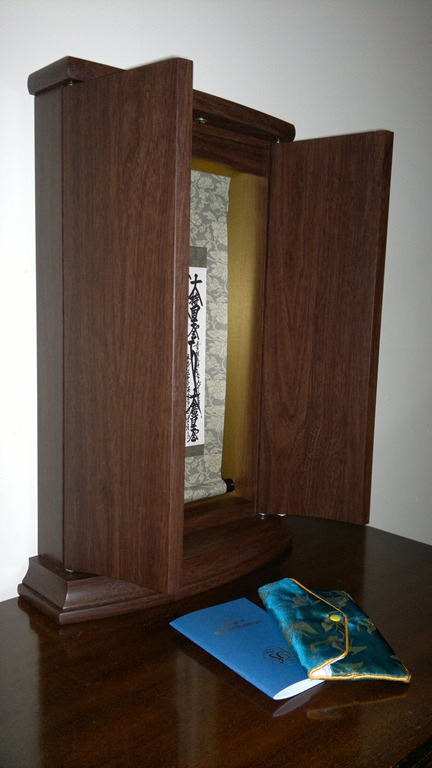
Nam Myoho Renge KyoThe Gosho discussed before the Gohonzon ceremony yesterday as well as the message Jayne wrote in my card, was about Nichiren’s letter regarding the relationship between us and the Gohonzon.

“This Gohonzon is the essence of the Lotus Sutra and the eye of all the scriptures. It is like the sun and the moon in the heavens, a great ruler on earth, the heart in a human being, the wish-granting jewel among treasures, and the pillar of a house.

When we have this mandala with us, it is a rule that all the Buddhas and gods will gather round and watch over us, protecting us like a shadow day and night, just as warriors guard their ruler, as parents love their children, as fish rely on water, as trees and grasses crave rain, and as birds depend on trees.

You must trust in it with all your heart.”

With my deep respect,
Nichiren

As always, Nichiren explains the connection using beautifully evocative examples, that even today, over 900 years after the letter was written show us exactly what he means.

A Feeling Of Helplessness, Resolved

Chant For JapanI can’t be alone in feeling that I would like to be of some practical help to the poor people of Japan. Whether it is because it is the birthplace of Nichiren Daishonin, that makes the feeling more acute, I’m not sure. But the increasing worries over the atomic power stations, rising numbers of dead and even a deterioration in the weather with northerly winds and snow, every day seems to bring more tales of woe.

Within living history, the Japanese have been our enemies. My parents generation had very strong feelings about the atrocities against prisoners in WWII and those feelings took a long time to subside.

But it is impossible to have anything but sympathy for the citizens of Japan when we see and hear all the news reports coming out of the Pacific. It seems almost impossible to imagine what the people affected by first the earthquake and the tsunami that followed and now the rising radiation levels and increasing danger of a nuclear meltdown.

I have no medical skills or engineering experience in the nuclear industry, so what could I offer other than sympathy and support? Well I can chant and pray for respite for the victims of the disasters, in the full knowledge that my energies will help the situation, half a world away.

I urge all my Buddhist friends to send Diamoku to the people of Japan, though I am sure that you are already doing so. I would love to offer my help in a more practical way, but chanting allows me to feel that I am making a difference.

Nam Myoho Renge Kyo

More Learning

ChantingI attended my second meeting in a week tonight, so as promised, a short report from the study group in Bournemouth.

I have to say that I have nothing but praise for everyone I met tonight, they were so welcoming, and the lecture was very interesting and beautifully delivered. My humble apologies to everyone, but there were so many names that I have forgotten most of them. I really look forward to getting to know you all much better. Boots from the Salisbury meeting was there, as was Ken Hawkins who had been kind enough to phone me, to give details of the meeting, yesterday.

So what happened?

Gongyo was led by a Japanese lady and was totally amazing. I thought chanting with four other people was great, but chanting with twenty other people took it to a completely different level. The whole thing happened at, what seemed like, a hundred miles an hour. Many people had their beads to hand, but I was very interested to see that each one had their own way of honouring the Gohonzon. It was very powerful and liberating and a total joy to be part of it.

The study lecture, delivered by an Italian lady, with the Japanese lady and another lady reading parts as well. A very cosmopolitan group to be sure.

The study was taken from Daisaku Ikeda’s lecture on Nichiren Daishonin’s letter to Jakunichi-bo. Although the letter was written in 1279, the points it raises are just as relevant today. President Ikeda’s lecture notes help us understand the letter in the language of today. Although there was not the group interaction of the Salisbury meeting, I was so happy to be part of this wonderful group of Nichiren Buddhists and I already have more dates of meetings in my diary. Thanks again everyone, i look forward to our next meeting.

More Proof Of Practice?

WhoopeeIf you read yesterday’s post, you will know that today was Charlotte’s day of reckoning.

The decision to be made, was that of whether she could commence her cancer treatment whilst being able to continue with her pregnancy.

So I chanted, and chanted and chanted some more. Several people who read the blog also offered to chant for Charlotte, and for that, I am so very grateful.

This morning was very tense, I knew that Charlotte’s appointment was looming and that any decision that meant she would lose the baby would be a terrible blow.

I sent supportive texts and waited.

Then relief, a text from Charlotte telling me that she had got her dearest wish, she can keep the baby.

I realise that this is not the end, it is not even the beginning of the end, but it is the end of the beginning. I also realise that the result doesn’t prove that my practice influenced the outcome today, all I do know, is that the more I practice, the more these positives seem to happen.

Previous Older Entries Next Newer Entries