Cowards Cannot Become Buddhas

BuddhaThis challenging and inspiring piece came from last night’s Gosho Study.

The direct route to uncovering your enlightenment is by challenging negativity. You don’t call out your Buddhahood by running away from your problems. Change your way of thinking. Obstacles, negativity, adversity, whatever words you want to attach to it – think instead – opportunity, opportunity, opportunity! This is the means by which you can call out your Buddhahood and become in charge of your life.

Every time that you think that you are powerless to change a problem in your life; you have reverted to being non Buddhist. You must chant out of the conviction that you will win. It is not mindless Nam-myoho-renge-kyo, it is not half hearted. It is a deep conviction that Nam-myoho-renge-kyo is more powerful than anything else and you must attack your negativity with this conviction. You can’t do it if you won’t become a fighter. Buddhism is win or lose. And, for those of us practising Buddhism, victory is the only option. We must become masters at life by mastering negativity.

You learn that after challenging negativity, negativity, negativity, day after day, over many years, that what you were always looking for all of your life you always had; it’s always been there within you. What you learn is that your life is the greatest dream that you could ever dream. It is within your grasp and control at this moment and every moment.

So create a life for yourself that is beyond your wildest dreams. Buddhism is about winning. Buddhism is about not stopping until all people become happy. It’s about becoming mad at fundamental darkness that takes away peoples’ souls so that they become hopeless, when in fact; inside them they have the greatest seed to change anything.

The reason we have faith is to do what you cannot do already with your own human effort. You don’t need faith to do what you can already do. But how can you ever know your limitless potential of the power of Nam-myoho-renge-kyo unless you have the courage to fight for that which is illogical in your mind. Challenge the impossible. The more you have the courage to challenge the impossible, the more you will come to understand YOU ARE MAGNIFICENT!

(Source unknown)

Awakening Our Intrinsic Value

Intrinsic ValueOne way to overcome our tendency to compare ourselves with others is through learning how to praise ourselves for our unique, intrinsic value.

A common concern about self-praise is that it may cause arrogance, probably due to our Judeo-Christian tradition in which self-humiliation is often regarded as a necessary virtue to praise God, while self-praise is deemed as a sign of pride, which is one of the seven deadly sins. It should be noted, however, that arrogance is a defensive posture caused by a tendency to assume a sense of superiority or inferiority by comparing oneself with others. Therefore, so long as we praise ourselves solely for who we are and for our innate Buddhahood, we will never become arrogant, though we may at times seem arrogant to arrogant people.

Indeed, the greatest way to praise ourselves is prayer that sincerely affirms our supreme potential as the Daishonin states, When you chant Myoho and recite Renge, you must summon up deep faith that Myoho-renge-kyo is your life itself (WND, 3).

As we praise ourselves in this way, we will grow confident yet humble because we start to recognize the same quality of Buddhahood in others as well. Appreciation for oneself leads to appreciation for others, which further strengthens self-esteem. The way we see ourselves is not only the way we live our lives, but also the way we relate to others.

(from the November 9, 2001 World Tribune)

Freeing The Caged Bird

Freeing The Caged Bird

There is no such thing as coincidence in Buddhism. I would therefore like to thank Jayne for putting this right under my nose, amongst a number of other good lessons, whether it was intentional or not …

Nichiren writes: “Myoho-renge-kyo is the Buddha nature of all living beings…. The Buddha nature that all these beings possess is called by the name Myoho-renge-kyo” (wnd, 131). Regarding how to manifest one’s innate Buddha nature, Nichiren explains: “When we revere Myoho-renge-kyo inherent in our own life as the object of devotion, the Buddha nature within us is summoned forth and manifested by our chanting of Nam-myoho-renge-kyo. This is what is meant by ‘Buddha.’ To illustrate, when a caged bird sings, birds who are flying in the sky are thereby summoned and gather around, and when the birds flying in the sky gather around, the bird in the cage strives to get out. When with our mouths we chant the Mystic Law, our Buddha nature, being summoned, will invariably emerge” (wnd, 887).

In Nichiren’s metaphor, our innate Buddha nature, whose name is Nam myoho renge kyo, is a bird trapped in the cage of ignorance. In other words, our deluded minds create this cage that imprisons our Buddha nature. But when we chant Nam myoho renge kyo to the Gohonzon, which expresses Nichiren’s enlightened life and the potential of all people, our dormant Buddha nature becomes activated.

The singing of the caged bird is our chanting, and the birds flying in the sky are the Buddha nature in our environment, particularly as it is expressed in the Gohonzon. Through our chanting, the Buddha nature within our lives and the Buddha nature inherent in the universe begin their dynamic interaction.

For Nichiren’s metaphor to work, however, it is necessary for the caged bird to recognize the birds in the sky as being its own kind. In other words, when we pray to the Gohonzon, rather than thinking of it as an external power or deity, we must think of it as the mirror image of our own Buddha nature. If the caged bird thinks of itself as an elephant, it is unlikely to give the slightest thought to flying.

Nichiren Buddhism clarifies that the teaching of the Buddha nature is a teaching of faith and practice. All people have it, but not many can believe in it. Furthermore, some of those who believe in their Buddha nature may not practice to manifest it, erroneously thinking-I’m already a Buddha, so I don’t have to do anything. One’s faith in the Buddha nature must be expressed in one’s actions to manifest it.

Those who see the universal Buddha nature of oneself and others, and work to awaken it in all people are already Buddhas, for such actions belong to none other than a Buddha. As we cultivate our inherent Buddha nature through our conviction and actions to manifest it no matter our circumstances, we begin to see it and experience it. In our everyday lives, seeing may be believing. But in the world of Buddhism, believing in the Buddha nature is the first step toward seeing it.

(from Living Buddhism – February 2005)

Be Constant And Be Strong

Strength When times are easy and things go our way, it is easy to stick to the plan. It is when things go wrong, problems arise or we are distracted from our Practice that we need to summon up our inner strength.

Practicing Nichiren Buddhism is rewarding and fulfilling. Chanting and praying before the Gohonzon becomes part of the everyday routine, and wavering makes us feel that we are letting ourselves and our mentor down.

But we have to remember that being constant takes effort and that allowing ourselves to back slide can be the easiest of things. Nichiren Daishonin wrote to Shinjo Kingo on this very topic way back in 1275 ad, so it’s not a new problem.

This is in regard to the passage “This sutra is hard to uphold.” According to Acharya Ben, you said to him: “I have been practicing the Lotus Sutra correctly since last year, when you told me that those who embrace this sutra will ‘enjoy peace and security in their present existence and good circumstances in future existences.’ Instead, however, great hardships have showered down on me like rain.” Is this true, or did he give me a false report? In either case, I will take advantage of this opportunity to resolve any doubts you may have.

A passage from the Lotus Sutra reads that it is “the most difficult to believe and the most difficult to understand.” Many hear about and accept this sutra, but when great obstacles arise, just as they were told would happen, few remember it and bear it firmly in mind. To accept is easy; to continue is difficult. But Buddhahood lies in continuing faith. Those who uphold this sutra should be prepared to meet difficulties. It is certain, however, that they will “quickly attain the unsurpassed Buddha way.” To “continue” means to cherish Nam-myoho-renge-kyo, the most important principle for all the Buddhas of the three existences. The

sutra reads, “We will protect and uphold what the Buddha has entrusted to us.” The Great Teacher T’ien-t’ai stated, “One accepts because of one’s power of faith and continues because of one’s power of constant thought.” Another part of the sutra reads, “This sutra is hard to uphold; if one can uphold it even for a short while I will surely rejoice and so will the other Buddhas.”

A fire burns higher when logs are added, and a strong wind makes a kalakula grow larger. The pine tree lives for ten thousand years, and therefore its boughs become bent and twisted. The votary of the Lotus Sutra is like the fire and the kalakula, while his persecutions are like the logs and the wind. The votary of the Lotus Sutra is the Thus Come One whose life span is immeasurable; no wonder his practice is hindered, just as the pine tree’s branches are bent or broken. From now on, always remember the words “This sutra is hard to uphold.”

With my deep respect,
Nichiren

So when times get tough, or distractions occur, be strong and maintain a strong practice. It will help you through the bad times and being constant will help sustain your faith.

Nam Myoho Renge Kyo

A Birthday Party To Remember

Happy Birthday CharlotteWhat a lovely day, the weather was kind to us, it didn’t rain, the sun did shine for a while and it was a lovely party for my eldest daughter today.

Now turning 30 is not generally a particularly happy day for people. These landmark birthdays simply serve to remind us that time stops for nobody. But in the current circumstances, with Charlotte recovering from cancer, reaching another birthday is something to celebrate with gusto.

Within weeks Charlotte will also give birth to our fourth grandchild, another reason for celebration. All positive, all going in the right direction and Charlotte has been amazing throughout. Happy birthday Charlotte, we all love you so very much.

Of course, birthdays have always been a reason for celebration, here is a letter from Nichiren Daishonin written in 1271 …

The Birth of Tsukimaro

I UNDERSTAND that your baby has been born. Congratulations! In particular, today is the eighth day of the month. Not only have you had your baby, but on such an auspicious day! The fulfilment of your wish is now complete, just like the tide at the high watermark or the blossoming of flowers in a spring meadow. Thus, I have wasted no time in giving her a name. Please call her Tsukimaro.

What is more, Great Bodhisattva Hachiman, the sovereign deity of this country, was born on the eighth day of the fourth month. Shakyamuni Buddha, the lord of teachings in this saha world, was also born on the eighth day of the fourth month. Though the month is different, your baby girl was also born on the eighth day. She could well be the reincarnation of Shakyamuni Buddha or Hachiman. Since I am an ordinary man, I have no way of knowing for certain, but I am convinced that the reason for this auspicious birth is that I gave you the protective agent. How happy you, her parents, must be! In celebration, you have kindly sent me rice cakes, sake, and one thousand coins. I have also reported this to the object of devotion and the ten demon daughters.

When the Buddha was born in this world, there were thirty-two auspicious phenomena, as is recorded in a work called The Record of Wonders in the Book of Chou. Immediately following his birth, Shakyamuni Buddha took seven steps, opened his mouth, and uttered the words, expressed in sixteen characters, “Throughout heaven and earth, I alone am worthy of respect. The three- fold world is a place of suffering from which I will save all living beings.” Tsukimaro must have chanted Nam-myoho-renge-kyo with her very first cry at birth. The Lotus Sutra speaks of “the true aspect of all phenomena.” T’ien-t’ai said, “Voices do the Buddha’s work.” This is also what I think. The deaf cannot hear the thunder, and the blind cannot see the light of the sun and moon. But I am quite certain that the ten demon daughters must be together side by side, giving the baby her first bath and watching over her growth.

Let me heartily congratulate you. I can imagine your joy. I have respectfully reported this to the ten demon daughters and to the Sun Goddess. I am too excited to write any more. I will be writing you again.

Respectfully,
Nichiren

The Gohonzon Explained

What is the Gohonzon?

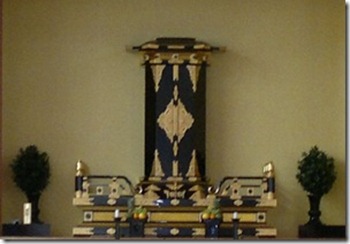
The Butsudan At Taplow Court - SGI-UK HeadquartersThe Gohonzon is the prime point of faith, practice and study in Nichiren Buddhism. It provides us with a correct model or standard of faith and practice for our time. It usually takes the form of a paper scroll, with Chinese and Sanskrit characters printed on it in black ink. It is kept in a protective box, or butsudan. The area around the Gohonzon often has offerings of light (in the form of candles), evergreen, incense, water, and fruit. You may also see other offerings, and items like a bell around the butsudan.

In Reply to Kyo’o the Daishonin writes,

“I, Nichiren, have inscribed my life in sumi ink, so believe in the Gohonzon with your whole heart.”

Although the Gohonzon takes the form of a paper scroll, it is vital that when we are chanting to it, it is not seen as outside one’s life. It is through our chanting to the ‘external’ Gohonzon in the butsudan, that we activate all the forces and functions within our own lives.

Nichiren Daishonin began to inscribe the Gohonzon for his followers around the time of his exile to Sado in 1271. He wanted to establish an object of fundamental respect which would enable anyone chanting to it to awaken the Buddhahood in their lives, and to experience the same life state as he did. Nichiren Daishonin provided us with the means to draw out the state of Buddhahood inherent in life.

The word ‘Gohonzon’ is translated into English as ‘object of fundamental respect’. ‘Go’ is an honorific prefix, and ‘honzon’ means what it is that we base our lives on.

Nichiren Daishonin was aware of the difficulty people had in believing that the life state of the Buddha could exist in their lives, and then how hard it is to manifest it. His writing The Object of Devotion for Observing the Mind [WND p354] is in the form of a dialogue which strives to persuade the listener that if all the other nine worlds can be perceived in one’s life, then Buddhahood must be too. He inscribed the Gohonzon for individuals so that they would have a constant reminder of the eternal law, the cause for this life state, and which would serve as a focus for their daily practice, as well as functioning as the external cause for drawing out Buddhahood and revealing their greater self.

It is not necessary to be able to read or understand the characters on the Gohonzon in order to experience benefit from chanting to it. The Daishonin used script or calligraphy for the Gohonzon because he wanted the Gohonzon to be a universal mirror, free of the connotations of race and gender inherent in pictures or images.

The Calligraphy on the Gohonzon

The Gohonzon is sometimes described as a ‘mandala’, a word used in the East to describe an object in which Buddhas and bodhisattvas are depicted or on which a philosophical doctrine is expressed. Originally it meant a circle drawn in the earth around the place where a religious ceremony was to take place. The circle embraced all the people who participated in the ceremony, and was believed to protect them from negative influences. The word mandala was rendered in Chinese as ‘perfectly endowed’ or ‘cluster of blessings’.

Using Chinese calligraphy, Nichiren Daishonin put the characters Nam-myoho-renge-kyo Nichiren boldly down the centre of the Gohonzon. This represents the oneness of the Person and the Law. In other words, the ordinary person is the Buddha, and the Mystic Law is inherent in each living being. He then surrounded these characters with the names of people referred to in the Lotus Sutra, such as Shakyamuni Buddha and Many Treasures and others. All the characters represent an aspect of life, whether as a protective function, or as a representative of the ten worlds, and all are illuminated by the Law of Nam-myoho-renge-kyo.

In the writing The Real Aspect of the Gohonzon Nichiren Daishonin explains why he placed the particular characters where he did. The blueprint for the Gohonzon was the description in the Lotus Sutra of the Ceremony in the Air, when a great jewelled Treasure Tower emerged out of the earth, and many Buddhas and bodhisattvas gathered to hear the Buddha Taho (or Many Treasures) confirm the truth that Shakyamuni had taught – that we all have the potential to reveal our Buddha nature in our daily life, as we are. This story in the Lotus Sutra represented the emergence of the state of Buddhahood in countless peoples’ lives, called Bodhisattvas of the Earth (the people who promised to propagate Nam-myoho-renge-kyo at the time we now live).

Shakyamuni described the dramatic events of the Tower emerging from out of the ground and reaching high into the sky. It was encrusted with precious gems and was intended to represent life with all its mystic and wonderful qualities. As it halted, floating in the air, the doors of the Tower opened and the Buddha Many Treasures was seen sitting inside. This Buddha invited Shakyamuni to enter and sit in the place of honour on Many Treasures’ right hand side. As we look at the Gohonzon, then, it is as if Shakyamuni and Many Treasures are in the Tower looking out at us and all the other characters on the Gohonzon. Then the Buddhas lifted the tower and the assembled company into the air, in what is known as the Ceremony in the Air, an event not limited to any particular time or place. When we look at the Gohonzon in this way, we realize that we are among the Bodhisattvas of the Earth. Through chanting to the Gohonzon, we are participating in the Ceremony in the Air, just as described in the Lotus Sutra.

The Gohonzon is said to contain all aspects of life, so it includes not just the positive and value creating qualities of life represented by the Buddha’s good disciples, but also examples of evil and destruction. For instance the representative of fundamental darkness, the Devil King of the Sixth Heaven is also included on it, although he too is bathed in the transforming power of Nam-myoho-renge-kyo and revealing his enlightened rather than his negative aspects.

The four corners of the Gohonzon each contain a Heavenly King, a character that represents the protective forces of the universe. Between these, in the middle of each side, and written in Sanskrit calligraphy are the characters Aizen (or Craving Filled) on the left as we look at the Gohonzon and Fudo (or Immovable) on the right, who represent the principles that `earthly desires are enlightenment` and `the sufferings of birth and death are nirvana`, respectively. Nichiren Daishonin’s teachings enable us to transform our desires and our sufferings into enlightenment, rather than having to deny them.

Practising with the Gohonzon

Nichiren Daishonin teaches that the Gohonzon enables us to see the ten worlds in our lives, in other words, that we have Buddhahood, and can use it. It is easy to see the lower life states, and to have the illusion that we can never be like the Buddha. The Gohonzon is described as a clear mirror which shows the law of Nam-myoho-renge-kyo and all its manifestations in the different life states, revealing their enlightened qualities.

The way to practise is to have the attitude while we are chanting that we are in no way different or separate from the eternal Law of Nam-myoho-renge-kyo, or the Buddhas who are enlightened to that Law. The key is to praise one’s inherent Buddhahood and then go out into the world and practise as a bodhisattva, treasuring others, encouraging them to experience their Buddhahood too.

Through studying Nichiren Daishonin’s writings and awakening the wisdom we have within our lives, we become alive with the qualities of the Buddha state that are embodied in the Gohonzon. At the same time, we develop a natural desire to change our lives so that we bring out more and more consistently the condition of Buddha revealed by the Gohonzon. The more we practise with this desire to change, the more our lives and Nichiren Daishonin’s life-state embodied in the Gohonzon become as one.

This is a gradual process. When we practise to the Gohonzon, Nichiren Daishonin said we are simultaneously in the state of Buddhahood or enlightenment, but we cannot easily discern that life condition with our minds; therefore we do not always act accordingly. However, through our constant relationship with the Gohonzon, we gradually challenge and overcome the influence of negativity arising from our karma. As we open up our hearts we can begin to experience all those qualities of Buddhahood working naturally and vibrantly inside us and affecting everything that we think and say and do.

President Ikeda has recently described the process as this:

“When we chant Nam-myoho-renge-kyo while practising for ourselves and others, with the Gohonzon of Nam-myoho-renge-kyo manifested by the Buddha as our clear mirror, and with deep confidence in the Gohonzon existing in our own lives, Myoho-renge-kyo within us resonates with the Myoho-renge-kyo outside us, and the world of Buddhahood emerges within us.”

[World of Nichiren Daishonin’s Writings Part 12]

Unity in Buddhism

Nichiren DaishoninTo start the process of Human Revolution you must meet the right teaching. The best and easiest way to do this is to have a mentor. Nichiren Daishonin was the ultimate in mentors and his successors, right through to Daisaku Ikeda have followed his teachings, been his disciples and, in turn, become amazing mentors in their own right. Find the right mentor and follow the right teaching.

‘Many in Body – One in Mind’ and the ‘Oneness of Mentor and Disciple’

In many of Nichiren Daishonin’s writings, the principle of unity is stressed again and again. Unity starts with the individual. He writes: ‘Even an individual at cross purposes with himself is certain to end in failure.’ (1)

We all know what it is like to be ‘at cross purposes’ – those feelings of indecision, confusion or vagueness. Maybe we have also experienced the opposite feeling when we are focused on a goal and confident that we will not deviate from our path towards it, and ready for any problem that may appear to try to hinder us.

Truly fulfilling our potential, however, is dependent on more than not being ‘at cross purposes’ with our self. Although practising Nichiren Buddhism brings happiness to each of us as individuals, this alone is not enough. As Nichiren Daishonin explains:

All disciples and lay supporters of Nichiren should chant Nam-myoho-renge-kyo with the spirit of many in body but one in mind, transcending all differences among themselves to become as inseparable as fish and the water in which they swim. This spiritual bond is the basis for the universal transmission of the ultimate Law of life and death. Herein lies the true goal of Nichiren’s propagation. When you are so united, even the great desire for widespread propagation can be fulfilled. But if any of Nichiren’s disciples disrupt the unity of many in body but one in mind, they would be like warriors who destroy their own castle from within. (2)

Many in Body, One in Mind

When we look at our neighbours, our colleagues, even members of our family, we can see that while there are clearly similarities between some groups of people, there are also enormous differences. Around the world, cultural and language differences can appear insurmountable.

Nichiren Daishonin accepts that we are all very different; in fact we are each unique. He asks us to learn to respect other people’s unique characteristics and differences. This becomes much easier to do when we look beneath the surface and recall that everyone has the qualities of a Buddha deep in their lives, even if it is not yet apparent.

Although we are all different (‘many in body’), it is possible for us to share a common goal, or ‘one mind’. This does not mean that we all have to ‘think the same’, as past experience of totalitarian regimes may indicate. Indeed, it is essential for us to develop our own unique qualities to the full. As Nichiren Daishonin pointed out, different sorts of fruit are perfect in themselves. A pear, for example, should not try to be, or to taste like, a plum. All of our own individual talents and characteristics are necessary for us to realise our goal of a harmonious peaceful world. The essence of ‘many in body – one in mind’ (Japanese. itai doshin) is for us to learn how to transcend the differences between us; to develop respect for each person in our environment.

The concept of many in body, one in mind is based on the vow of Shakyamuni Buddha, which is contained in the Lotus Sutra, ‘to make all persons equal to me, without any distinction between us.’ (3) Therefore true enlightenment only comes from helping others to achieve the same state of life. This vow is at the heart of Nichiren Daishonin’s teachings.

Consequently, those who chant Nam-myoho-renge-kyo share the same ideal of basing their actions on the qualities of courage, compassion and wisdom, which is in fact ‘attaining Buddhahood’. When we see a positive change in our self, we naturally want to encourage others to reveal their potential in the same way. This leads to a desire for the widespread propagation of Buddhist philosophy throughout the world so that society becomes based on fundamental respect for life, rather than on greed, anger or foolishness.

This leads to another important principle – that of the ‘oneness of mentor and disciple’, or as it is sometimes referred to – ‘the mentor and disciple relationship’.

The Oneness of Mentor and Disciple

The ‘oneness of mentor and disciple’ is a principle which has profound significance in Buddhism. Nichiren Daishonin re-confirmed Shakyamuni’s plea to his followers to: ‘Rely on the Law and not upon persons’(4). Therefore, we do not worship or pray to statues of the Daishonin or Shakyamuni. Rather we have an object of devotion – the Gohonzon – which is a representation of Nichiren Daishonin’s enlightened life state. However, the Daishonin also stated that we should ‘seek out the votary of the Lotus Sutra and make him our teacher.’ (5)

There are many examples in society of the relationship between a teacher and student, or a master and apprentice. Generally this relationship occurs when a mentor or teacher has some knowledge or skill which they want to pass on to someone else. In the case of Nichiren Buddhism it is the essence of the teachings that the mentor is communicating. Both mentor and disciple are therefore equal and united in their desire to become enlightened. A true mentor desires that the disciples will eventually surpass them in understanding whilst a true disciple shares the same sense of responsibility and commitment to the Law as the mentor.

We may come to a time when we think we understand everything about Nichiren Buddhism. At this point we can stop making as much effort in our practice as we previously did. Then, without being aware of it, start to stagnate in faith and stop seeing positive changes in our life. In order to continue developing our self and speaking with sincerity to others about the teachings, it is vital for us to remain close to the heart of Nichiren Buddhism so that we are able to maintain a strong life state.

We consider that Nichiren Daishonin is our mentor because he provided us with a profound teaching. He first expounded Nam-myoho-renge-kyo and inscribed his enlightened life-condition in the Gohonzon, which enables us to reveal our own inherent Buddha nature. His life is an inspiring example of the potential an ordinary human being has to single-mindedly achieve all their goals. We are able to read about his extraordinary life in the many letters of encouragement he wrote to his followers. Consequently, Nichiren Daishonin has been called the ‘mentor of life’ (6).

Daisaku Ikeda was born in 1928 and began practising this Buddhism just after the Second World War, when he was 19 years old. He became the third President of the Soka Gakkai in 1960. His example has shown us how to practise and spread Nichiren Daishonin’s teachings in twenty-first century. Therefore, he has been described as the ‘mentor for kosen-rufu [widespread propagation]’ (7). SGI President Daisaku Ikeda’s guidance and activities are thoroughly based on his profound understanding of the teachings of Nichiren Daishonin.

Studying any of Daisaku Ikeda’s guidance we can see how he has continually applied the principles of Nichiren Buddhism in order to achieve wonderful victories in all areas of his life. Yet he does not proclaim himself to be our ‘mentor’. His great pride is to be the disciple of his predecessor second Soka Gakkai president Josei Toda (1900 – 1958), who in turn was the disciple of Tsunesaburo Makiguchi (1871 -1944).

The mentor-disciple relationship in Nichiren Buddhism depends upon the disciple or how the disciple responds. We choose the mentor, not the other way round. If we look at this from another angle, we can see that it is the activities and achievements of the disciple that validates the mentor. This concept is very different from a traditional understanding of the function of religious leaders, such as guru’s, saviours or saints, to give security and reassurance to their disciples.

President Ikeda clarifies this as follows:

“The Daishonin urges his followers to practise ‘just as Nichiren’ and to ‘spread the Lotus Sutra as he does’. Disciples who wait for the mentor to do something for them are disciples of the pre-Lotus Sutra teachings. True disciples of the Lotus Sutra are those who struggle just as the mentor does.”(8)

The oneness of mentor and disciple in Nichiren Buddhism is not a passive relationship, where the disciple waits for instructions from the mentor. It is an active two-way process based on a vow or pledge that both disciple and mentor make to continuously develop their characters for the sake of the happiness of other people.

President Ikeda has likened the concepts of ‘many in body, one in mind’ and the ‘oneness of mentor and disciple’ to the process of making a beautiful cloth or carpet:

The warp represents the bond of mentor and disciple, and the weft to the bond of fellow members. When these are interlaced, a splendid brocade of kosen-rufu is created. (9)

The mentor-disciple relationship provides the vertical ‘structure’ and the members are like the individual multi-coloured strands of thread that bonded together form the ‘pattern or design’. This principle applies to people chanting together in small local groups as well as to the world wide organisation.

If we wish to see a change in the core values of our society, then learning how to work in harmonious co-operation with our fellow human beings is crucial. Nichiren Daishonin’s teachings are rooted in a humanistic belief that each person is deeply worthy of respect. Chanting Nam-myoho-renge-kyo gives each person the ability to reveal their highest life condition. President Ikeda’s guidance and actions for peace becomes a model for us to transform our society.


  1. Nichiren Daishonin, ‘Many in Body, One in Mind’ (WND p. 618).
  2. Nichiren Daishonin, ‘The Heritage of the Ultimate Law of Life’ (WND p. 217).
  3. Burton Watson, The Lotus Sutra (Columbia University Press, 1993) p. 36.
  4. Nirvana Sutra
  5. Nichiren Daishonin, ‘The Opening of the Eyes’ (WND p. 278).
  6. See Suzanne Pritchard’s article ‘The Oneness of Mentor and Disciple’ in the Art of Living, September 2004.
  7. ibid
  8. Daisaku Ikeda, The World of Nichiren Daishonin’s Writings (SGI-Malaysia, 2004) Vol. 1, pp. 164-165. See also ‘The World of Nichiren Daishonin’s Writings’ No. 8 (SGI Newsletter No. 5290, 2 October 2002).
  9. Daisaku Ikeda, The World of Nichiren Daishonin’s Writings (SGI-Malaysia, 2004) Vol. 1, p. 135. See also ‘The World of Nichiren Daishonin’s Writings’ No. 7 (SGI Newsletter No. 5251 22 August 2002).

A Day Of Learning And Tranquillity

Just PerfectWhat a glorious day it turned out to be. Beautiful sunshine, a cooling breeze, just perfect for a nice bit of learning and a spot of sunbathing.

So often lately it has been glorious all week and disappointing at the weekend, but not today.

I’ve spent the majority of the the day out on the balcony, reading Pat Allwright’s ‘Basics Of Buddhism’. Much of it reiterates what I already know, but it never hurts to go back over the basics. So much wisdom packed into such a little book.

To quote the opening page,

“If you wish to free yourself from the sufferings of birth and death you have endured through eternity and attain supreme enlightenment in this lifetime, you must awaken to the mystic truth which has always been within your life” -Nichiren Daishonin

It is quite a powerful statement with which to start a book, but as I know to my own benefit, the teachings within are just that powerful and could be the basis for a happier and more enlightened life for all of us.

We are, I believe, all Buddhists at heart, that is why, as Allwright says,

“People who hear about it [Buddhism] for the first time often remark ‘I always thought that anyway’. This is because ultimately, we all know the Universal Truths, but have become separated from them. The adventure into the inner self is an endless journey of discovery, insight and joy.”

I could not agree more.

Good Friends

Mr TurtleThis quote is for Jayne and Ken …

“The best way to attain Buddhahood is to encounter a good friend.

How far can our own wisdom take us? If we have even enough wisdom to distinguish hot from cold, we should seek out a good friend. But encountering a good friend is the hardest possible thing to do.

For this reason, the Buddha likened it to the rarity of a one-eyed turtle finding a floating log with a hollow in it, the right size to hold him, or to the difficulty of trying to lower a thread from the Brahma heaven and pass it through the eye of a needle on the Earth.”

Nichiren Daishonin

Which in modern parlance means, it’s pretty difficult to find one good friend, let alone two.

So thank you, you two are the best of good friends.

Nam Myoho Renge Kyo

Complete Gongyo

Lotus FlowerIt has been asked, ‘Why do we chant two verses of the Lotus Sutra during Gongyo, when Nichiren says that chanting Nam Myoho Renge Kyo is the true path to enlightenment?’

The Lotus Sutra has the drama of fighting for justice against evil. It has the warmth that comforts the weary. It has a vibrant, pulsing courage that drives away fear. It has a chorus of joy at attaining absolute freedom throughout past, present and future. It has the soaring flight of liberty. It has brilliant light, flowers, greenery, music, painting, vivid stories. It offers unsurpassed lessons on psychology, the workings of the human heart, lessons on life, lessons on happiness and lessons on peace. It maps out the basic rules for good health.

But maybe most importantly, it awakens us to the Universal Truth, that a change in one’s heart can transform everything.

Nam Myoho Renge Kyo.

Previous Older Entries Next Newer Entries