A Gem Of An Idea

Sew Those Hidden GemsPassing on the ideas and ideals behind Buddhist teachings is a little like sewing a hidden gem into the lining of a friends clothes.

This is the parable about the rich man, the poor man, and the hidden gem …

A poor man visits a rich friend, gets drunk, and passes out.

The rich man, who has to leave on business, gives his poor man a priceless gem, which he secretly sews into the lining of his friend’s clothes.

When the poor man comes to, he resumes his life as a vagrant, unaware of the treasure he received during his blackout.

Later, he meets the rich man again, who shows him where the gem is concealed, and the poor man realizes his wealth.

Discovering the gem, even years later, can transform a poor life into one of untold enlightened riches, so keep sewing those gems of wisdom into the people you meet in life.

The act of giving benefits both parties and you never know when you might be giving to just the right person, at the right time and place, to transform their life for the better, forever.

Namaste

Good News Cubed

Good NewsMy own experiences with Nichiren Buddhism have shown me how powerfully it can change your life.

Whether that is simply making you a happier person or helping you see situations from a different perspective, that will help you solve problems in a better way.

As with all good things, you want to tell people about it, so they can share the benefits.

So the greatest feeling, for me, is when someone actually comes straight out and asks. At that point, it’s important to offer as much, or as little as they request. Force feeding them will kill that spark as surely as piling logs onto a smouldering ember. So be enthusiastic, but be reserved as well. Let them set the pace, be there for them when they want to ask for more, and just see what happens.

Giving people a gift is a great feeling. The shining smile you see when they open it and are delighted by what they find. Giving people the way to find Nichiren Buddhism is just like that, only a million times better for both parties.

P Is For Practice

P For PracticeFor me, my Buddhist Practice is a way of life. A routine that I go through every day, Gongyo, Daimoku, even writing this blog. But routine is also another word for boring, mundane or even hum-drum, so it’s important to keep in mind why we Practice.

We Practice for several reasons …

  • To raise our life-energy levels …
  • To chant for certain outcomes …
  • To move us along the road to Buddhahood …
  • To give a stable anchor in our lives …

and there are many others, often different for every individual.

As a novice, I find that I can learn a little more each day Let’s face it, Buddhism has been around for well over two thousand years, so there’s plenty to learn about.. I can improve or seek to perfect my Practice and to maintain a more focused attention to the subject of my chanting.

I look forward to the feeling I get during and after Gongyo. I often find that I am quite warm when I finish chanting and in a really good mood, despite any problems I am facing.

I never cease to be amazed by the effectiveness of chanting either. To start with, the word coincidence came into my mind when I saw results, but not any more. But I do get surprised by the way the Universe solves the problems with which I have asked it to help. Not always the way I expected, and often in better, more subtle ways than I could have imagined.

So my Practice is a pleasure, not a chore. It’s something I enjoy and never something I feel I have to do.

As Nichiren Daishonin said, ‘If you practice something, you must test it’s validity with the results you see’. In other words, if it doesn’t work, stop doing it.

For me, it’s working wonders and I think the World would be a better place if more people were to discover those wonders.

More On Mindfulness

BreatheWhen we are feeling down, or simply the challenges of everyday life are coming at us too fast, it is all too easy to concentrate on ourselves, forgetting about those around us.

To stop this happening takes mindfulness and courage, as noted by Sensei in Daily Encouragement.

Buddhism is not about leading a self-centred existence. If we do not base our lives on the Law, we are not practicing Buddhism.

The German writer Friedrich von Schiller writes, “The brave man thinks upon himself the last.”

This is analogous to the spirit of not begrudging one’s life taught in the Lotus Sutra.

This means treasuring the Law more highly than one’s life.

The Law and kosen-rufu are central.

The old adage that ‘No Man is an island’ is very true. It is our family, friends and those we meet each day in our communities, who make our lives meaningful, and it is The Law that shows us the way we are to conduct ourselves and how we should relate to them.

To help with increasing our mindfulness, consciously focus on a simple task each day. Be that taking a shower, doing the dishes, going upstairs, even breathing, anything will do, but concentrate on every aspect of your feelings, your surroundings, everything, and you will find that even the simplest task takes on a whole new meaning.

On Thinking Straight

Right ThinkingOne of the many aims of Nichiren Buddhism is to smooth out the emotional highs and lows in life. through right thinking. However, one of the most difficult things to do, personally speaking, is to remain in a constant life-state when confronted by the highs and lows of life.

A Buddhist quotation says that “The Wise Man is neither elated by success nor deflated by failure”. That is not to say that you cannot be happy when you succeed, or sad when you fail, it’s about the intensity of those feelings and trying to stay nearer the mid-point.

We all find it tough at times, but I find the more I practice. the better I get at achieving equilibrium.

On Beads & Chanting

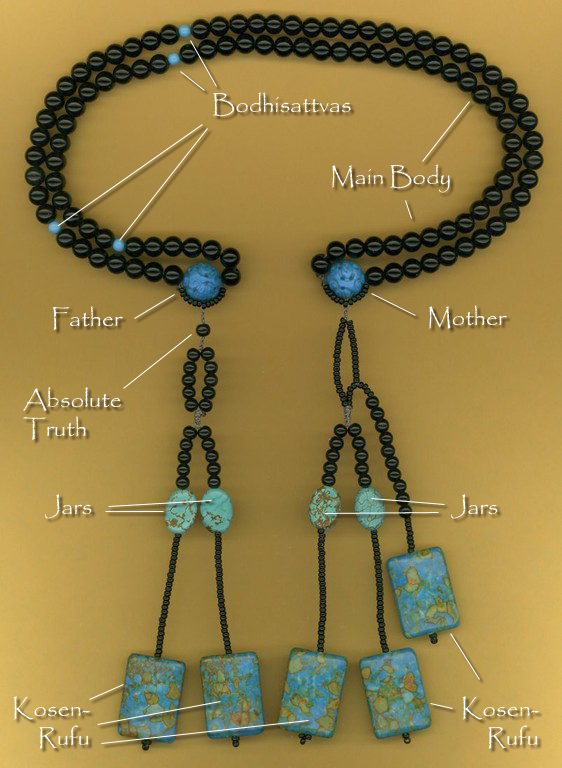
Click for a larger imageIn the practice of Nichiren Buddhism, we hold juzu beads in our hands while reciting Gongyo and chanting Diamoku.

There are 108 beads in the main body, signifying the 108 Earthly Desires.

The 4 smaller beads in the main body represent the 4 Great Bodhisattvas of the Earth … Jogyo, Muhengyo, Jyogyo, and Anryugyo.

The 2 large beads at each end of the main body, are the “parent” beads.  The “mother” bead, representing “mystic” is on the side with 3 dangles, and is placed over the middle finger of the right hand.  The “father” bead, representing “law” is on the side with 2 dangles, and is placed on the middle finger of the left hand.

We cross the beads in the middle, which shows our oneness with The Law.  Also, we cross the beads so our benefits do not fall through our hands and lives.  By placing the beads on our hands this way, we are accepting the reality that Buddhahood exists within our lives.

When we press our hands together while we hold our juzu beads, our 10 fingers represent the 10 Worlds which fuse together simultaneously in the life of a Buddha, our lives.  Our life is now one with the Mystic Law!

The one small bead that sits below the “father” bead, represents Absolute Truth.

Prior to Nichiren Buddhism, there were only 2 dangles on each end of juzu beads.  The third dangle, consisting of 10 beads and a “Kosen-Rufu” bead, on the side of the “mother” was added, actually tied on, to signify Nichiren Buddhism and distinguish it from other Buddhist sects.

On the remaining 4 dangles, there is a differently shaped bead part way down each string.  This bead is called the “jar” bead and holds the benefits of our practice.

The 5 larger beads at the bottom of each dangle are the “Kosen-Rufu” beads, and represent our desire to spread Nichiren Buddhism,  Kosen-Rufu, throughout the World.

My huge thanks are due to my lovely friend Lily Rose of Myoho Beads for researching the meanings of the individual beads and for allowing me to use her explanation.

As Lily Rose says on her site, be careful buying juzu beads on line.  Use this description or the juzu purchased in SGI bookstores as a guide.  Make sure the beads you purchase have been created in an ethical and politically correct manner. Sorry to say, but many are not.

If you would like to learn more about chanting, this link will take you to a very informative video produced by SGI.

It’s Nice To Be Told

It's Nice To Be ToldI had the pleasure of having someone tell me they loved me today. Whilst it was very nice to hear, it did come as a bit of a shock, as I had no idea the person felt so fondly about me.

When I tell you that it was a young man, one of my Saudi students, and that he told me he wants me to become a Muslim because he loves me and wants me to go to Heaven, you now get the full picture.

Loving, and being loved is really great isn’t it? There is little to compare with the feeling one gets from being part of a loving relationship, but there are two types of love, unconditional and conditional.

Unconditional love is about giving without limits, about being happy for the happiness of others. Conditional love, on the other hand, can be painful for both parties. Elements of jealousy, or the need to be loved in order to love, can lead the way to a painful end of the relationship.

Buddhism defines love as an action. It is that force that motivates people to become better, to improve themselves in order to reach eternity and happiness. Love brings out the best in people, as when they love, the target is not themselves but the beloved one. This wish to serve the other is a reflection of an innate knowledge that everyone is connected through the same principle, and therefore, it is an illusion to believe that one can achieve true happiness while those around haven’t attained it . So, love is the action that makes people forego their own ego and concentrate their efforts on the other in a search for fulfilment.

Personally, I have been criticised for suggesting that, if my partner would be happier with someone else, I would not stand in their path. That feeling, I believe, shows that I love them unconditionally and, arguably, more than someone who wants to control or confine them. It does not mean that I want them to go, just that I want them to be happy, and that my happiness is found through their happiness.

Achieving unconditional love is hard. So many people feel that they need to be loved to be happy. In fact, the most happiness comes from loving another, and the need to be loved is often a sign of insecurity. Loving unconditionally requires a totally unselfish attitude to the other. Being happy when they are happy, being happy for them when they succeed, rather than feeling jealous of their success. Keeping those negative feelings in check requires constant effort, but the happiness gained from so doing is unbounded.

So take a look at your motives next time you tell that special someone that you love them. Will you still love them if that love is not reciprocated? Are you happy for them when they find pleasure in something that is of no interest to you? Would you sacrifice the relationship if that added to their happiness? If the answer to any of those questions is no, then you are not loving unconditionally.

It is not the end of things if you are not, there is always time to change. Loving everyone, in the broadest sense of the word, is a very rewarding way to lead your life. Being concerned for the happiness of someone who clearly has no time for you is tough. Going the extra mile to ensure that the happiness of another at the expense of yourself is not necessarily a natural thing to do, but the rewards for doing so are great indeed.

So next time you say ‘I love you’ to someone, try mentally tagging on ‘no matter what’ to that phrase and see how that makes you feel inside. If you can honestly say that it makes no difference to you saying it, then you have reached the state of unconditional love and that will reward you every time you say it.

Remain True To Your Beliefs

The Ungrateful ScorpionShortly after he had finished his practice, an old man opened his eyes to see a scorpion floating helplessly in the river that was flowing slowly past his feet.

As the scorpion was washed closer to the tree, the old man quickly stretched himself out on one of the long roots that branched out into the river and reached out to rescue the drowning creature.

As soon as he touched it, the scorpion stung him. Instinctively the man withdrew his hand. A minute later, after he had regained his balance, he stretched himself out again on the roots to save the scorpion. This time the scorpion stung him so badly with its poisonous tail that his hand became swollen and bloody and his face contorted with pain.

At that moment, a passer-by saw the old man stretched out on the roots struggling with the scorpion and shouted: “Hey, stupid old man, what’s wrong with you? Only a fool would risk his life for the sake of an ugly, evil creature. Don’t you know you could kill yourself trying to save that ungrateful scorpion?”

The old man turned his head. Looking into the stranger’s eyes he said calmly, “My friend, just because it is the scorpion’s nature to sting, that does not change my own nature to save”. There are times when, despite adversities, we need to hold true to our beliefs and faith, even when it may attract ridicule and criticism from others.

The Seeds Of Change

Human Revolution - Change For The BetterIn today’s world where global issues are so important, many people feel a sense of powerlessness and resignation; a feeling that no single individual’s effort can change the way things are.

But the Buddhist viewpoint is that the world should be seen from the perspective of the individual, and that the human life contains the entire universe.

That is why changing our own lives one by one will bring a change in our family, our community, and the society in which we live. It will change the age we live in, our history, and indeed all aspects of our world.

If we look for the true causes of war, we see that it is essentially caused by the human mind. War stems from the desire to control and conquer others, to have power, and from hatred and antipathy. Such is a human being in the grip of the negative force of life. World peace starts with the inner transformation of the individual, and the struggle to elevate our state of life, and free ourselves from the domination of the negative force of life.

A single sunflower contains the seeds for more than a thousand new plants. Similarly, when one brave person stands up for peace, his or her resolve spreads out into the environment in thousands of ways. Courage always brings a response. One person’s human revolution can therefore eventually change the destiny of the entire human race.

The Spirit of Human Revolution

In his writing On Attaining Buddhahood, Nichiren Daishonin conveys the basic spirit of human revolution: “You must never think that any of the eighty thousand sacred teachings of Shakyamuni’s lifetime or any of the Buddhas and bodhisattvas of the ten directions and three existences are outside yourself. Your practice of the Buddhist teachings will not relieve you of the sufferings of birth and death in the least unless you perceive the true nature of your own life.” [WND p3]

We could summarise the spirit of this teaching as being, “It’s not up to others; nor can I blame anyone else. I have to change myself first.” It is a viewpoint which says, everything in life is part of our own training; it is for our benefit and development. Human revolution takes place right now, in the situation we find ourselves at this moment.

World peace starts with this inner transformation of the individual. And yes it is a struggle to develop and elevate our state of life but human revolution is the foundation for world peace and also for individual peace and happiness. It is at the heart of our Buddhist practise. It is about changing our heart and drawing out our humanity.

It is the most amazing feeling as you discover that if the cause of your suffering is within the realms of your own life then you and only you can change that aspect of your life. This is the most freeing feeling. This is human revolution and the door to your Buddhahood.

Human revolution brings into play all the principles and processes that make up the Buddhist teachings of life. Learning to be able to live our lives on the basis of correct teachings is part of our human revolution. The process is a transformation of the heart.

Transforming the Self, Living the Teachings

When we commit our lives to chanting we embark on a journey of self-discovery and challenge. By taking responsibility for our feelings and emotions, especially those we most dislike, we come to realise we have the ability to transform our lives from within. As we broaden our experiences of chanting daimoku we get experiences of our environment reflecting the transformation of our inner lives. This could be in our family relationships, at work or in other aspects of life.

It is usually within one of these arenas that we find life can be difficult or cause us to suffer. As we continue chanting, the more we start to see our lives very differently. At first this process may seem a little uncomfortable because it is quite unique and new to us. We may or may not like what we see. Perhaps we realise we have set attitudes or opinions about others or various issues that make us suffer. It may seem that others have a problem with us. This can draw out all sorts of feelings and emotions that can make us uneasy, or uncomfortable.

Getting this kind of reaction does not mean that chanting is not working or that it is working in a negative way. On the contrary you are actually in the process of transforming exactly that which has always led you to suffer in that particular area of your life. Your chanting is illuminating an area of your life that needs to change for your own happiness. The realisation that this opinion or attitude stems from our own lives and not from others opinions of us, leads us to uncover the Buddha nature inherent in our lives. The quickest way to transform these feelings or attitude is to keep chanting until you realise the cause of these uncomfortable feelings.

However, it may be that is exactly when you find it the most difficult time to chant. You are on the brink of changing a part of your life that always stops you from progressing or being happy. It will probably feel like walking up a hill backwards. At such times obstacles and devils arise. You will probably be able to justify why it is more beneficial to watch TV than do gongyo or chant or tell a friend about Nam-myoho-renge-kyo or study some of Nichiren Daishonin`s writings. But this is exactly the time to do these things in order to break through and win over something that has always held you back. This is the time to muster a fighting spirit and to be courageous.

In his book Seven Paths to Peace, Daisaku Ikeda talks about human revolution in terms of self-mastery. Simply put, this means winning control over oneself, overcoming the small self that is dominated by narrow self-interest and awakening to the larger self that works for the good of all humanity. From this standpoint a major obstacle to developing ourselves is to pursue a way of life bound by our small ego or self. Expanding from the lesser self to the greater self is the path of human revolution.

Through our practice of introducing others to Nichiren Daishonin’s Buddhism, and through efforts to share Buddhism with others, we ourselves grow immensely, we can carry out our human revolution, and transform our karma. Therefore by guiding another individual towards happiness, we also guide ourselves towards happiness. The act of introducing others to Buddhism, which enables us to profoundly benefit both ourselves and others, is the formula of hope for humanity.

At a time when an ordinary person attains Buddhahood, or at a time when a person is at a turning point in doing their human revolution, the negative aspect of life will always appear in some form. This is an unavoidable fact of life! Nichiren Daishonin assures us of this and asks us to transmit it as an axiom or principle of faith so that it is understood by all those who practise.

Taken from the SGI-UK study notes, this encapsulates the meaning of Human Revolution. It beautifully explains the way that self discipline through practice makes us examine our own thoughts and deeds and promotes an inner change by increasing our self awareness.

Chanting Nam Myoho Renge Kyo (at least) twice a day, every day, may seem a mindless practice, but it enables us to devote our whole lives to changing for the better.

The Perfect Gift?

The Buddha, Geoff and MeI’m always going on about this brilliant book, but The Buddha, Geoff and Me is the perfect gift for pretty well anyone you know. It is full of wisdom, courage and compassion.

An amazing, invigorating and enlightening story about a young man’s friendship with a Buddhist, who teaches him the basics of the religion and covers aspects of practice.

For anyone, interested in Buddhism (particularly Nichiren Buddhism) its teachings and practices, in a most readable form, this book is a must read.

The book will transform your thinking, help you to control your mood (life states) and lead you towards a more meaningful life. Buy it here or listen to it in podcast form here.

I don’t think it is overstating the case, when I say that this book changed the course of my life forever. It relates Nichiren Buddhism to everyday life so well, and in such an understandable form, it should be required reading for all students, it would change the world.

Previous Older Entries Next Newer Entries