The Law Is Central

The Lotus SutraWhen we are sick, or the challenges of everyday life are coming thick and fast, it is all too easy to concentrate on ourselves, forgetting about those around us. To stop this happening takes mindfulness and courage, as noted by Sensei in today’s encouragement.

Buddhism is not about leading a self-centred existence. If we do not base our lives on the Law, we are not practicing Buddhism.

The German writer Friedrich von Schiller writes, “The brave man thinks upon himself the last.”

This is analogous to the spirit of not begrudging one’s life taught in the Lotus Sutra.

This means treasuring the Law more highly than one’s life.

The Law and kosen-rufu are central.

The old adage that ‘No Man is an island’ is very true. It is our family, friends and those we meet each day in our communities, who make our lives meaningful, and it is The Law that shows us the way we are to conduct ourselves and how we should relate to them.

NMRK Explored

The Lotus FlowerAfter the initial question “do you chant?” we are then asked “what do you chant?” followed closely by “how long do you chant?” and almost certainly “what does it mean?“. After a little practice, no pun intended, most people can master the phrase Nam-myoho-renge-kyo, but explaining why we chant it, and what it means may take a little longer.

Here is how the SGI website describes the meaning of the individual parts …

Nichiren Daishonin established the chanting of Nam-myoho-renge-kyo as the way to awaken one’s Buddha nature and tap into the deepest levels of our existence, on which our own lives and that of the universe are one. He first taught the invocation of the phrase to a small group at Seicho-ji temple in Awa province, Japan, on April 28, 1253.

Myoho-renge-kyo is the name of the Lotus Sutra in Japanese pronunciation of classical Chinese characters, and so the literal meaning of Nam-myoho-renge-kyo is “I devote myself to the Lotus Sutra.” As the following explanation shows, there are deeper levels of meaning attached to each element of the phrase.

Nam

Nam derives from the Sanskrit word namu, meaning “to devote oneself.” Nichiren established the practice of chanting Nam-myoho-renge-kyo as a means to enable all people to put their lives in harmony or rhythm with the law of life, or Dharma. In the original Sanskrit, namu indicates the elements of action and attitude, and refers therefore to the correct action one needs to take and the attitude one needs to develop in order to attain Buddhahood in this lifetime.

Myoho

Myoho literally means the Mystic Law–the underlying truth or principle which governs the mysterious workings of the universe and our life from moment to moment. Myo refers to the very essence of life, which is “invisible” and beyond intellectual understanding. This essence always expresses itself in a tangible form (ho) that can be apprehended by the senses. Phenomena (ho) are changeable, but pervading all such phenomena is a constant reality known as myo. Myo also means to open, to revive, and to be fully endowed with the qualities we need to develop our lives.

Renge

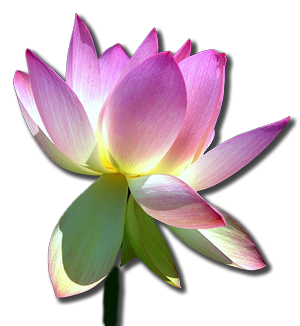
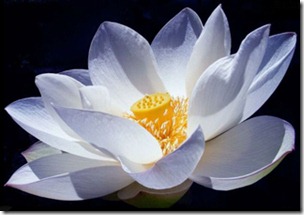
Renge means lotus flower. The lotus blooms and produces seeds at the same time, and thus represents the simultaneity of cause and effect. The circumstances and quality of our individual lives are determined by the causes and effects, both good and bad, that we accumulate (through our thoughts, words and actions) at each moment. This is called our “karma.” The law of cause and effect affirms that we each have personal responsibility for our own destiny. We create our destiny and we have the power to change it. The most powerful positive cause we can make is to chant Nam-myoho-renge-kyo; the effect of Buddhahood is simultaneously created in the depths of our life and will definitely manifest in time.

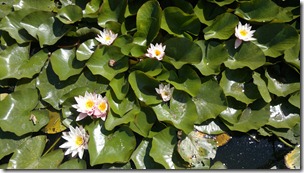
The lotus flower grows and blooms in a muddy pond, and yet remains pristine and free from any defilement, symbolizing the emergence of Buddhahood from within the life of an ordinary person in the midst of the struggles of day-to-day existence.

Kyo

Kyo literally means sutra, the voice or teaching of a Buddha. In this sense, it also means sound, rhythm or vibration. In a broad sense, kyo conveys the concept that all things in the universe are a manifestation of the Mystic Law.

Further explanation of the meaning of Nam-myoho-renge-kyo can be found here.

Speaking Out

The Lotus SutraNichiren Daishonin, in his writings to Soya Jiro Hyoe-no-jo Kyoshin, said this about speaking out in defence of slander of The Lotus Sutra …

To hope to attain Buddhahood without speaking out against slander is as futile as trying to find water in the midst of fire or fire in the midst of water.

No matter how sincerely one believes in the Lotus Sutra, if one is guilty of failing to rebuke slander of the Law, one will surely fall into hell, just a single crab leg will ruin a thousand pots of lacquer.

This is the meaning of the passage in the sutra, “Because the poison has penetrated deeply and their minds no longer function as before.”

Nichiren was referring specifically of The Lotus Sutra, but we should speak out against all manner of slander, the likes of which appear to be on the increase in modern life.

Soggy Shoes

New Forest ColoursThe autumn colours have arrived here on the south coast, making today a great opportunity to get out into the watery sunshine and the soft warm air. A short trip over to Burley, a spot of lunch and then an early afternoon stroll in the midst of beautiful nature.
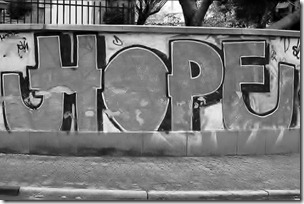
Those of you who have been to the heathland in The New Forest will know that it is areas of heather, criss-crossed with sandy paths. Even down by Whitten Pond, it is usually rather dry under foot, but not today.

The wet summer and the recent torrential rainfall has changed everything. The paths, where they have not been washed away, are a mixture of puddles and mud. The  peat beneath the clumps of heather is totally sodden, like walking on black sponge.

The fresh air seems to have done my cough and cold the world of good. The exercise, light though it may have been will have done no harm, but the jury is still out when it comes to assessing the effect of wearing very soggy shoes for a couple of hours.

Being prepared for what life throws at us is exactly what Buddhist practice is all about. Maybe I missed a lesson somewhere along the way, but I have failed to find the chapter in the Lotus Sutra that mentions stout footwear. I’ll keep looking.

There Is Always Hope

There Is Always HopeFollowing on from my rant about the inequalities and lack of fairness in the way modern governments and those in power treat us mere morals, I found this piece by Sensei rather encouraging …
What can the individual accomplish in the face of the huge institutions that run our world? This feeling of powerlessness fuels a vicious cycle that only worsens the situation and increases people’s sense of futility.

At the opposite extreme of this sense of powerlessness lie the Lotus Sutra’s philosophy of three thousand realms in a single moment of life and the application of this teaching to our daily lives.

This principle teaches us that the inner determination of an individual can transform everything; it gives ultimate expression to the infinite potential and dignity inherent in each human life.

~ Daisaku Ikeda

Ultimate Respect

The Lotus SutraThe Lotus Sutra, which explains that all people can attain Buddhahood and that all people are Buddhas, embodies a spirit of supreme respect for human beings.
By contrast, those teachings and ideas that seek to turn people into objects to be exploited, embody ultimate disrespect for human beings.

Such disrespect is an expression of fundamental darkness. On the level of the individual, practising the Lotus Sutra means confronting the fundamental darkness in one’s own life.

~ Daisaku Ikeda

Have Faith

The Lotus SutraBe resolved to summon forth the great power of faith, and chant Nam-Myoho-Renge-Kyo with the prayer that your faith will be steadfast and correct at the moment of death.

Never seek any other way to inherit the ultimate Law of life and death, and manifest it in your life. Only then will you realize that earthly desires are enlightenment, and that the sufferings of birth and death are nirvana. Even embracing the Lotus Sutra would be useless without the heritage of faith.

~ Nichiren

Every Child

Every Child Is PreciousWith my thoughts being dominated by Charlotte, and her slow and painful recovery from the latest surgery, whilst remembering that she is but one of my three children, I was reminded of this explanation, by Daisaku Ikeda, of a relevant parable from the Lotus Sutra.

Every child is precious. The Lotus Sutra tells the parable of the three kinds of medicinal herbs and two kinds of trees. There are many different kinds of plants; their shape, size and nature come in myriad varieties. Some plants grow fast while others take time to mature. In this parable, however, the heavens rain upon all the plants equally, nurturing their growth. And the plants blossom and bear fruits according to their own unique character.

This parable symbolizes the Buddha’s vast compassion to nurture all living beings despite their differences. All children are different; each possesses his or her wonderful unique quality. We must pour upon all children our great love and compassion so that each child can blossom, true to his or her unique quality.

~ Daisaku Ikeda

The Joy Of Life

Studying Buddhist PracticeWhat is true joy in life? This is a difficult question to answer, and one that has occupied the time of a great many thinkers and philosophers.

Joy is transitory and can quickly give way to suffering. Joy is often short and suffering often long.

Also, what passes for joy in society is superficial. It cannot compare with the joy derived from the Mystic Law. The key therefore, lies in cultivating a state of mind where we can declare without reservation, that life itself is a joy.

This is the purpose of our Buddhist practice.

~ Daisaku Ikeda

Nam Myoho Renge Kyo Explained

Nam Myoho Renge KyoThe most commonly asked questions, when people learn that I am a Buddhist, are ‘do you chant?’ followed by ‘what do you chant?’ and then ‘what does it mean?’. Nichiren Buddhists chant Nam Myoho Renge Kyo in a rhythmic mantra during Gongyo, and quite often at other times, to raise our Life-State and Life-Energy levels.

But what does it mean? Well it encapsulates many things, including affirmation of our devotion to the Lotus Sutra. This explanation comes from the  Soka Gakkai Dictionary of Buddhism.

[南無妙法蓮華経] Nam-myoho-renge-kyo

The ultimate Law or truth of the universe, according to Nichiren’s teaching. Nichiren first taught the invocation of Nam-myoho-renge-kyo to a small group of people at Seicho-ji temple in his native province of Awa, Japan, on the twenty-eighth day of the fourth month in 1253. It literally means devotion to Myoho-renge-kyo. Myoho-renge-kyo is the Japanese title of the Lotus Sutra, which Nichiren regards as the sutra’s essence, and appending nam (a phonetic change of namu ) to that phrase indicates devotion to the title and essence of the Lotus Sutra. Nichiren identifies it with the universal Law or principle implicit in the meaning of the sutra’s text.

The meaning of Nam-myoho-renge-kyo is explained in the opening section of The Record of the Orally Transmitted Teachings, the record of Nichiren’s lectures on the Lotus Sutra compiled by his disciple and successor, Nikko. It states that namu derives from the Sanskrit word namas and is translated as devotion, or as “dedicating one’s life.” What one should dedicate one’s life to, he says, are the Person and the Law. The Person signifies “Shakyamuni,” which means the eternal Buddha, and the Law is “the Lotus Sutra,” which means the ultimate truth, or Myoho-renge-kyo. According to Orally Transmitted Teachings, the act of devotion (namu) has two aspects: One is to devote oneself to, or fuse one’s life with, the eternal and unchanging truth; the other is that, through this fusion of one’s life with the ultimate truth, one simultaneously draws forth inexhaustible wisdom that functions in accordance with changing circumstances.

Orally Transmitted Teachings further states: “We may also note that the nam of Nam-myoho-renge-kyo is a Sanskrit word, while Myoho-renge-kyo are Chinese words. Sanskrit and Chinese join in a single moment to form Nam-myoho-renge-kyo. If we express the title [of the Lotus Sutra] in Sanskrit, it will be Saddharma-pundarika-sutra. This is Myoho-renge-kyo. Sad (a phonetic change of sat ) means myo, or wonderful. Dharma means ho, Law or phenomena. Pundarika means renge, or lotus blossom. Sutra means kyo, or sutra. The nine Chinese characters [that represent the Sanskrit title] are the Buddha bodies of the nine honoured ones. This expresses the idea that the nine worlds are none other than the Buddha world.”

Myo stands for the Dharma nature, or enlightenment, while ho represents darkness, or ignorance. Together as myoho, they express the idea that ignorance and the Dharma nature are a single entity, or one in essence. Renge stands for the two elements of cause and effect. Cause and effect are also a single entity.”

Kyo represents the words and voices of all living beings. A commentary says, ‘The voice carries out the work of the Buddha, and it is called kyo.’ Kyo may also be defined as that which is constant and unchanging in the three existences of past, present, and future. The Dharma realm is myoho, the wonderful Law; the Dharma realm is renge, the lotus blossom; the Dharma realm is kyo, the sutra.”

As Nichiren states, namu derives from Sanskrit, and Myoho-renge-kyo comes from Chinese. Nam-myoho-renge-kyo is, therefore, not simply a Japanese phrase, but a Japanese reading of a Sanskrit and Chinese phrase. In this sense, it contains aspects of the languages of three countries in which Mahayana Buddhism spread. According to Nichiren’s treatise The Entity of the Mystic Law, Nan-yüeh and T’ient’ai of China and Dengyoof Japan recited the invocation meaning devotion to the Lotus Sutra of the Wonderful Law, or Nam-myoho-renge-kyo, as their private practice, but they did not spread this practice to others.

In On the Three Great Secret Laws, Nichiren states that the daimoku Nichiren chants today in the Latter Day of the Law is different from that of the previous ages—the daimoku T’ient’ai and others chanted in the Former Day and Middle Day of the Law—because the practice of daimoku in the Latter Day of the Law involves chanting it oneself and teaching others to do so as well. Nichiren not only established the invocation (daimoku) of Nam-myoho-renge-kyo but embodied it as a mandala, making it the object of devotion called Gohonzon. In Reply to Kyo’o, he states, “I, Nichiren, have inscribed my life in sumi ink, so believe in the Gohonzon with your whole heart. The Buddha’s will is the Lotus Sutra, but the soul of Nichiren is nothing other than Nam-myoho-renge-kyo” (412).

Previous Older Entries Next Newer Entries