Ichinen Sanzen Explained

Ichinen Sanzen

Many thanks to Ken Hawkins for providing the following explanation of the Chinese symbols of Ichinen Sanzen.

Ichinen Sanzen is the wish-granting gem. There are as many sides to this gem as there are living beings. Like a gem, each side reflects its own reality. Our life is a wish-granting gem.

When we peer into our lives we can barely see our own reflection. But when we polish our lives through chanting and making efforts to improve ourselves, we can see ourselves reflected clearly.

When our gem is polished in this way we can see beyond our own reflection and see inside the gem that is the ultimate reality of all life.

Ichinen Sanzen in Chinese is composed of four main Chinese characters.

Ichi

Ichi

The first character (Ichi) is a horizontal line. It is the character one. It is both the beginning of the Chinese alphabet and  numbering system. In Buddhism, Ichi is the source of all beings.  The “Fundamental Essence” in the Japanese title of  Heritage of the Ultimate Law

Nen

Nen

Nen  is composed of three elemental characters. On top are three lines  forming a triangle. Under the triangle is a person bending to  completely enclose an object, and under the bending person is a  heart.

 – The triangle is a convergence of the elements of one’s life.

 – It combines with the bending person to form a compound meaning the  present moment. (All of one’s life is enfolded in the present  moment.)

 – The character, Kokoro or shin. The heart, in this case, is the core of intention. The derived meaning is to make present the heart’s intent, reviving or making real a person’s intent.

In some sects, “Nen” means mindfulness – that is being aware of the Buddha in the present moment.

San

San

San is the number three, representing heaven (the cosmos), earth, and humanity (also known as the three realms).

Zen

Zen

Zen is ten times 100. Connected to this concept is the harvest of crops or a thousand grains. The character for 1000 is also used to indicate an uncountable number.

Putting it all together:

Ichi

a single (Ichi) core intention in the present moment

Nen

makes real, enfolds, and harvests (Nen)

San

three (San)

Zen

thousand (Zen) – or uncountable – realms and possibilities.

A determination or decision (Ichi) at the core of your being makes real (Nen) that self-pledge or vow in all the realms (Sanzen) of your life.

A Day Of Learning And Tranquillity

Just PerfectWhat a glorious day it turned out to be. Beautiful sunshine, a cooling breeze, just perfect for a nice bit of learning and a spot of sunbathing.

So often lately it has been glorious all week and disappointing at the weekend, but not today.

I’ve spent the majority of the the day out on the balcony, reading Pat Allwright’s ‘Basics Of Buddhism’. Much of it reiterates what I already know, but it never hurts to go back over the basics. So much wisdom packed into such a little book.

To quote the opening page,

“If you wish to free yourself from the sufferings of birth and death you have endured through eternity and attain supreme enlightenment in this lifetime, you must awaken to the mystic truth which has always been within your life” -Nichiren Daishonin

It is quite a powerful statement with which to start a book, but as I know to my own benefit, the teachings within are just that powerful and could be the basis for a happier and more enlightened life for all of us.

We are, I believe, all Buddhists at heart, that is why, as Allwright says,

“People who hear about it [Buddhism] for the first time often remark ‘I always thought that anyway’. This is because ultimately, we all know the Universal Truths, but have become separated from them. The adventure into the inner self is an endless journey of discovery, insight and joy.”

I could not agree more.

Make Causes, See Effects

Kosen-RufuFollowing Ken’s insightful comment, I can see that although I was talking about morals, all life is about cause and effect.

So rather than drifting into the World of Tranquillity again, I have been making causes and am already starting to see effects.

I have been working on the topic for our discussion group, Transforming Society Through a Vision of Dynamic Peace. It has allowed me to read some very powerful ideas from Sensei and other thinkers and that study has had the effect of raising my life-state and that has taken me into the World of Learning.

One of the most powerful lessons has been that the only way to overcome Tranquillity is to push myself towards resolving an achievable goal. Another lesson, is that the cause of Kosen-Rufu requires constant effort and striving, to set the goal firmly in my heart, and to compose an understandable message to the rest of the world.

Back To Reality

EmbarrasingHaving re-read my post from yesterday, I was feeling a little embarrassed at the gushy nature of it. Then I read today’s entry from Buddhism Day by Day …

“Worthy persons deserve to be called so because they are not carried away by the eight winds: prosperity, decline, disgrace, honour, praise, censure, suffering and pleasure. They are neither elated by prosperity nor grieved by decline.”

Nichiren Daishonin ~ circa 1277

Well that put me well and truly in my place. Wise words from The Buddha for the Modern Age, as usual.

Here is the whole letter, written to one of The Daishonin’s loyal disciples, Shijo Kingo …

The Eight Winds

“I had been anxious about you because I had not heard from you in so long. I was overjoyed to receive your messenger, who arrived with your various offerings. I am going to bestow the Gohonzon on you for your protection.

About the problem of your transfer to another estate: I have studied your lord’s letter to you and your letter to me, and compared them. I anticipated this problem even before your letter arrived. Since your lord regards this as a matter of the utmost importance, I surmise that other retainers have spoken ill of you to him, saying: “He shows a lack of respect for you in his unwillingness to move to a new estate. There are many selfish people, but he is more selfish than most. We would advise you to show him no further kindness for the time being.” You must beware and act cautiously.

As vassals, you, your parents, and your close relatives are deeply indebted to your lord. Moreover, he showed you great clemency by taking no action against your clan when I incurred the wrath of the government and the entire nation hated me. Many of my disciples had their land seized by the government and were then disowned or driven from their lords’ estates. Even if he never shows you the slightest further consideration, you should not hold a grudge against your lord. It is too much to expect another favour from him, just because you are reluctant to move to a new estate.

Worthy persons deserve to be called so because they are not carried away by the eight winds: prosperity, decline, disgrace, honour, praise, censure, suffering, and pleasure. They are neither elated by prosperity nor grieved by decline. The heavenly gods will surely protect one who is unbending before the eight winds. But if you nurse an unreasonable grudge against your lord, they will not protect you, not for all your prayers.

When one goes to court, one may win one’s case, but then again one may lose, when satisfaction could have been obtained outside of court. I considered how the night watchmen might win their case. I felt great pity for them; they were deeply troubled, and their houses and lands had been confiscated just because they were Nichiren’s followers. I said that I would pray for them, provided they did not go to court. They agreed and promised not to go. So when I heard they had submitted petitions and were embroiled in lawsuits, I was concerned that it would not go their way; so far no results have been forthcoming.

Daigaku and Uemon no Tayu had their prayers answered because they followed my advice. Hakiri seems to believe my teachings, but he ignored my suggestions about his lawsuit, and so I have been concerned about its progress. Some good seems to have come of it, perhaps because I warned him that he would lose unless he followed my advice. But because he did not listen to the extent I had hoped, the outcome has been less fruitful than he expected.

If lay believers and their teacher pray with differing minds, their prayers will be as futile as trying to kindle a fire on water. Even if they pray with one mind, their prayers will go unanswered if they have long made the error of attacking greater teachings with lesser ones. Eventually, both lay believers and their teacher will be ruined.

Myoun was the fiftieth chief priest of the Tendai school. He was punished by the retired emperor in the fifth month of the second year of Angen (1176) and ordered into exile in the province of Izu. En route, however, he was rescued at Otsu by his priests from Mount Hiei. He reassumed his position as chief priest, but in the eleventh month of the second year of Juei (1183), he was captured by [Minamoto no] Yoshinaka and beheaded. I am not saying that being exiled or beheaded is in itself an indication of fault. Even sages and worthies undergo such things.

When civil war broke out between Yoritomo of the Minamoto clan and Kiyomori of the Taira clan, more than twenty of Kiyomori’s clansmen signed a pledge and affixed their seals. They vowed: “We will look to Mount Hiei as our clan temple. We will revere the three thousand monks as our own parents. The sorrows of the mountain temple will be our sorrows, and the joys of the mountain temple, our joys.” They donated all the twenty-four districts of Omi Province to the temple. Then the chief priest [Myoun] and his disciples employed all the rites of the True Word teachings in their prayers to vanquish the enemy and even ordered

their armed priests to shoot arrows at the Minamoto soldiers. Yoshinaka [of the Minamoto clan] and one of his retainers, Higuchi, however, accompanied by a mere five or six men, climbed Mount Hiei and burst into the main hall. They dragged Myoun from the platform where he was praying for victory, bound him with a rope, rolled him down the west slope of the mountain like a big stone, and beheaded him. Nevertheless, the people of Japan do not shun the True Word teachings, nor have they ever delved into this matter.

During the fifth, sixth, and seventh months of the third year of Jokyu (1221), the cyclical sign kanoto-mi, the imperial court and the barbarian warriors engaged in combat. At that time Mount Hiei, To-ji, the seven major temples of Nara, Onjo-ji, and the other temples each performed all the most esoteric rites of the True Word school in their prayers to the Sun Goddess, Great Bodhisattva Hachiman, the Mountain King, and other deities. Forty-one of the most renowned priests, including the General Administrator of Priests Jien, a former chief priest of the Tendai school, and the administrators of priests of To-ji, of Omuro, and of the Joju-in hall of Onjo-ji temple, prayed repeatedly for [Hojo] Yoshitoki’s defeat.

The prelate of Omuro also began a ceremony to overpower the enemies in Shishin-den Palace on the eighth day of the sixth month. He proclaimed that the imperial court would be victorious within seven days. But on the seventh day— the fourteenth day of the sixth month— the battle ended in defeat, and the prelate died of extreme grief because his beloved page, Setaka, had been beheaded. Yet despite all this, no one ever wondered what was wrong with the True Word doctrines. The ceremonies that incorporated all the True Word doctrines— the first conducted by Myoun and the second by Jien— resulted in the complete collapse of royal rule in Japan. Now, for the third time, a special religious ceremony is being held to ward off the Mongol invasion. The present regime will surely suffer the same fate. This is a confidential matter; you should keep it strictly to yourself.

As for your own problem, I advise you not to go to court. Neither harbour a grudge against your lord, nor leave his service. Stay on in Kamakura. Go to attend on your lord less frequently than before; wait upon him only from time to time. Then you can expect that your wish will be fulfilled. Never conduct yourself in a shameful manner. Be unmoved by greed, by the desire for fame, or by anger.”

WND-1, p794

Always Keep Believing

PoisonMy progress, through my Practice, has been pretty steady and positive.

So imagine my surprise when I seemed to take a step backwards yesterday. Nothing terminal, of course, and maybe it was long overdue.

Naturally, it’s tempting to only blog my successes, the good things, and paint a rosy picture. But that wouldn’t be a true reflection of my path.

I’m not going to go into details, but I am going to use this problem to strengthen my resolve, so more poison into medicine and proof that my faith is strong..

The Limitation Of Changes

Sadness On The Path To HappinessI know that my Buddhist practice has changed the way I interact with everything and everyone in my own personal Universe.
The change is difficult to explain, and even more difficult to prove over the short term to others within that Universe.

Those difficulties are still further compounded by the fact that no matter how radical the change, nothing can change the past.

Like karma, my past was formed from the past causes I made. What I can do, is to try to make better causes now, and in the future. What I can not do, is influence the past.

That limitation is, I have to say, a very real sadness on this journey towards a happier and more enlightened future.

A Blinkered View

A Blinkered ViewThe fourth and final part of Professor Brian Cox’s Wonders Of The Universe covered the role that light has played, and continues to play in the evolution of the Universe as well as our understanding of it.

By examining the properties of the light reaching the Earth from the most distant galaxies, we can determine the age of the Universe and track its history from the Big Bang, right up to today.

All the scientific evidence shows us that the beginning of every thing was around 13.7 billion years. 13.7 Billion, not Million, Billion years ago. That is a mind blowing figure, a figure that puts our three score and ten lifetime into true perspective.

Even the widely accepted time that man came into existence, 2.4 million years ago, is belittled by such timescales.

I find these figures fascinating, and it lends a certain credence to my Buddhist belief, that we are born, live, and die, again and again through reincarnation. Whilst I respect everyone’s right to their own beliefs, I find some faiths more credible than others.

One branch of faith, which is growing in strength and following, is Creationism or Intelligent Design. Although they purport to be different, they appear to try to overturn the science of evolution from opposite ends of the same argument. The theory that all the creatures on Earth, including man, were created or designed by God flies in the face of accepted and verifiable proof of the process of evolution.

Harping back to my post about youth, and that our youths are our future, I feel strongly that they should be given all the ‘facts’ to allow them to make up their own minds. Hence the growing pressure to abandon the teaching of Darwinism in US schools is a blinkered and foolish path to tread.

If the protagonists of this determination are so confident of their beliefs, why do they ban the teaching of alternative views. I hope that they will open their eyes, and their minds and see that ‘channelling’ their children down this blinkered route, can only end in tears once the betrayal becomes clear.

Inspiration Every Day

Postman PatA parcel arrived in the post this morning, that will offer a little inspiration every day.

In the parcel was a copy of Daisaku Ikeda’s Buddhism Day by Day. Like a diary, it offers a different thought provoking passage for every day of the year.

I had seen the book before, on the SGI website, but my thanks go to Thierry for bringing the Wisdom of its contents to my attention.

Although it is primarily a compilation of Sensei’s thoughts, with an obvious Buddhist slant, I believe it would be an inspiration for anyone, irrespective of their religion or beliefs.

Here are a few of examples …

February 17

“True individuality never comes to full flower without hard work. Therefore you’re making a big mistake if you think that who you are right now represents all you are capable of being.”

March 25

“The significance of Buddhism lies both in the discovery of the Buddha nature in all beings and in the establishment of a practical method for bringing it out, so that human beings can derive maximum meaning from their lives. This reformation of the inner human world – what we in the Soka Gakkai call ‘human revolution’ – is especially relevant to modern civilisation, which has long been trapped in a sort of spiritual quicksand. We can escape the quicksand by calling forth the supreme human potential available to each of us.”

July 31

“What is the purpose of life? It is happiness. But there are two kinds of happiness: relative and absolute. Relative happiness comes in a wide variety of forms. The purpose of Buddhism is to attain Buddhahood. In modern terms, this could be explained as realising absolute happiness – a state of happiness that can never be destroyed or defeated.”

I think a little snippet of Sensei’s wisdom, each morning, will set me up for the day.

Wimborne Men’s Meeting

Buddhism Day by Day - Daisaku IkedaThis morning was great. The sun was shining and the short trip to Jack Horwood’s house in Wimborne, for the meeting, was traffic free.

I really like the idea that the SGI districts have men’s and women’s meetings, as well as meetings for everyone. This morning was a men’s meeting and there were half a dozen of us in attendance.

Of course Jack and Ken were there, as was Boots, who appears to have a season ticket, because he’s been at every meeting I have attended since finding the local groups. Good on you Boots. Thierry and Jeff arrived a little later, having come from Dorchester. Jack has a beautiful garret room, dedicated to his Butsudan, very conducive to concentrating on Practice and study.

Having had a quick coffee, which was very welcome and did a good job of waking me up, we sat and chanted, guided by Ken. Again, the energy of the group was amazing, and being all male voices, the dynamic of the resonance was different from that at the mixed meetings.

I know I’ve said this a number of times, but the energy levels at group chanting sessions are so much higher than when I chant alone. It’s a bit addictive if I’m honest.

Following Gongyo, the group discussion started with Thierry reading some quotes, from the last few days, from Daisaku Ikeda’s book Buddhism Day By Day. It has, as you might expect, a quote for every day of the year. and as with all Sensei’s writings, they were full of wisdom and provided several interesting talking points. The discussion continued on a varied and diverse number of topics, with much humour, but with much to absorb, me being a complete novice compared to the others.

I was given the honour of closing the meeting by chanting Nam Myoho Renge Kyo and ringing the bell three times. Even I couldn’t muck that up.

So the morning flew by and, as always, I left feeling full of life-energy, having learned more about the Practice and Nichiren Buddhism in general.

My thanks to Jack for being the perfect host, and to the guys for making me welcome as usual.

The Wonderful World Of Woollard

The Reluctant BuddhistAs I mentioned yesterday, I’ve been re-reading and listening to William Woollard’s book The Reluctant Buddhist. It’s a fantastic account of William’s journey from Buddhist sceptic to devout Nichiren Buddhist practitioner.
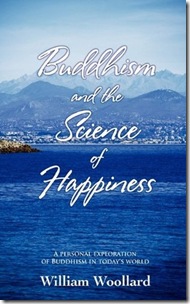
His second book, Buddhism And The Science Of Happiness is, in my opinion, is an even better read. More scientific, to which I can relate, it shows how modern science is converging towards the Buddhist principles of eternal change and energy, all the time.

Sometimes tasks are a bit of a labour of love. So it was with the process of organising the chapters from William’s books from Jason Jarrett’s podcasts. I worked on the mp3 files for hours, arranging them into a structure that allows me to store them on my mobile phone and play them back through my car stereo on my way to and from work.

Buddhism and the Science of HappinessI find that listening to books on the drive to work, coupled with my morning chanting, puts me in a higher life-state, and helps me apply Buddhist principles to my working day. The same applies to the drive home, the World of learning again raises my life-state and means that I am in one of the higher Ten Worlds for the rest of the day. I find the higher the World I am in, the happier I am.

Given that the main reason I practice Nichiren Buddhism is to make me a happier person, I find that this way I can virtually guarantee that I am happy for most of the day, seven day a week.

So you can just imagine what a happy chappie I am today, almost 48hrs of the Wonderful World of Woollard has been fantastic. Thank you William, please keep the inspiration coming. I would also like to extend my thanks to Jason Jarrett for working with William to bring William’s books to the whole world, through his amazing podcasts.

Previous Older Entries Next Newer Entries