Passing It On

Ed is having a hard time - at work, in his love life and, well, generally. Then he meets an unlikely Buddhist - who drinks and smokes and talks his kind of language. Bit by bit, things begin to change...When you find something that excites and enthuses you, you want to tell people about it and spread the news. When it is a spiritual matter it can be a more delicate situation, wanting to be enthusiastic without being evangelical or overbearing.

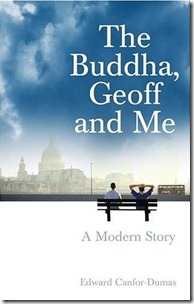
My go to book, as we all know, is The Buddha, Geoff and Me, beautifully simple, brilliantly written and, for me at least, a life changer. So to make a present of the book, to someone you care about, might be an idea.

That way, you show you care, you pass on the idea , but you don’t force the issue. If they are interested they may choose to read it. They also have the chance to pass on the news at a later date, if they so decide. And so the good news spreads.

Walking In Another Person’s Shoes

Another Person's ShoesThere is an old saying, that before you criticise someone, you should walk a mile in their shoes. That way, when you criticise them, you have a pair of their shoes, and you are a mile away 🙂

But seriously, it is easy to see the faults in another when you are only seeing things from your point of view.

There is a wise Buddhist saying that says ‘we hate in others, what we refuse to see in ourselves’. Before you start picking on someone for their faults, make sure that you don’t have the same faults yourself.

Seeing the other persons viewpoint takes wisdom, courage and compassion, particularly in the heat of the moment. But taking a few seconds to allow yourself to become mindful, and then trying to reach a balanced view will do no harm, and may help resolve the issue once and for all.

The Learning Process

Look Both WaysI love the way this poem beautifully encapsulates the stages of learning, and the long, long road to enlightenment …

  1. I walk down the street.
    There is a deep hole in the sidewalk
    I fall in.
    I am lost…
    I am hopeless.
    It isn’t my fault.
    It takes forever to find a way out.
    ~~~~
  2. I walk down the same street.
    There is a deep hole in the sidewalk.
    I pretend I don’t see it.
    I fall in again.
    I can’t believe I’m in the same place.
    But it isn’t my fault.
    It still takes a long time to get out.
    ~~~~
  3. I walk down the same street.
    There is a deep hole in the sidewalk.
    I see it is there.
    I still fall in…it’s a habit
    My eyes are open; I know where I am;
    It is my fault.
    I get out immediately.
    ~~~~
  4. I walk down the same street.
    There is a deep hole in the sidewalk.
    I walk around it.
    ~~~~
  5. I walk down another street.
~ Portia Nelson

On Ichinen Sanzen

Ichinen SanzenMany thanks to that most learned of  fellows, Ken Hawkins, for providing the following explanation of the Chinese symbols of Ichinen Sanzen.

Ichinen Sanzen is the wish-granting gem.

There are as many sides to this gem as there are living beings. Like a gem, each side reflects its own reality. Our life is a wish-granting gem.

When we peer into our lives we can barely see our own reflection. But when we polish our lives through chanting and making efforts to improve ourselves, we can see ourselves reflected clearly.

When our gem is polished in this way we can see beyond our own reflection and see inside the gem that is the ultimate reality of all life.

Ichinen Sanzen in Chinese is composed of four main Chinese characters.

Ichi

Ichi

The first character (Ichi) is a horizontal line. It is the character one. It is both the beginning of the Chinese alphabet and  numbering system. In Buddhism, Ichi is the source of all beings.  The “Fundamental Essence” in the Japanese title of  Heritage of the Ultimate Law

Nen

Nen

Nen  is composed of three elemental characters. On top are three lines  forming a triangle. Under the triangle is a person bending to  completely enclose an object, and under the bending person is a  heart.

– The triangle is a convergence of the elements of one’s life.

– It combines with the bending person to form a compound meaning the  present moment. (All of one’s life is enfolded in the present  moment.)

– The character, Kokoro or shin. The heart, in this case, is the core of intention. The derived meaning is to make present the heart’s intent, reviving or making real a person’s intent.

In some sects, “Nen” means mindfulness – that is being aware of the Buddha in the present moment.

San

San

San is the number three, representing heaven (the cosmos), earth, and humanity (also known as the three realms).

Zen

Zen

Zen is ten times 100. Connected to this concept is the harvest of crops or a thousand grains. The character for 1000 is also used to indicate an uncountable number.

Putting it all together:

Ichi

a single (Ichi) core intention in the present moment

Nen

makes real, enfolds, and harvests (Nen)

San

three (San)

Zen

thousand (Zen) – or uncountable – realms and possibilities.

A determination or decision (Ichi) at the core of your being makes real (Nen) that self-pledge or vow in all the realms (Sanzen) of your life.

Learn To Know Thyself

Socrates - 'Know Thyself'The path to enlightenment involves a lot of learning, much of it about ourselves. My growing emphasis on mindfulness leads to much self examination, of feelings, thoughts and of the workings of the mind.

Wisdom is rooted in the souls of human beings. The way to acquire it is to follow the simple advice of Socrates – ‘Know Thyself’.

This is the starting point for the establishment of a sense of human dignity, preventing the degradation of human beings into anonymous, interchangeable cogs in a machine.

The basis of all true knowledge is self knowledge.

Forever Reading

Forever ReadingDaisaku Ikeda, in his book, Buddhism Day By Day, says this about the act of reading:

‘Reading is dialogue with oneself; it is self-reflection, which cultivates profound humanity. Reading is therefore essential to our development.

It expands and enriches the personality like a seed that germinates after a long time and sends forth many blossom-laden branches.

People who can say of a book ‘this changed my life’ truly understand the meaning of happiness. Reading that sparks inner revolution is desperately needed to escape drowning in the rapidly advancing information society.

Reading is more than intellectual ornamentation; it is a battle for the establishment of the self, a ceaseless challenge that keeps us young and vigorous.’

We all know which book ‘changed my life’, and I can confirm that I fully understand the meaning of the happiness that this encompasses. Books transformed civilisation in the broadest sense when they became widely available via the printing presses of William Caxton and all those who have followed.

The advent of the world wide web and the internet has simply taken that process to the Nth level. The dissemination of information, and the written word has never been so widespread. Although there are associated dangers and we must be circumspect about the source of the information we consume, there has never been an easier time to read.

During my CELTA course I read to expand my knowledge of the English language, currently I am reading to increase my understanding of psychology and the workings of the mind. Whatever we read, be it fact or fiction, it adds to the kaleidoscope of facts and emotions locked in our brains, so read and read and read again, it will never be a waste of your precious time.

There’s A Kind Of Hush …

There's A Kind Of HushAs you know, I’ve just had the perfect long weekend. Albeit that it’s a couple of days ago now, but the memories are still sinking in. In the past, I might be rueing having to come back to work, but the period I had without work has rather put a stop to that, and it’s also because I now have the ability to pour a mental calm over everything.

You know the calm I mean, at least I hope you do, when slowly everything starts to come together, to fit into place and there’s a soft and easy feel about things. At work, at home, in my practice, in fact in life, I have definitely turned some magical corner and tranquillity is the result.

Not that tranquillity itself is necessarily always a good thing. It can make us lazy, complacent, stop setting goals for ourselves or making the causes for the effects we want to see. But the tranquillity that accompanies the calmness of a balanced situation is very magical indeed.

Sometimes we have to go through a rough ride to reach the place we want to be. During the ride it’s tough, tranquillity is a million miles away and sometimes appears to be receding fast. But if you stick with it, learn from the pain and make the necessary causes, you will reap the benefits of the effects when they arrive.

So stick with it. If you have confidence in your goals, remain determined and resolute in your quest, and have the courage to withstand the pain, you too will see the benefits. It’s marvellous.

Through Different Eyes

Through Different EyesDo you remember the day you mastered the art of riding a bicycle? Of course you do. For me, it was the culmination of a rather lengthy, and very frustrating process, and but for the perseverance  of my father, I might never have learned at all.

I just couldn’t seem to get it. It looked so simple, but the harder I tried, the worse I got. Then suddenly it clicked, I had it nailed, and from that day on I have been able to ride a bike.

Ok, so it’s no huge revelation, but I think learning about Buddhism is a bit like learning to ride a bike.

As you learn, about The Oneness of Self and the Universe, about Karma, about Life-Energy or The Ten Worlds, you also learn to see yourself, life and the Universe in a different way. And just in the way that having learned to ride a bicycle, you never unlearn the skill, once you learn to see the world through different eyes, you never unlearn that either.

Deep in my heart, I know that I am different for having Buddhism at the centre of my life. Some people have noticed that change, others ask what has changed and how I know that it’s a real change, not just a fad, or ‘a phase I’m going through’.

Well as I say, once you see the world differently, you just can’t un-see it that way. It’s a wonderful change, and I’m very confident, not to say delighted, that it’s a permanent change.

All In Good Time

You Can Lead A Horse To WaterYou’ve probably heard the old adage, ‘you can lead a horse to water, but you can’t make it drink’.

I believe it means that you can introduce an idea to someone, but you can’t make them accept the suggestion.

So it is with Nichiren Buddhism, or in fact vegetarianism or veganism, but let’s focus on Buddhism in this instance.

I have many friends who show an interest in my Practice. They ask lots of questions, often offer their views and sometimes will join me in Daimoku or Gongyo.

I find that the most difficult thing about this, is to feed their inquisitive nature without allowing my own enthusiasm to take over. It is so easy to appear evangelical and that can be a most unattractive trait, particularly for someone who is just taking the first tentative steps.

If you were teaching a child to swim, you wouldn’t take them to the poolside, explain a little about how to do the breast stroke and then push them into the deep end to experience it for themselves. At best, they might flounder their way back to the side, never to ask you for guidance ever again, at worst they might get into real difficulties, need rescuing and develop such a phobia, that they would never go near deep water again.

And so it can be with Buddhism. Like learning to swim, Buddhist practice can open up amazing new vistas on the world and be a life-long pleasure, but it has to be introduced gently, wisely and at the right pace for each and every individual.

To try to rush someone into Buddhism, or swimming for that matter, may be depriving that person of a life-changing journey, so show some wisdom and let them go at their own pace.
Writing Nice Letters To Ourselves?

Creating Our Own DestinyThe law of cause and effect, action and reaction, applies to everything in life and forms the basis of our Karma.

The results of all the causes we have made in this, and previous lives, is precisely why we are where we are today.

The more good causes we create, generally speaking, the more good effects we see, and the happier we are with our lives.

Dora, in the book The Buddha, Geoff and Me, explains that Karma is a bit like letters we write to ourselves. Many of those letters were written so long ago, that we have forgotten all about them.

The nice letters are lovely surprises when they arrive. Nasty ones come as a bit of a shock, they may annoy us and we might even write another nasty one in response. Of course, in time, those responses get delivered too, so the cycle can repeat itself, time after time.

That is, of course, until you understand the way the process works. Once you realise that you create the causes, you can create causes for nice, or good effects, rather than going round and round forever.

I cannot imagine a more important lesson to learn, to know that your Karma, and hence your future, is determined by you? It is the most empowering feeling, to take control of your life and to have your destiny in your own hands.

Previous Older Entries Next Newer Entries