On Beads & Chanting

Click for a larger imageIn the practice of Nichiren Buddhism, we hold juzu beads in our hands while reciting Gongyo and chanting Diamoku.

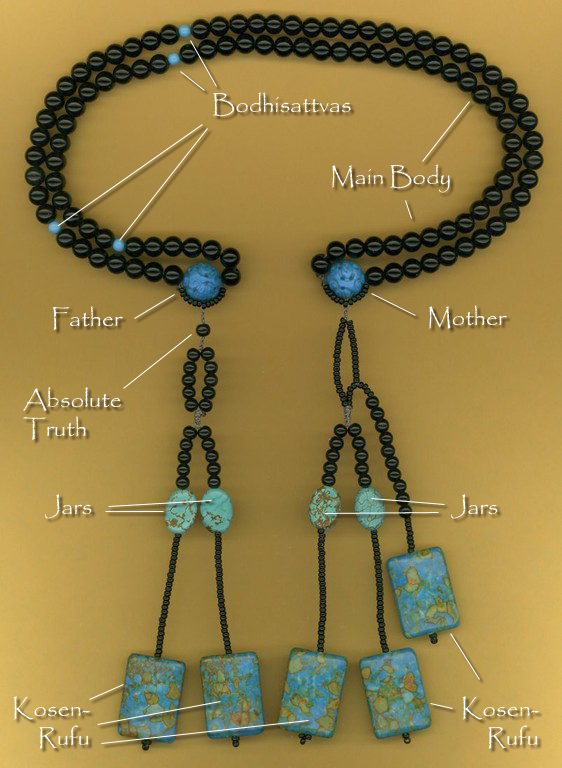
There are 108 beads in the main body, signifying the 108 Earthly Desires.

The 4 smaller beads in the main body represent the 4 Great Bodhisattvas of the Earth … Jogyo, Muhengyo, Jyogyo, and Anryugyo.

The 2 large beads at each end of the main body, are the “parent” beads.  The “mother” bead, representing “mystic” is on the side with 3 dangles, and is placed over the middle finger of the right hand.  The “father” bead, representing “law” is on the side with 2 dangles, and is placed on the middle finger of the left hand.

We cross the beads in the middle, which shows our oneness with The Law.  Also, we cross the beads so our benefits do not fall through our hands and lives.  By placing the beads on our hands this way, we are accepting the reality that Buddhahood exists within our lives.

When we press our hands together while we hold our juzu beads, our 10 fingers represent the 10 Worlds which fuse together simultaneously in the life of a Buddha, our lives.  Our life is now one with the Mystic Law!

The one small bead that sits below the “father” bead, represents Absolute Truth.

Prior to Nichiren Buddhism, there were only 2 dangles on each end of juzu beads.  The third dangle, consisting of 10 beads and a “Kosen-Rufu” bead, on the side of the “mother” was added, actually tied on, to signify Nichiren Buddhism and distinguish it from other Buddhist sects.

On the remaining 4 dangles, there is a differently shaped bead part way down each string.  This bead is called the “jar” bead and holds the benefits of our practice.

The 5 larger beads at the bottom of each dangle are the “Kosen-Rufu” beads, and represent our desire to spread Nichiren Buddhism,  Kosen-Rufu, throughout the World.

My huge thanks are due to my lovely friend Lily Rose of Myoho Beads for researching the meanings of the individual beads and for allowing me to use her explanation.

As Lily Rose says on her site, be careful buying juzu beads on line.  Use this description or the juzu purchased in SGI bookstores as a guide.  Make sure the beads you purchase have been created in an ethical and politically correct manner. Sorry to say, but many are not.

If you would like to learn more about chanting, this link will take you to a very informative video produced by SGI.
Prayer Beads

Click for a larger imageIn the practice of Nichiren Buddhism, we hold juzu beads in our hands while reciting Gongyo and chanting Diamoku.

There are 108 beads in the main body, signifying the 108 Earthly Desires.

The 4 smaller beads in the main body represent the 4 Great Bodhisattvas of the Earth … Jogyo, Muhengyo, Jyogyo, and Anryugyo.

The 2 large beads at each end of the main body, are the “parent” beads.  The “mother” bead, representing “mystic” is on the side with 3 dangles, and is placed over the middle finger of the right hand.  The “father” bead, representing “law” is on the side with 2 dangles, and is placed on the middle finger of the left hand.

We cross the beads in the middle, which shows our oneness with THE LAW.  Also, we cross the beads so our benefits do not fall through our hands and lives.  By placing the beads on our hands this way, we are accepting the reality that Buddhahood exists within our lives.

When we press our hands together while we hold our juzu beads, our 10 fingers represent the 10 Worlds which fuse together simultaneously in the life of a Buddha, our lives.  Our life is now one with the Mystic Law!

The one small bead that sits below the “father” bead, represents Absolute Truth.

Prior to Nichiren Buddhism, there were only 2 dangles on each end of juzu beads.  The third dangle, consisting of 10 beads and a “Kosen-Rufu” bead, on the side of the “mother” was added, actually tied on, to signify Nichiren Buddhism and distinguish it from other Buddhist sects.

On the remaining 4 dangles, there is a differently shaped bead part way down each string.  This bead is called the “jar” bead and holds the benefits of our practice.

The 5 larger beads at the bottom of each dangle are the “Kosen-Rufu” beads, and represent our desire to spread Nichiren Buddhism,  Kosen-Rufu, throughout the World.

My huge thanks are due to my lovely friend Lily Rose of Myoho Beads for researching the meanings of the individual beads and for allowing me to use her explanation.

As Lily Rose says on her site, be careful buying juzu beads on line.  Use this description or the juzu purchased in SGI bookstores as a guide.  Make sure the beads you purchase have been created in an ethical and politically correct manner. Sorry to say, but many are not.

If you would like to learn more about chanting, this link will take you to a very informative video produced by SGI.

Juzu Beads & Chanting

Click for a larger imageIn the practice of Nichiren Buddhism, we hold juzu beads in our hands while reciting Gongyo and chanting Diamoku.

There are 108 beads in the main body, signifying the 108 Earthly Desires.

The 4 smaller beads in the main body represent the 4 Great Bodhisattvas of the Earth … Jogyo, Muhengyo, Jyogyo, and Anryugyo.

The 2 large beads at each end of the main body, are the “parent” beads.  The “mother” bead, representing “mystic” is on the side with 3 dangles, and is placed over the middle finger of the right hand.  The “father” bead, representing “law” is on the side with 2 dangles, and is placed on the middle finger of the left hand.

We cross the beads in the middle, which shows our oneness with The Law.  Also, we cross the beads so our benefits do not fall through our hands and lives.  By placing the beads on our hands this way, we are accepting the reality that Buddhahood exists within our lives.

When we press our hands together while we hold our juzu beads, our 10 fingers represent the 10 Worlds which fuse together simultaneously in the life of a Buddha, our lives.  Our life is now one with the Mystic Law!

The one small bead that sits below the “father” bead, represents Absolute Truth.

Prior to Nichiren Buddhism, there were only 2 dangles on each end of juzu beads.  The third dangle, consisting of 10 beads and a “Kosen-Rufu” bead, on the side of the “mother” was added, actually tied on, to signify Nichiren Buddhism and distinguish it from other Buddhist sects.

On the remaining 4 dangles, there is a differently shaped bead part way down each string.  This bead is called the “jar” bead and holds the benefits of our practice.

The 5 larger beads at the bottom of each dangle are the “Kosen-Rufu” beads, and represent our desire to spread Nichiren Buddhism,  Kosen-Rufu, throughout the World.

My huge thanks are due to my lovely friend Lily Rose of Myoho Beads for researching the meanings of the individual beads and for allowing me to use her explanation.

As Lily Rose says on her site, be careful buying juzu beads on line.  Use this description or the juzu purchased in SGI bookstores as a guide.  Make sure the beads you purchase have been created in an ethical and politically correct manner. Sorry to say, but many are not.

If you would like to learn more about chanting, this link will take you to a very informative video produced by SGI.

Back In The Groove

Back In The GrooveWith the pressure of work having eased slightly, albeit for only a few days, it was nice to give more time and focus to my Practice.

It never ceases to amaze me how quickly things drift to the back of your mind when they don’t receive the attention they deserve. So it was with my Gongyo, having been too tied up to make a proper job of it.

Now I know what you are saying, that my Honzon should come first, last and everywhere in between. But life isn’t like that really, is it? Man cannot life by Gongyo alone, to paraphrase, so work had to take precedence.

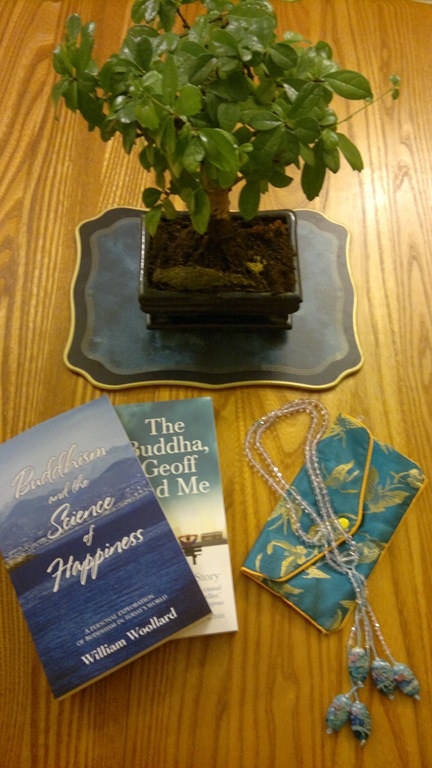
While I was at work this week, my two books arrived and until this evening I hadn’t even had time to open the parcel to take a quick peek.

The copy of The Buddha, Geoff and Me is similar in every respect to the last one I owned. No surprise there, though it will be good to have an old friend back on my bedside cabinet.

Having dipped into the new William Woollard, it does look interesting. He has a way of saying very profound or very technical concepts in a very easy to understand way, a real gift. He has been struggling against cancer and I will be very interested in how he has gone about it. I say struggled against cancer, but he is so grounded, that I can’t imagine William struggling against anything now.

Any road up, as my Mom might say, it’s nice to be back in the swing and I’m looking forward to relating my take on Buddhism and the Science of Happiness to you over the coming weeks.

P.S. In case anyone is wondering where the Juzu beads came from, they were made by my friend Lily Rose at Myoho Beads. Lily Rose is a lovely lady who happens to live just round the corner from the Arizona supermarket where the US Senator was shot a little while back. I really get in touch to make sure she is recovering from the shock of it all.