Complete Gongyo

Lotus FlowerIt has been asked, ‘Why do we chant two verses of the Lotus Sutra during Gongyo, when Nichiren says that chanting Nam Myoho Renge Kyo is the true path to enlightenment?’

The Lotus Sutra has the drama of fighting for justice against evil. It has the warmth that comforts the weary. It has a vibrant, pulsing courage that drives away fear. It has a chorus of joy at attaining absolute freedom throughout past, present and future. It has the soaring flight of liberty. It has brilliant light, flowers, greenery, music, painting, vivid stories. It offers unsurpassed lessons on psychology, the workings of the human heart, lessons on life, lessons on happiness and lessons on peace. It maps out the basic rules for good health.

But maybe most importantly, it awakens us to the Universal Truth, that a change in one’s heart can transform everything.

Nam Myoho Renge Kyo.

Gongyo, Daily Respite

ButsudanThe twice daily chanting of Gongyo is the basis of Nichiren Buddhist Practice.

Reciting two chapters of the Lotus Sutra and chanting Nam Myoho Renge Kyo is my way of moulding my mind, my heart, my very life, towards Buddhahood.

The twice daily routine is not always easy. There are times in the morning when I would rather have a little more time in bed. In the evening, there are times when there are important things to get done, or I am tired. But I Practice all the same.

Before I chant I sometimes focus on a particular problem or situation. Then sitting in front of the Gohonzon I chant, and as I chant I detach myself from the stresses of everyday life and let the repetition of Diamoku still, cleanse, stir and stimulate my heart and mind.

Speaking personally, I look forward to Gongyo. The day hasn’t started till morning Gongyo has been done, and the day is only complete when evening Gongyo is complete.

If there are times when you don’t feel like chanting remember one thing, the only person who loses out if you skip it … is you.

Nam Myoho Renge Kyo.

You Can Lead A Horse To Water

You Can Lead A Horse To WaterYou know the old adage, ‘you can lead a horse to water, but you can’t make it drink’. I believe it means that you can introduce an idea to someone, but you can’t make them accept the suggestion.

So it is with Nichiren Buddhism, or in fact any religion, but let’s talk about Buddhism in this instance.

I have many friends who show an interest in my Practice. They ask lots of questions, often offer their views and sometimes will join me in Daimoku or Gongyo.

I find that the most difficult thing about this, is to feed their inquisitive nature without allowing my own enthusiasm to take over. It is so easy to appear evangelical and that can be a most unattractive trait, particularly for someone who is just taking the first tentative steps.

If you were teaching a child to swim, you wouldn’t take them to the poolside, explain a little about how to do the breast stroke and then push them into the deep end to experience it for themselves. At best, they might flounder their way back to the side, never to ask you for guidance ever again, at worst they might get into real difficulties, need rescuing and develop such a phobia, that they would never go near deep water again.

And so it can be with Buddhism. Like learning to swim, Buddhist practice can open up amazing new vistas on the world and be a life-long pleasure, but it has to be introduced gently, wisely and at the right pace for each and every individual.

To try to rush someone into Buddhism, or swimming for that matter, may be depriving that person of a life-changing journey, so show some wisdom and let them go at their own pace.

Gongyo Translated – The Life Span Chapter

The Lotus SutraFollowing yesterday’s post about the Expedient Means chapter, here is the translation of the second chapter recited during Gongyo, The Life Span of the Thus Come One (Juryo) chapter, sometimes abbreviated to The Life Span chapter.

To explain further, The Life Span of the Thus Come One refers to the duration of Shakyamuni’s life as a Buddha.

As previously, the Japanese phonetic recital is in italics, with the English translation below.

Ji ga toku bur-rai. Sho kyo sho kosshu. Muryo hyaku sen man. Oku sai asogi. Jo seppo kyoke Mushu oku shujo. Ryo nyu o butsu-do. Nirai muryo ko.

Since I attained Buddhahood the number of kalpas that have passed is an immeasurable hundreds, thousands, ten thousands, millions, trillions, asamkhyas. Constantly I have preached the Law, teaching, converting countless millions of living beings, causing them to enter the Buddha way, all this for immeasurable kalpas.

I do shujo ko. Hoben gen nehan. Ni jitsu fu metsu-do. Jo ju shi seppo.

In order to save living beings, as an expedient means I appear to enter nirvana but in truth I do not pass into extinction. I am always here preaching the Law.

Ga jo ju o shi. I sho jin-zu-riki. Ryo tendo shujo. Sui gon ni fu ken.

I am always here, but through my transcendental powers I make it so that living beings in their befuddlement do not see me even when close by.

Shu ken ga metsu-do. Ko kuyo shari. Gen kai e renbo. Ni sho katsu-go shin.

When the multitude see that I have passed into extinction, far and wide they offer alms to my relics. All harbor thoughts of yearning and in their minds thirst to gaze at me.

Shujo ki shin-buku. Shichi-jiki i nyunan. Isshin yok-ken butsu. Fu ji shaku shinmyo. Ji ga gyu shuso. Ku shutsu ryojusen.

When living beings have become truly faithful, honest and upright, gentle in intent, single-mindedly desiring to see the Buddha not hesitating even if it costs them their lives, then I and the assembly of monks appear together on Holy Eagle Peak.

Ga ji go shujo. Jo zai shi fu-metsu. I hobenrik-ko. Gen u metsu fu-metsu. Yo-koku u shujo. Kugyo shingyo sha. Ga bu o hi chu. I setsu mujo ho.

At that time I tell the living beings that I am always here, never entering extinction, but that because of the power of an expedient means at times I appear to be extinct, at other times not, and that if there are living beings in other lands who are reverent and sincere in their wish to believe, then among them too I will preach the unsurpassed Law.

Nyoto fu mon shi. Tan ni ga metsu-do. Ga ken sho shujo. Motsu-zai o kukai. Ko fu i gen shin. Ryo go sho katsu-go. In go shin renbo. Nai shutsu I seppo.

But you have not heard of this, so you suppose that I enter extinction. When I look at living beings I see them drowned in a sea of suffering; therefore I do not show myself, causing them to thirst for me. Then when their minds are filled with yearning, at last I appear and preach the Law for them.

Jin-zu riki nyo ze. O asogi ko. Jo zai ryo jusen. Gyu yo sho jusho. Shujo ken ko jin. Dai ka sho sho ji. Ga shi do annon. Tennin jo juman. Onrin sho dokaku. Shuju ho Shogon. Hoju ta keka. Shujo sho yuraku. Shoten gyaku tenku. Jo sas-shu gi-gaku. U mandara ke. San butsu gyu daishu. Ga jodo fu ki. Ni shu ken sho jin. Ufu sho kuno. Nyo ze shitsu juman.

Such are my transcendental powers. For asamkhya kalpas constantly I have dwelled on Holy Eagle Peak and in various other places. When living beings witness the end of a kalpa and all is consumed in a great fire, this, my land, remains safe and tranquil, constantly filled with heavenly and human beings. The halls and pavilions in its gardens and groves are adorned with various kinds of gems. Jewelled trees abound in flowers and fruit where living beings enjoy themselves at ease. The gods strike heavenly drums, constantly making many kinds of music. Mandarava blossoms rain down, scattering over the Buddha and the great assembly. My pure land is not destroyed, yet the multitude see it as consumed in fire, with anxiety, fear and other sufferings filling it everywhere.

Ze sho zai shujo. I aku-go innen. Ka asogi ko. Fu mon sanbo myo.

These living beings with their various offenses, through causes arising from their evil actions, spend asamkhya kalpas without hearing the name of the Three Treasures.

Sho u shu ku-doku. Nyuwa shichi-jiki sha. Sokkai ken gashin. Zai shi ni seppo. Waku-ji i shi shu. Setsu butsu-ju muryo. Ku nai ken bussha. I setsu butsu nan chi.

But those who practice meritorious ways, who are gentle, peaceful, honest and upright, all of them will see me here in person, preaching the Law. At times for this multitude I describe the Buddha’s life span as immeasurable, and to those who see the Buddha only after a long time I explain how difficult it is to meet the Buddha.

Ga chi-riki nyo ze. Eko sho muryo. Jumyo mushu ko. Ku shugo sho toku.

Such is the power of my wisdom that its sagacious beams shine without measure. This life span of countless kalpas I gained as the result of lengthy practice.

Nyoto u chi sha. Mot-to shi sho gi. To dan ryo yo jin. Butsu-go jip-puko. Nyo i zen hoben. I ji o shi ko. Jitsu zai ni gon shi. Mu no sek-komo. Ga yaku I se bu. Ku sho kugen sha.

You who are possessed of wisdom, entertain no doubts on this point! Cast them off, end them forever, for the Buddha’s words are true, not false. He is like a skilled physician who uses an expedient means to cure his deranged sons. Though in fact alive, he gives out word he is dead, yet no one can say he speaks falsely. I am the father of this world, saving those who suffer and are afflicted.

I bonbu tendo. Jitsu zai ni gon metsu. I joken ga ko. Ni sho kyoshi shin. Ho-itsu jaku go-yoku. Da o aku-do chu. Ga jo chi shujo. Gyo do fu gyo do. Zui o sho ka do. I ses-shuju ho.

Because of the befuddlement of ordinary people, though I live, I give out word I have entered extinction. For if they see me constantly, arrogance and selfishness arise in their minds. Abandoning restraint, they give themselves up to the five desires and fall into the evil paths of existence. Always I am aware of which living beings practice the way, and which do not, and in response to their needs for salvation I preach various doctrines for them.

Mai ji sa ze nen. I ga ryo shujo. Toku nyu mu-jo do. Soku joju busshin.

At all times I think to myself: How can I cause living beings to gain entry into the unsurpassed way and quickly acquire the body of a Buddha?
Gongyo Translated – The Expedient Means Chapter

The Lotus SutraDuring Gongyo, apart from chanting Nam Myoho Renge Kyo, we also recite two chapters from the Lotus Sutra, Chapter 2 Expedient Means (Hoben) and Chapter 16 The Life Span of the Thus Come One (Juryo). Both chapters are recited in Chinese, so unless you are fluent, the meaning may be lost. I believe that it is important to understand what I am reciting. So the following is an English translation in order that the true meaning can be understood.
The Chinese phonetic recital is in italics, with the English translation below.

Niji seson. Ju sanmai. Anjo ni ki. Go shari-hotsu. Sho-but chi-e. Jinjin muryo. Go chi-e mon. Nange nannyu. Issai shomon. Hyaku-shi-butsu. Sho fu no chi.

At that time the World-Honoured One calmly arose from his samadhi and addressed Shariputra, saying: “The wisdom of the Buddhas is infinitely profound and immeasurable. The door to this wisdom is difficult to understand and difficult to enter. Not one of the voice-hearers or pratyekabuddhas is able to comprehend it.

Sho-i sha ga. Butsu zo shingon. Hyaku sen man noku. Mushu sho butsu. Jin gyo sho-butsu. Muryo doho. Yumyo shojin. Myosho fu mon. Joju jinjin. Mi-zo-u ho. Zui gi sho setsu. Ishu nange

What is the reason for this? A Buddha has personally attended a hundred, a thousand, ten thousand, a million, a countless number of Buddhas and has fully carried out an immeasurable number of religious practices. He has exerted himself bravely and vigorously, and his name is universally known. He has realized the Law that is profound and never known before, and preaches it in accordance with what is appropriate, yet his intention is difficult to understand.

Shari-hotsu. Go ju jo-butsu irai. Shuju innen. Shuju hiyu. Ko en gonkyo. Mu shu hoben. Indo shujo. Ryo ri sho jaku

Shariputra, ever since I attained Buddhahood I have through various causes and various similes widely expounded my teachings and have used countless expedient means to guide living beings and cause them to renounce attachments.

Sho-i sha ga. Nyorai hoben. Chiken hara-mitsu. Kai i gu-soku

Why is this? Because the Thus Come One is fully possessed by both expedient means and the paramita of wisdom.

Shari-hotsu. Nyorai chiken. Kodai jinnon. Muryo muge. Riki. Mu-sho-i. Zenjo. Gedas. Sanmai. Jin nyu musai. Joju issai. Mi-zo-u ho

Shariputra, the wisdom of the Thus Come One is expansive and profound. He has immeasurable [mercy], unlimited [eloquence], power, fearlessness, concentration, emancipation, and samadhis, and has deeply entered the boundless and awakened to the Law never before attained.

Shari-hotsu. Nyorai no. Shuju fun-betsu. Gyo ses sho ho. Gonji nyunan. Ekka shushin. Shari-hotsu. Shu yo gon shi. Muryo muhen. Mi-zo-u ho. Bus shitsu joju

Shariputra, the Thus Come One knows how to make various kinds of distinctions and to expound the teachings skilfully. His words are soft and gentle and delight the hearts of the assembly. “Shariputra, to sum it up: the Buddha has fully realized the Law that is limitless, boundless, never attained before.

Shi shari-hotsu. Fu shu bu setsu. Sho-i sha ga. Bus sho joju. Dai ichi ke-u. Nange shi ho

But stop, Shariputra, I will say no more. Why? Because what the Buddha has achieved is the rarest and most difficult-to-understand Law.

Yui butsu yo butsu. Nai no kujin. Shoho jisso. Sho-i shoho. Nyo ze so. Nyo ze sho. Nyo ze tai. Nyo ze riki. Nyo ze sa. Nyo ze in. Nyo ze en. Nyo ze ka. Nyo ze ho. Nyo ze honmak kukyo to

The true entity of all phenomena can only be understood and shared between Buddhas. This reality consists of the appearance, nature, entity, power, influence, inherent cause, relation, latent effect, manifest effect, and their consistency from beginning to end.

I hope the translation serves to demystify Gongyo and help explain why the chapter is recited.

A Legend In My Own Lunchtime

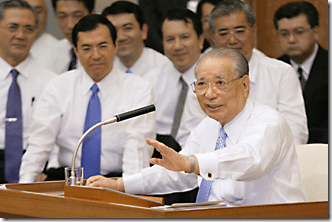
Daisaku IkedaToday was our HQ study meeting, around forty like minded people descended on the sleepy village of Durweston to chant, learn, chat and spend time together.
As usual there were lots of people who seemed to know me, or about me, whose names I instantly forget. I really must sort out some process to stop this happening.

Many familiar faces were there, Ken and Jayne, Boots, Simon and Jack, Thierry and a few of the folks from Salisbury and it’s always a pleasure to meet with them all.

After Gongyo we watched a couple of videos on Sensei’s lectures in Japan and his visit to Hong Kong. It is fifty years since he spread the message of Nichiren Buddhism to Hong Kong and Europe. It was noticeable how formal the lecture was in Japan, everyone dressed the same, responding in the same way and set times, very different to the way things are in the UK. Sensei is such an amazing man, a man who has dedicated his life to spreading the message of Buddhism and Kosen-Rufu.

Then came the nerve wracking bit. Ken had asked me to do a five minute talk on my experience of finding the Practice and a few thoughts on receiving the Gohonzon last week. I think it went ok, and standing in front of a group of friends is not the most daunting prospect. Everyone was very kind, laughed at my little jokes and clapped when it was over.

Later in the day, my initial thoughts were that the speed I have been so readily accepted into the SGI fold has surprised me. A month ago I had no Buddhist friends at all and yet here I am, the topic of conversation all over the area and having already received Gohonzon. Very humbling, but very nice to be part of such a friendly and dedicated group. I hope I can live up to expectations and, more importantly, give back to the group as much, or more, support as they have given me.

So the legend bit is obviously very tongue in cheek, but I would like to thank everyone for making me feel so welcome.

Nam Myoho Renge Kyo

A Day To Remember

Taplow Court - SGI-UK HeadquartersTomorrow I am going to travel up to Taplow Court in Maidenhead, the UK headquarters of the Soka Gakkai, to receive a Gohonzon.

I was tempted to say ‘presented with my Gohonzon’ but I believe that is more correct to say ‘a’ because I will merely be the custodian of the Gohonzon, as it will most certainly still be in existence long after I have passed on.

So I am hoping for an auspicious visit and looking forward to the honour of receiving the Gohonzon.

Although I have a Gohonzon I ‘rescued’ from eBay it will be an honour to have an authentic one, if that is the right term, to be the object of my Practice.

Ken Hawkins is going to accompany me on the trip. I hope I don’t talk him to death on the journey, there are so many things I want to ask about. We are planning to arrive in good time to attend Kosen Rufu Gongyo, which will be followed by registration and the ceremony during which I will receive the Gohonzon.

I’ll give you an update on how it all turns out when I get back, hopefully with a few photos.

Back In The Groove

Back In The GrooveWith the pressure of work having eased slightly, albeit for only a few days, it was nice to give more time and focus to my Practice.

It never ceases to amaze me how quickly things drift to the back of your mind when they don’t receive the attention they deserve. So it was with my Gongyo, having been too tied up to make a proper job of it.

Now I know what you are saying, that my Honzon should come first, last and everywhere in between. But life isn’t like that really, is it? Man cannot life by Gongyo alone, to paraphrase, so work had to take precedence.

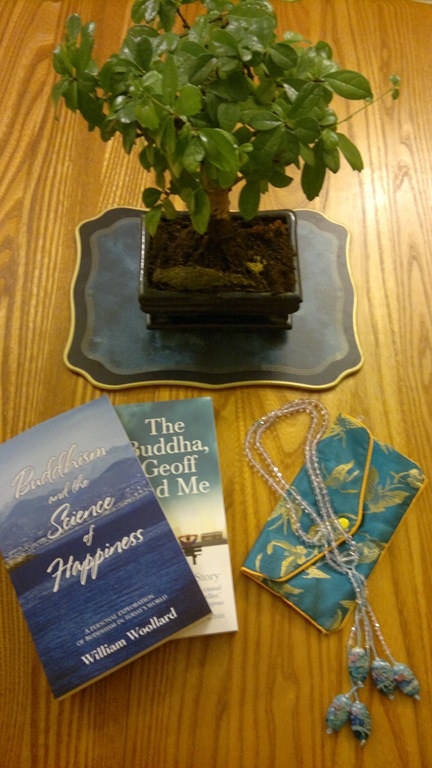
While I was at work this week, my two books arrived and until this evening I hadn’t even had time to open the parcel to take a quick peek.

The copy of The Buddha, Geoff and Me is similar in every respect to the last one I owned. No surprise there, though it will be good to have an old friend back on my bedside cabinet.

Having dipped into the new William Woollard, it does look interesting. He has a way of saying very profound or very technical concepts in a very easy to understand way, a real gift. He has been struggling against cancer and I will be very interested in how he has gone about it. I say struggled against cancer, but he is so grounded, that I can’t imagine William struggling against anything now.

Any road up, as my Mom might say, it’s nice to be back in the swing and I’m looking forward to relating my take on Buddhism and the Science of Happiness to you over the coming weeks.

P.S. In case anyone is wondering where the Juzu beads came from, they were made by my friend Lily Rose at Myoho Beads. Lily Rose is a lovely lady who happens to live just round the corner from the Arizona supermarket where the US Senator was shot a little while back. I really get in touch to make sure she is recovering from the shock of it all.

The Nichiren Buddhist Prayers

During morning Gongyo we say four Prayers, the first out loud, the last three silently to ourselves. During evening Gongyo, the first prayer is omitted.

The First Prayer – Appreciation for Life’s Protective Forces (spoken – morning Gongyo)

lotusI offer appreciation to the Shoten Zenjin, the functions in life and in the environment that serve to protect us, and prey that these protective powers may be further strengthened and enhanced through my practice of the Law.
The Second Prayer – Appreciation for the Gohonzon (silent)

lotusI offer my deepest praise and most sincere gratitude to the Dai-Gohonzon of the Three Great Secret Laws, which was bestowed upon the entire world.
I offer my deepest praise and most sincere gratitude to Nichiren Daishonin, the Buddha  of the Latter Day of the Law.

I offer my deepest praise and most sincere gratitude to Nikko Shonin.

I offer sincere gratitude to Nichimoku Shonin.

The Third Prayer – For the attainment of kosen-rufu (silent)

lotusI pray that the great desire for kosen-rufu is fulfilled, and that the Soka Gakkai International develops eternally in this endeavour.

I offer my most sincere gratitude to the three founding presidents – Tsunesaburo Makiguchi, Josei Toda and Daisaku Ikeda – for their eternal example of selfless dedication to the propagation of the Law.

The Fourth Prayer – Personal prayers and prayer for the deceased – (silent)

lotusI pray to bring forth Buddhahood from within my life, change my karma and to fulfil my wishes in the present and the future.

(we may offer additional prayers here)

I pray for my deceased relatives and for all those who have passed away, particularly for these individuals:

(we name our relatives and friends here)

I pray for peace throughout the world and for the happiness of all humanity.

Nam Myoho Renge Kyo

A Pleasant Surprise

I suppose, with Christmas just around the corner, I should not have been so surprised when the postman arrived this afternoon, with a parcel.

You may remember that I had seen a Gohonzon offered for sale on eBay. I was unsure whether it was right for such an item to be offered, so I decided to put in a bid, to ‘rescue’ it from falling into less appreciative hands.

The Gohonzon had originally hung in a Buddhist temple in Japan, some forty years ago, and was in New York. Combined with the current cold spell, the distance had meant that it had taken a while to arrive, but it was really worth the wait, it’s beautiful.

It will take it’s rightful place in the Butsudan, The House of Buddha, the place in my home where I perform Gongyo, chant and pray.

Whether it will make my Practice more effective is yet to be proven, but it has formed the perfect focus for my chanting. Results will, as always, be the proof.

My eternal thanks, to my partner, for a most unusual, inspired and inspiring birthday present.

Previous Older Entries Next Newer Entries