 Being a Buddhist in Western society makes you a ‘bit different’, and the curious like to ask questions about the philosophy.
After the initial question “do you chant?” we are then asked “what do you chant?” followed closely by “for how long do you chant?” and then almost certainly “what does it mean?”.
After a little practice, no pun intended, most people can master the phrase Nam-myoho-renge-kyo, but explaining why we chant it, what it means, and how it works may take a little longer.
Here is how the SGI website describes the meaning of the individual parts …
Nichiren Daishonin established the chanting of Nam-myoho-renge-kyo as the way to awaken one’s Buddha nature and tap into the deepest levels of our existence, on which our own lives and that of the universe are one. He first taught the invocation of the phrase to a small group at Seicho-ji temple in Awa province, Japan, on April 28, 1253.
Myoho-renge-kyo is the name of the Lotus Sutra in Japanese pronunciation of classical Chinese characters, and so the literal meaning of Nam-myoho-renge-kyo is “I devote myself to the Lotus Sutra.” As the following explanation shows, there are deeper levels of meaning attached to each element of the phrase.
Nam
Nam derives from the Sanskrit word namu, meaning “to devote oneself.” Nichiren established the practice of chanting Nam-myoho-renge-kyo as a means to enable all people to put their lives in harmony or rhythm with the law of life, or Dharma. In the original Sanskrit, namu indicates the elements of action and attitude, and refers therefore to the correct action one needs to take and the attitude one needs to develop in order to attain Buddhahood in this lifetime.
Myoho
Myoho literally means the Mystic Law–the underlying truth or principle which governs the mysterious workings of the universe and our life from moment to moment. Myo refers to the very essence of life, which is “invisible” and beyond intellectual understanding. This essence always expresses itself in a tangible form (ho) that can be apprehended by the senses. Phenomena (ho) are changeable, but pervading all such phenomena is a constant reality known as myo. Myo also means to open, to revive, and to be fully endowed with the qualities we need to develop our lives.
Renge
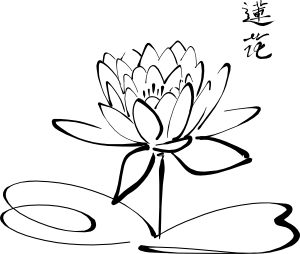
Renge means lotus flower. The lotus blooms and produces seeds at the same time, and thus represents the simultaneity of cause and effect. The circumstances and quality of our individual lives are determined by the causes and effects, both good and bad, that we accumulate (through our thoughts, words and actions) at each moment. This is called our “karma.” The law of cause and effect affirms that we each have personal responsibility for our own destiny. We create our destiny and we have the power to change it. The most powerful positive cause we can make is to chant Nam-myoho-renge-kyo; the effect of Buddhahood is simultaneously created in the depths of our life and will definitely manifest in time.
The lotus flower grows and blooms in a muddy pond, and yet remains pristine and free from any defilement, symbolizing the emergence of Buddhahood from within the life of an ordinary person in the midst of the struggles of day-to-day existence.
Kyo
Kyo literally means sutra, the voice or teaching of a Buddha. In this sense, it also means sound, rhythm or vibration. In a broad sense, kyo conveys the concept that all things in the universe are a manifestation of the Mystic Law.
Further explanation of the meaning of Nam-myoho-renge-kyo can be found here.
 Buddhism comes down to practice. This means making a personal determination and steadfastly taking action to accomplish it, no matter what obstacles may arise.
 Sometimes the World of Tranquillity can be a true blessing, a lull after a period of intense effort.
 Have you ever woken from such a vivid dream that you struggle to put it to the back of your mind? The feelings that it evoked refuse to subside and somehow it weaves its way into the reality of your day.
 Dealing with the ever changing aspects of life is a little like sailing a yacht in a squally breeze. There are external influences that push and pull on the direction of our path. Our role as skipper of our own craft, is to deal with the challenges that those influences bring, whilst trying to steer in the direction we want our lives to go.
 There is the temptation, whilst continuing to practice, to wonder whether we will ever become a Buddha or doubt whether Buddhahood even resides within us. With his usual wisdom, Nichiren showed us the truth of the matter in his simple words.
 We all have a mental view of where we are going in life, what we would like our future to look like, a set of challenges that we must conquer if we are to find our utopia.
 The challenges we meet in life are often seen as the negative side of our existence. We alone can decide how we deal with them, either we can accept them, tackle them head on, or we can shy away from them and hope they go away. Anyone who has tried the second path will know that it virtually never works, so accepting challenges has to be the right way to go.
 Some days we are strong, some days not so strong.
 With the trials and tribulations of the current infrastructure changes, by lunchtime I was in need of some peace and quiet.
 The Search For Enlightenment
Recents Comments