Ten Worlds In One Day

The Ten Worlds are the life-states we all experience, many each and every day.

The Ten WorldsThe Ten Worlds are:

  • Hell
  • Hunger
  • Animality
  • Anger
  • Humanity
  • Heaven
  • Learning
  • Realisation
  • Bodhisattva
  • Buddhahood

Each World contains the other nine Worlds to a greater or lesser extent, so even though you might be in a Heaven (or Rapture) life-state, you will have elements of Hell, Hunger, Animality, Anger, Humanity(or Tranquillity), Learning, Realisation, Bodhisattva and Buddhahood within that life-state. This helps us to explain how our life-state (or mood) can change so quickly when we encounter new or changing causes.

The first six Worlds, Hell, Hunger, Animality, Anger, Humanity and Heaven are brought about by external causes, events which we cannot control.

The last four, Learning, Realisation, Bodhisattva and Buddhahood are brought about by our own thoughts and actions, which we can control.

Nichiren Daishonin wrote:

‘If you wish to free yourself from the sufferings of birth and death you have endured since time without beginning and to attain without fail unsurpassed enlightenment in this lifetime, you must perceive the mystic truth that is originally inherent in all living beings. This truth is Myoho-renge-kyo. Chanting Myoho-renge-kyo will therefore enable you to grasp the mystic truth innate in all life.

The Lotus Sutra is the king of sutras, true and correct in both word and principle. Its words are the ultimate reality, and this reality is the Mystic Law (myoho). It is called the Mystic Law because it reveals the principle of the mutually inclusive relationship of a single moment of life and all phenomena. That is why this sutra is the wisdom of all Buddhas.

Life at each moment encompasses the body and mind and the self and environment of all sentient beings in the Ten Worlds as well as all insentient beings in the three thousand realms, including plants, sky, earth, and even the minutest particles of dust. Life at each moment permeates the entire realm of phenomena and is revealed in all phenomena. To be awakened to this principle is itself the mutually inclusive relationship of life at each moment and all phenomena. Nevertheless, even though you chant and believe in

Myoho-renge-kyo, if you think the Law is outside yourself, you are embracing not the Mystic Law but an inferior teaching. “Inferior teaching” means those other than this [Lotus] sutra, which are all expedient and provisional. No expedient or provisional teaching leads directly to enlightenment, and without the direct path to enlightenment you cannot attain Buddhahood, even if you practice lifetime after lifetime for countless kalpas. Attaining Buddhahood in this lifetime is then impossible. Therefore, when you chant myoho and recite renge, you must summon up deep faith that Myoho-renge-kyo is your life itself.

You must never think that any of the eighty thousand sacred teachings of Shakyamuni Buddha’s lifetime or any of the Buddhas and bodhisattvas of the ten directions and three existences are outside yourself. Your practice of the Buddhist teachings will not relieve you of the sufferings of birth and death in the least unless you perceive the true nature of your life. If you seek enlightenment outside yourself, then your performing even ten thousand practices and ten thousand good deeds will be in vain. It is like the case of a poor man who spends night and day counting his neighbour’s wealth but gains not even half a coin. That is why the T’ien-t’ai school’s commentary states, “Unless one perceives the nature of one’s life, one cannot eradicate one’s grave offenses.” This passage implies that, unless one perceives the nature of one’s life, one’s practice will become an endless, painful austerity. Therefore, such students of Buddhism are condemned as non-Buddhist. Great Concentration and Insight states that, although they study Buddhism, their views are no different from those of non-Buddhists.

Whether you chant the Buddha’s name, recite the sutra, or merely offer flowers and incense, all your virtuous acts will implant benefits and roots of goodness in your life. With this conviction you should strive in faith. The Vimalakirti Sutra states that, when one seeks the Buddhas’ emancipation in the minds of ordinary beings, one finds that ordinary beings are the entities of enlightenment, and that the sufferings of birth and death are nirvana. It also states that, if the minds of living beings are impure, their land is also impure, but if their minds are pure, so is their land. There are not two lands, pure or impure in themselves. The difference lies solely in the good or evil of our minds.

It is the same with a Buddha and an ordinary being. When deluded, one is called an ordinary being, but when enlightened, one is called a Buddha. This is similar to a tarnished mirror that will shine like a jewel when polished. A mind now clouded by the illusions of the innate darkness of life is like a tarnished mirror, but when polished. it is sure to become like a clear mirror, reflecting the essential nature of phenomena and the true aspect of reality. Arouse deep faith, and diligently polish your mirror day and night. How should you polish it? Only by chanting Nam-myoho-renge-kyo.

What then does myo signify? It is simply the mysterious nature of our life from moment to moment, which the mind cannot comprehend or words express. When we look into our own mind at any moment, we perceive neither colour nor form to verify that it exists. Yet we still cannot say it does not exist, for many differing thoughts continually occur. The mind cannot be considered either to exist or not to exist. Life is indeed an elusive reality that transcends both the words and concepts of existence and nonexistence. It is neither existence nor nonexistence, yet exhibits the qualities of both. It is the mystic entity of the Middle Way that is the ultimate reality. Myo is the name given to the mystic nature of life, and ho, to its manifestations. Renge, which means lotus flower, is used to symbolize the wonder of this Law. If we understand that our life at this moment is myo, then we will also understand that our life at other moments is the Mystic Law. This realization is the mystic kyo, or sutra. The Lotus Sutra is the king of sutras, the direct path to enlightenment, for it explains that the entity of our life, which manifests either good or evil at each moment, is in fact the entity of the Mystic Law.

If you chant myoho-renge-kyo with deep faith in this principle, you are certain to attain Buddhahood in this lifetime. That is why the sutra states, “After I have passed into extinction, [one] should accept and uphold this sutra. Such a person assuredly and without doubt will attain the Buddha way.” Never doubt in the slightest. Respectfully. Maintain your faith and attain Buddhahood in this lifetime. Nam-myoho-renge-kyo, Nam-myoho-renge-kyo.’

Nichiren

The more we chant, and the more we practice, the higher our life-energy becomes and the more control we have over our life-state. The object of the exercise is to raise our own self-awareness and through selfless thoughts and deeds, to grow ever nearer our goal of attaining Buddhahood.
Problems, Problems

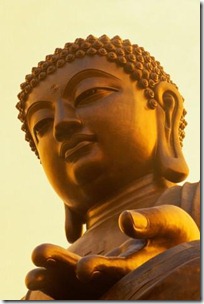
BuddhaA man once came to see the Buddha to get help with his problems. After the man had told the Buddha one of his problems and asked for help, the Buddha replied: “I cannot help you get rid of that problem.”

The man was surprised that the Buddha could not help him in this regard, but he told the Buddha about another problem; he thought to himself that the Buddha should at least be able to help him with that problem. But the Buddha told him “I cannot help you with that problem either.”

The man started to get impatient. He said: “How can it be that you are the perfectly Enlightened Buddha, when you can’t even help people get rid of their problems?” The Buddha answered: “You will always have 83 problems in your life. Sometimes a problem will go, but then another problem will come. I cannot help you with that.”

The baffled man asked the Buddha: “But, what can you help me with, then?” The Buddha replied: “I can help you get rid of your 84th problem.” The man asked: “But what is my 84th problem?” The Buddha replied: “That you want to get rid of your 83 problems.”

We all have problems of one nature or another. Buddhism will not remove those problems, but it will help you come to terms with, and solve them by giving you wisdom and allowing you to see those problems in a different light.

A Clean Slate

A Clean SlateSometimes we need to wipe the slate clean, take a deep breath, and start anew. I think I am at that point, and with the New Year just around the corner, this might just be the perfect time to do so. Having new goals, new horizons and renewed vigour is just the ticket.

I know that some people fear change, are loath to relinquish all the effort put into a particular path, even if that path may not be taking them in the right direction. I am not one of those people. I embrace change in all its forms, and look forward to the freshness of a new start.

Similarly, Buddhism looks at death in same way as sleep, it is not the end of something, it is a period of rest before the beginning of something new. In the case of sleep, it is the beginning of a new day. Death, on the other hand, is the beginning of a whole new life. So I do not fear death, though I do not wish to hasten its coming.

I intend to make the most of each and every day, and when death does arrive, as it will, I will enjoy the rest before being reborn into a new and exciting experience.

SGI – An Overview

SGI - An OverviewBeing a member of the SGI (Soka Gakkai International) sometimes raises questions about who we are, what we do, and why. Soka Gakkai is Japanese for Value Creating Society, and the organisation is dedicated to helping communities and individuals to create value and happiness in their lives.

Trying to explain this to people who ask can be a little tricky, so I was pleased to see a simple video, posted on Facebook by Jayne this afternoon. To get a better understanding, and to see a cameo appearance by Ken Hawkins, simply click on the image below …

A very smiley Ken Hawkins (click to view the SGI video)

The video is only a couple of minutes long, but it encapsulates the spirit of the SGI and explains a few of the principles behind the organisation.

Buddhist Thoughts

Rudyard KiplingThis poem, by Rudyard Kipling, is one of my favourites.

As I read it again tonight, for the first time in quite a while, I was intrigued by the similarity of the statements within it, to Buddhist principles.

IF …

IF you can keep your head when all about you
Are losing theirs and blaming it on you,
If you can trust yourself when all men doubt you,
But make allowance for their doubting too;
If you can wait and not be tired by waiting,
Or being lied about, don’t deal in lies,
Or being hated, don’t give way to hating,
And yet don’t look too good, nor talk too wise:

If you can dream – and not make dreams your master;
If you can think – and not make thoughts your aim;
If you can meet with Triumph and Disaster
And treat those two impostors just the same;
If you can bear to hear the truth you’ve spoken
Twisted by knaves to make a trap for fools,
Or watch the things you gave your life to, broken,
And stoop and build ’em up with worn-out tools:

If you can make one heap of all your winnings
And risk it on one turn of pitch-and-toss,
And lose, and start again at your beginnings
And never breathe a word about your loss;
If you can force your heart and nerve and sinew
To serve your turn long after they are gone,
And so hold on when there is nothing in you
Except the Will which says to them: ‘Hold on!’

If you can talk with crowds and keep your virtue,
‘ Or walk with Kings – nor lose the common touch,
if neither foes nor loving friends can hurt you,
If all men count with you, but none too much;
If you can fill the unforgiving minute
With sixty seconds’ worth of distance run,
Yours is the Earth and everything that’s in it,
And – which is more – you’ll be a Man, my son!

~ Rudyard Kipling 1895

Kipling was not a Buddhist. He was, from a very early age, a Freemason and a Christian, but I cannot help feeling that his time in India brought him into contact with Buddhism and the ethos of the poem has a Buddhist feel to it. I hope you enjoyed reading it as much as I.

For more details of the poem, you might want to visit www.allthingsif.org

Inspiration Every Day

Postman PatA parcel arrived in the post this morning, that will offer a little inspiration every day.

In the parcel was a copy of Daisaku Ikeda’s Buddhism Day by Day. Like a diary, it offers a different thought provoking passage for every day of the year.

I had seen the book before, on the SGI website, but my thanks go to Thierry for bringing the Wisdom of its contents to my attention.

Although it is primarily a compilation of Sensei’s thoughts, with an obvious Buddhist slant, I believe it would be an inspiration for anyone, irrespective of their religion or beliefs.

Here are a few of examples …

February 17

“True individuality never comes to full flower without hard work. Therefore you’re making a big mistake if you think that who you are right now represents all you are capable of being.”

March 25

“The significance of Buddhism lies both in the discovery of the Buddha nature in all beings and in the establishment of a practical method for bringing it out, so that human beings can derive maximum meaning from their lives. This reformation of the inner human world – what we in the Soka Gakkai call ‘human revolution’ – is especially relevant to modern civilisation, which has long been trapped in a sort of spiritual quicksand. We can escape the quicksand by calling forth the supreme human potential available to each of us.”

July 31

“What is the purpose of life? It is happiness. But there are two kinds of happiness: relative and absolute. Relative happiness comes in a wide variety of forms. The purpose of Buddhism is to attain Buddhahood. In modern terms, this could be explained as realising absolute happiness – a state of happiness that can never be destroyed or defeated.”

I think a little snippet of Sensei’s wisdom, each morning, will set me up for the day.

Comparison

At the end of a massive weekend for winners, Kara Tointon and Artem Chigvintsev in Strictly Come Dancing, AP McCoy in Sports Personality 2010 and Stella English in The Apprentice.

All winners in their own fields or chosen goal, but what about the losers? For every winner there must be at least one loser, right? Wrong !!!

Daisaku Ikeda had this to say:

“Strength is Happiness. Strength is itself victory. In weakness and cowardice there is no happiness. When you wage a struggle, you might win or you might lose. But regardless of the short-term outcome, the very fact of your continuing to struggle is proof of your victory as a human being.”

So going home with the shiny prize isn’t the only way you can win, again President Ikeda has pearls of Wisdom …

“It is not how you compare to others that is important, but rather how you compare to who you were yesterday. If you’ve advanced even one step, then you’ve achieved something great.”

So whatever kind of weekend you’ve had, you can look at things in several ways, and still come out of it as a winner.

The Nichiren Buddhist Prayers

During morning Gongyo we say four Prayers, the first out loud, the last three silently to ourselves. During evening Gongyo, the first prayer is omitted.

The First Prayer – Appreciation for Life’s Protective Forces (spoken – morning Gongyo)

lotusI offer appreciation to the Shoten Zenjin, the functions in life and in the environment that serve to protect us, and prey that these protective powers may be further strengthened and enhanced through my practice of the Law.
The Second Prayer – Appreciation for the Gohonzon (silent)

lotusI offer my deepest praise and most sincere gratitude to the Dai-Gohonzon of the Three Great Secret Laws, which was bestowed upon the entire world.
I offer my deepest praise and most sincere gratitude to Nichiren Daishonin, the Buddha  of the Latter Day of the Law.

I offer my deepest praise and most sincere gratitude to Nikko Shonin.

I offer sincere gratitude to Nichimoku Shonin.

The Third Prayer – For the attainment of kosen-rufu (silent)

lotusI pray that the great desire for kosen-rufu is fulfilled, and that the Soka Gakkai International develops eternally in this endeavour.

I offer my most sincere gratitude to the three founding presidents – Tsunesaburo Makiguchi, Josei Toda and Daisaku Ikeda – for their eternal example of selfless dedication to the propagation of the Law.

The Fourth Prayer – Personal prayers and prayer for the deceased – (silent)

lotusI pray to bring forth Buddhahood from within my life, change my karma and to fulfil my wishes in the present and the future.

(we may offer additional prayers here)

I pray for my deceased relatives and for all those who have passed away, particularly for these individuals:

(we name our relatives and friends here)

I pray for peace throughout the world and for the happiness of all humanity.

Nam Myoho Renge Kyo

The Real Aspect of the Gohonzon

Having received my Gohonzon, I was very interested to know what the inscriptions meant.

Nichiren Daishonin saidlotus3_soft

‘Never seek the Gohonzon outside yourself. The Gohonzon exists only within the mortal flesh of us ordinary people who embrace the Lotus Sutra and chant Nam-myoho-renge-kyo.’

But this letter, from Nichiren to Nichinyo, explains more completely the significance of the Gohonzon.

I have received your offerings to the Gohonzon of five thousand coins, one horseload of polished rice, and fruit. To begin with, this Gohonzon was revealed in the last eight years of the fifty that the Buddha preached in this world, and in this period of eight years, in eight chapters [of the Lotus Sutra], from the “Emerging from the Earth” chapter through the “Entrustment” chapter. Now, during the three periods following the Buddha’s passing, in the two thousand years of the Former and Middle Days of the Law, not even the term “object of devotion of the essential teaching” yet existed. How then could the object of devotion have been revealed? Moreover, there was no one who was able to give it expression. T’ien-t’ai, Miao-lo, and Dengyo perceived it in their hearts, but for some reason never put it into words, just as Yen Yüan realized the true meaning of Confucius’s teaching, but never gave it expression. Yet the sutra itself and the commentaries of T’ien-t’ai and Miaolo explicitly state that the Gohonzon will appear after two thousand years have elapsed following the Buddha’s passing, in the first five hundred years of the Latter Day of the Law.

How wondrous it is that, around two hundred years and more into the Latter Day of the Law, I was the first to reveal as the banner of propagation of the Lotus Sutra this great mandala that even those such as Nagarjuna and Vasubandhu, T’ien-t’ai and Miao-lo were unable to express. This mandala is in no way my invention. It is the object of devotion that depicts Shakyamuni Buddha, the World-Honored One, seated in the treasure tower of Many Treasures Buddha, and the Buddhas who were Shakyamuni’s emanations as perfectly as a print matches its woodblock. Thus the five characters of the Lotus Sutra’s title are suspended in the center, while the four heavenly kings are seated at the four corners of the treasure tower. Shakyamuni, Many Treasures, and the four leaders of the Bodhisattvas of the Earth are side by side at the top. Seated below them are the bodhisattvas, including Universal Worthy and Manjushri, and the voicehearers, including Shariputra and Maudgalyayana. [Beside them are] the gods of the sun and moon, the devil king of the sixth heaven, the dragon king, and an asura. In addition, the wisdom kings Immovable and Craving-Filled take up their stations to the south and north. The evil and treacherous Devadatta and the ignorant dragon king’s daughter form a group. Not only the Mother of Demon Children and the ten demon daughters, who are evil demons that sap the lives of people throughout the major world system, but also the Sun

Goddess, Great Bodhisattva Hachiman, and the seven reigns of the heavenly gods and five reigns of the earthly gods, who are the guardian deities of Japan— all the various great and small gods, that is, the main gods, are ranged in rows. How then could the remaining subordinate gods be left out? The “Treasure Tower” chapter states, “[Shakyamuni Buddha used his transcendental powers to] lift all the members of the great assembly up into the air.”

Without exception, all these Buddhas, bodhisattvas, great sages, and, in general, all the various beings of the two worlds and the eight groups who appear in the “Introduction” chapter of the Lotus Sutra dwell in this Gohonzon. Illuminated by the light of the five characters of the Mystic Law, they display the dignified attributes that they inherently possess. This is the object of devotion.

This is what is meant when the sutra says “the true aspect of all phenomena.” Miao-lo stated: “The true aspect invariably manifests in all phenomena, and all phenomena invariably manifest in the ten factors. The ten factors invariably manifest in the Ten Worlds, and the Ten Worlds invariably manifest in life and its environment.” It is also stated that the profound principle of the true aspect is the originally inherent Myoho-renge-kyo. The Great Teacher Dengyo said, “A single moment of life comprising the three thousand realms is itself the Buddha of limitless joy; this Buddha has forsaken august appearances.” Therefore, this Gohonzon shall be called the great mandala never before known; it did not appear until more than 2,220 years after the Buddha’s passing.

A woman who makes offerings to such a Gohonzon invites happiness in this life, and in the next, the Gohonzon will be with her and protect her always. Like a lantern in the dark, like a strong guide and porter on a treacherous mountain path, the Gohonzon will guard and protect you, Nichinyo, wherever you go. Therefore, you should take every care to ward off slanderers of the Law in the same way that you would never wish a courtesan even to come near your home. This is the meaning of “Thrust aside evil friends and associate with good companions.”

Never seek this Gohonzon outside yourself. The Gohonzon exists only within the mortal flesh of us ordinary people who embrace the Lotus Sutra and chant Nam-myoho-renge-kyo. The body is the palace of the ninth consciousness, the unchanging reality that reigns over all of life’s functions. To be endowed with the Ten Worlds means that all ten, without a single exception, exist in one world. Because of this it is called a mandala. Mandala is a Sanskrit word that is translated as “perfectly endowed” or “a cluster of blessings.” This Gohonzon also is found only in the two characters for faith. This is what the sutra means when it states that one can “gain entrance through faith alone.”

Since Nichiren’s disciples and lay supporters believe solely in the Lotus Sutra, honestly discarding expedient means and not accepting even a single verse of the other sutras, exactly as the Lotus teaches, they can enter the treasure tower of the Gohonzon. How reassuring! Make every possible effort for the sake of your next life. What is most important is that, by chanting Nam-myoho-renge-kyo alone, you can attain Buddhahood. It will no doubt depend on the strength of your faith. To have faith is the basis of Buddhism. Thus the fourth volume of Great Concentration and Insight states, “Buddhism is like an ocean that one can only enter with faith.” The fourth volume of The Annotations on “Great Concentration and Insight” explains this: “With regard to the phrase ‘Buddhism is like an ocean that one can only enter with faith,’ even Confucius taught that faith is first and foremost. How much more so is this true of the profound doctrines of Buddhism! Without faith, how could one possibly enter? That is why the Flower Garland Sutra defines faith as the basis of the way and the mother of blessings.” The first volume of Great Concentration and Insight says, “How does one hear, believe in, and practice the perfect teaching to attain perfect enlightenment?” The first volume of On “Great Concentration and Insight” says, “To ‘believe in the perfect teaching’ means to awaken faith through doctrine and to make faith the basis of practice.”

A non-Buddhist document relates that, because the emperor of Han believed his aide’s report, the waters of a river froze on the spot. Another tells how Li Kuang, because he was eager to revenge his father, shot an arrow all the way up to its feathers into a boulder hidden in the grass. The commentaries of T’ien-t’ai and Miao-lo make it perfectly clear that faith is the cornerstone. Because the Han emperor believed completely in his retainer’s words, the river froze over. And Li Kuang was able to pierce a rock with his arrow because he fully believed it to be the tiger that had killed his father. How much more so is this true in Buddhism!

Embracing the Lotus Sutra and chanting Nam-myoho-renge-kyo in itself encompasses the five practices. It was this matter, the wonderful practice that includes the immediate completion of the five practices, that was transmitted to the Great Teacher Dengyo when he journeyed to T’ang China and met the Reverend Tao-sui. No other teaching is more important for Nichiren’s disciples and lay supporters. It is referred to in the “Supernatural Powers” chapter. I will write again in detail.

Respectfully,
Nichiren

The twenty-third day of the eighth month in the third year of Kenji (1277)

The writings of Nichiren Daishonin and a very comprehensive dictionary of the terms of Nichiren Buddhism can be found online here.

The Jeremy Hunt Effect

Anyone who was lucky enough to be awake and listening to Radio 4 this morning around 8:00 will have had the perfect start to their week.

James Naughtie made the mother and father of Freudian slips when he transposed a couple of letters when introducing Jeremy Hunt, the Culture Secretary. If you missed it and want to hear it for yourself, go and listen here, but be warned, it is a very rude word for Radio 4 !!!

Now you might imagine that such a slip might cause consternation in the Corridors of Power, but no. Jeremy Hunt was a fantastic sport, he even Tweeted about it, even when it was repeated later in the morning by Andrew Marr.

Actually, Mr Hunt has come out of this smelling of roses, and with publicity that money just couldn’t buy. Yesterday, very few people knew who Jeremy Hunt was, now everyone knows the Culture Secretary.

In a similar way, when chanting for something, don’t be surprised if The Universe delivers the result you wanted, but in a very unexpected way. I’ve seen it happen so many times, it really doesn’t surprise me, though it always makes me smile.

Previous Older Entries Next Newer Entries