 We can all be guilty of trying to hold things, or people, too close to us. This may be for a number of reasons, fear of losing them probably being the most common. With possessions we may only cause ourselves problems, but with people, the act of holding them close, may actually have the effect of pushing them away. We must learn to give people the freedom to grow, to learn, to blossom and the chance to be themselves, otherwise we may lose them forever.
Nichiren writes: “Myoho-renge-kyo is the Buddha nature of all living beings…. The Buddha nature that all these beings possess is called by the name Myoho-renge-kyo” (wnd, 131). Regarding how to manifest one’s innate Buddha nature, Nichiren explains: “When we revere Myoho-renge-kyo inherent in our own life as the object of devotion, the Buddha nature within us is summoned forth and manifested by our chanting of Nam-myoho-renge-kyo. This is what is meant by ‘Buddha.’ To illustrate, when a caged bird sings, birds who are flying in the sky are thereby summoned and gather around, and when the birds flying in the sky gather around, the bird in the cage strives to get out. When with our mouths we chant the Mystic Law, our Buddha nature, being summoned, will invariably emerge” (wnd, 887).
In Nichiren’s metaphor, our innate Buddha nature, whose name is Nam myoho renge kyo, is a bird trapped in the cage of ignorance. In other words, our deluded minds create this cage that imprisons our Buddha nature. But when we chant Nam myoho renge kyo to the Gohonzon, which expresses Nichiren’s enlightened life and the potential of all people, our dormant Buddha nature becomes activated.
The singing of the caged bird is our chanting, and the birds flying in the sky are the Buddha nature in our environment, particularly as it is expressed in the Gohonzon. Through our chanting, the Buddha nature within our lives and the Buddha nature inherent in the universe begin their dynamic interaction.
For Nichiren’s metaphor to work, however, it is necessary for the caged bird to recognize the birds in the sky as being its own kind. In other words, when we pray to the Gohonzon, rather than thinking of it as an external power or deity, we must think of it as the mirror image of our own Buddha nature. If the caged bird thinks of itself as an elephant, it is unlikely to give the slightest thought to flying.
Nichiren Buddhism clarifies that the teaching of the Buddha nature is a teaching of faith and practice. All people have it, but not many can believe in it. Furthermore, some of those who believe in their Buddha nature may not practice to manifest it, erroneously thinking-I’m already a Buddha, so I don’t have to do anything. One’s faith in the Buddha nature must be expressed in one’s actions to manifest it.
Those who see the universal Buddha nature of oneself and others, and work to awaken it in all people are already Buddhas, for such actions belong to none other than a Buddha. As we cultivate our inherent Buddha nature through our conviction and actions to manifest it no matter our circumstances, we begin to see it and experience it. In our everyday lives, seeing may be believing. But in the world of Buddhism, believing in the Buddha nature is the first step toward seeing it.
(from Living Buddhism – February 2005)
 So often, and I am as guilty as anyone, we want things to happen now.
 In the true reality of life as viewed from the enlightened state of a Buddha, one who has broken free of all delusion, all things are equal, transcending distinctions and differences between subject and object, self and others, mind and body, the spiritual and the material.
  Sometimes I surprise myself, or rather something, that in all truth should be totally ingrained by now, suddenly permeates my grey matter and comes as a bit of a shock. I’ve been writing my blog for nearly three years now, and over sixty thousand people have visited it in that time, but it is important that the whole purpose behind it is not to get attention, is to help me, and others, to reach a state of enlightenment.
 When we are open and engaged, we experience the greater self. When we are closed off, we are exhibiting our lesser self.
 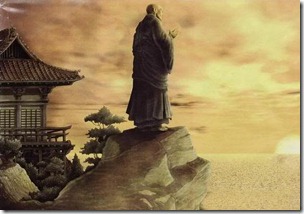 In Nichiren Buddhism, attaining enlightenment is not about embarking on some inconceivably long journey to become a resplendent, all knowing Buddha, it is about accomplishing a transformation in the depths of one’s being, little by little.
 The very reason for my Buddhist Practice is to bring me a little closer to Buddhahood each and every day.
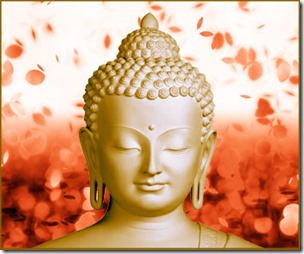 What does attaining Buddhahood mean for us? It does not mean that one day we suddenly turn into a Buddha or become magically enlightened. In a sense, attaining Buddhahood means that we have securely entered the path, or orbit, of Buddhahood inherent in the cosmos.
 Each and every one of our actions in previous existences are engraved, and contained, in this lifetime. The causes for our present suffering or joy, misery or happiness, all lie in our own past actions.
 The Search For Enlightenment
Recents Comments