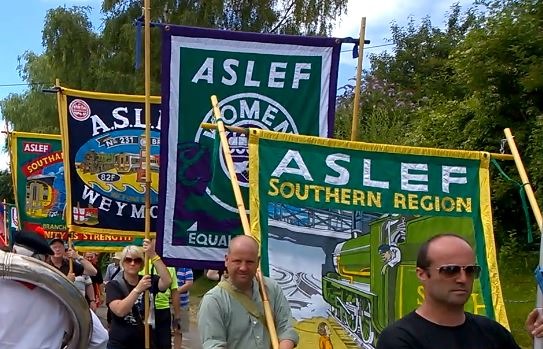
 Today has been a joyous celebration of a hugely important part of British, and arguably World history. In a rather unplanned manner, three of us set off to the historic Dorset village of Tolpuddle.
Now many of you may never have heard of Tolpuddle, but if you have ever been a member of a workers union, been on strike to register your opposition to a change in working conditions or in a demand for a rise in pay, Tolpuddle is inextricably linked to those actions. A group of six men from the village made history, and paid temporarily with their freedom, when they formed the first workers union. Wikipedia says this of them …
The Tolpuddle Martyrs were a group of 19th century Dorset agricultural labourers who were arrested for and convicted of swearing a secret oath as members of the Friendly Society of Agricultural Labourers. The rules of the society show it was clearly structured as a friendly society and operated as a trade-specific benefit society. But at the time, friendly societies had strong elements of what are now considered to be the predominant role of trade unions. The Tolpuddle Martyrs were subsequently sentenced to transportation to Australia.
Before 1824/25 the Combination Acts had outlawed “combining” or organising to gain better working conditions. In 1824/25 these Acts were repealed, so trade unions were no longer illegal. In 1832, the year of a Reform Act which extended the vote in England but did not grant universal suffrage, six men from Tolpuddle in Dorset founded the Friendly Society of Agricultural Labourers to protest against the gradual lowering of agricultural wages in the 1830s caused by the surplus supply of labour in an era when mechanisation was beginning to have an impact on agricultural working practices for the first time. This was a particular problem in remote parts of southern England, such as Dorset, where farmers did not have to compete with the higher wages paid to workers in London and in the northern towns experiencing the Industrial Revolution. They refused to work for less than 10 shillings a week, although by this time wages had been reduced to seven shillings a week and were due to be further reduced to six shillings. The society, led by George Loveless, a Methodist local preacher, met in the house of Thomas Standfield.
In 1834 James Frampton, a local landowner, wrote to the Prime Minister, Lord Melbourne, to complain about the union, invoking an obscure law from 1797 prohibiting people from swearing oaths to each other, which the members of the Friendly Society had done. James Brine, James Hammett, George Loveless, George’s brother James Loveless, George’s brother in-law Thomas Standfield, and Thomas’s son John Standfield were arrested, tried before Judge Baron John Williams in R v Lovelass and Others. They were found guilty, and transported to Australia.
When sentenced to seven years’ transportation, George Loveless wrote on a scrap of paper the following lines:
God is our guide! from field, from wave,
From plough, from anvil, and from loom;
We come, our country’s rights to save,
And speak a tyrant faction’s doom:
We raise the watch-word liberty;
We will, we will, we will be free!
They became popular heroes and 800,000 signatures were collected for their release. Their supporters organised a political march, one of the first successful marches in the UK, and all, except James Hammett (who had a previous criminal record for theft) were released in 1836, with the support of Lord John Russell, who had recently become Home Secretary. Four of the six returned to England, disembarking at Plymouth, a popular stopping point for transportation ships.
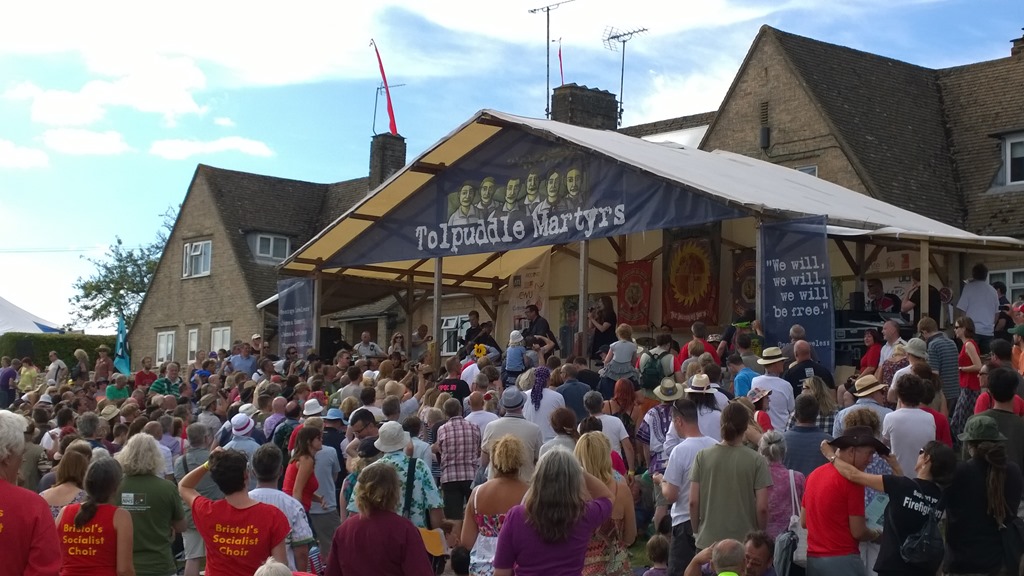 Members of unions from all over the country, as well as a large number of non-members, converge on the village each year, to commemorate the anniversary of the historic events, listen to speeches, enjoy music, and generally have fun. The impromptu manner of the day only further added to the enjoyment of the day. The commemorative march was remarkable, walking in the footsteps of some very famous people. The highlight, for me however, was a performance by Paul Heaton and Jacqui Abbott, previously of the band Beautiful South with the band playing some of the classics, a great day out had by all.
 Shortly after he had finished his practice, an old man opened his eyes to see a scorpion floating helplessly in the river that was flowing slowly past his feet.
 Once upon a time, there was a general who was leading his army into battle against an enemy ten times the size of his own.
 A great work of art is one that truly moves and inspires you. The test is when you yourself are moved. Don’t look at art with anyone else’s eyes. Don’t listen to music with others’ ears. You should view art with your own feelings, your own heart and mind.
 Having confidence in yourself, in your faith, and in my case, my practice is a really comfortable place to be. But simply having someone else question that confidence can be a good thing at times, even though it might leave you questioning yourself.
 A great work of art is one that truly moves and inspires you. The test is when you yourself are moved. Don’t look at art with anyone else’s eyes. Don’t listen to music with others’ ears. You should view art with your own feelings, your own heart and mind.
 It’s a pretty well known fact, that nothing in life that’s worth doing is very easy to achieve. So it is with B’s cottage. It’s the best part of 150 years old, was built before the invention of the right angle and restoration consumes more TLC than money, and that’s a lot.
 Best wishes for an environmentally conscious, socially responsible, low stress, non-addictive, gender neutral, winter solstice holiday, practiced within the most joyous traditions of the religious persuasion of your choice, but with respect for the religious persuasion of others who choose to practice their own religion as well as those who choose not to practice a religion at all.
 The Search For Enlightenment
Recents Comments