One Last Thing

Make That CallWe’ve all been shocked by the devastation caused by the earthquake in Japan this morning. The sheer scale of the destruction caused by the most powerful quake in a hundred years shows us just how powerful nature can be, and how fragile our existence on this Earth really is.

It may strike you as a rather strange thought, but something kept playing on my mind all day. I wonder how many of the people who have lost loved ones in the disaster took the time to tell their partner, child, friend or neighbour, that they loved them this morning.

They will never get that chance again, and may forever wish that they had taken those few precious seconds to express their feelings.

We all take life, and the immediate future for granted. Sometimes days, weeks, months or even years go by, without us taking time to make contact with someone for whom we care, but our lives are just too busy or complicated for us to make that call, write that email or even take that trip to reconnect.

Impermanence is key to Buddhist philosophy, nothing is forever. So before it is too late, before the chance has slipped from your grasp, make that contact and tell the person just how much you care. When you leave the house in the morning, or part company with any other person, let the last thing you say to them, be full of Wisdom, Courage and Compassion, not something you might regret saying for the rest of your life.

More Learning

ChantingI attended my second meeting in a week tonight, so as promised, a short report from the study group in Bournemouth.

I have to say that I have nothing but praise for everyone I met tonight, they were so welcoming, and the lecture was very interesting and beautifully delivered. My humble apologies to everyone, but there were so many names that I have forgotten most of them. I really look forward to getting to know you all much better. Boots from the Salisbury meeting was there, as was Ken Hawkins who had been kind enough to phone me, to give details of the meeting, yesterday.

So what happened?

Gongyo was led by a Japanese lady and was totally amazing. I thought chanting with four other people was great, but chanting with twenty other people took it to a completely different level. The whole thing happened at, what seemed like, a hundred miles an hour. Many people had their beads to hand, but I was very interested to see that each one had their own way of honouring the Gohonzon. It was very powerful and liberating and a total joy to be part of it.

The study lecture, delivered by an Italian lady, with the Japanese lady and another lady reading parts as well. A very cosmopolitan group to be sure.

The study was taken from Daisaku Ikeda’s lecture on Nichiren Daishonin’s letter to Jakunichi-bo. Although the letter was written in 1279, the points it raises are just as relevant today. President Ikeda’s lecture notes help us understand the letter in the language of today. Although there was not the group interaction of the Salisbury meeting, I was so happy to be part of this wonderful group of Nichiren Buddhists and I already have more dates of meetings in my diary. Thanks again everyone, i look forward to our next meeting.

Make Causes, See Effects

Creating Our Own DestinyI find it fascinating, that having searched for Buddhist study groups around Poole, and drawn a near blank, I make one cause and see such an immediate effect.

Finding the Salisbury study group, and attending the meeting last night, has directly resulted in me speaking with the husband of the SGI Poole district leader. Not only that, but there is a meeting tomorrow night, and I’m going.

So months after practically giving up trying to find like minded Nichiren Buddhists, even to the point of thinking I might need to try to start a local group, I am going to meet those very people tomorrow.

The law of cause and effect applies to everything in life and forms the basis of our Karma. The results of all the causes we create are the effects we see every day. The more good causes we create, the more good effects we see, and generally, the happier we are in our lives.

Dora, in The Buddha, Geoff and Me, explains that karma is a little like letters we write to ourselves. Many of those letters were written so long ago, that we have forgotten all about them. The nice letters are lovely surprises when they arrive. The nasty ones come as a bit of a shock, they may annoy us and we might even write another nasty one in response. Of course, in time, those responses get delivered too, so the cycle may repeat itself, time after time.

That is, of course, until you understand the way the process works. Once you realise that you create the causes, you can create causes for nice, or good effects, rather than going round and round forever.

Can there be a more important lesson to learn, to know that your karma, your future, is determined by you? It is the most empowering feeling, to take control of your life and to have your destiny in your own hands.

Amazing Resonance

Study Notes & BeadsTonight was my first study group meeting, and it was fantastic.

There were only five of us, I say only, but when we chanted together there was a melodic resonance that completely filled the room. Chanting alone is great, it boosts my life-energy and raises my life-state, but group chanting is like lone chanting on steroids.

A small altar was set up at the front of the room, with flowers, candles and a picture of Daisaku Ikeda surrounding the Omamori Gohonzon, a miniature copy of the Gohonzon.

Gongyo, chanting Nam Myoho Renge Kyo and part of The Lotus Sutra, took about thirty minutes although it just flew by.

We then discussed the nature of Karma. Mutable Karma, that which is created and experienced within this lifetime. Immutable Karma, that which was created in previous lifetimes and which can be experienced within this, or future lifetimes.

We discussed The Nine Consciousnesses. Sight, Hearing, Touch, Smell and Taste being our five senses as well as The Mind, The Subconscious, The Karmic Storehouse (alaya) and Buddha Nature (amala). We talked about how chanting Nam Myoho Renge Kyo allows us, with constant practice, to perceive all nine levels on consciousness.

There were study notes on all aspects covered during the discussion. We covered a lot, and the notes will help jog the memory on some of the finer points.

The group was very welcoming and happy to help me find a group nearer to home, so I may attend another meeting on Thursday near Poole. I was also given a gift of a book of lectures ‘On Attaining Buddhahood in This Lifetime’ by Daisaku Ikeda.

All in all a brilliant experience. Thank you all, Nam Myoho Renge Kyo.

Being The Voice Of Reason

W.C.CWho would have ever believed it?

I the past, I have been guilty of some very emotional decisions, letting my heart rule my head, and suffering the consequences at times. So my new found W.C.C (Wisdom, Courage and Compassion) has been a very useful tool to use in a very awkward, emotional  situation.

Being part of a situation as well as part of the answer is a kind of limbo. So I have decided to use my head, rather than my heart, in an attempt to resolve the problem. I’m going to let things happen the way they will, without trying to influence the decision, even though I really, really only want one outcome.

By the time you’ve read this far, you’ll either know exactly what I’m talking about, or you won’t have a clue. I’m not going to elucidate, those who should know, will know.

On a totally different theme, I going to my first SGI study group meeting in Salisbury tomorrow night. I’ll let you know how it goes.

Painful Questions, Honest Answers

Q&AGoing back over your mistakes, being asked painful questions and giving honest answers is a difficult, but cathartic experience.

We’ve all made mistakes in life, some more serious than others, but talking them through, trying to explain why you made that decision at that point in time, makes you re-examine your own values. In my case, having changed through my Buddhist Practice, it also becomes clear that I would have made different decisions in many cases.

Our history is set in stone, we cannot go back and make those decisions anew. But we can try to make amends, apologise for any hurt we have caused, and, above all, be honest with ourselves and others.

The changes in myself, that I see and feel, the way I view life, and my responsibility for events affecting me and people around me, have come about through my Practice and my study of Nichiren Buddhism.

As I have said before, once you see things in a different light, you cannot undo that change. Nor would I want to, because even though I know I will make other mistakes in the future, I know that those mistakes will be made despite honourable intentions, and with a great deal more Wisdom, Courage and Compassion.

More Signs Of Spring

More signs ...It’s sometimes difficult to wait for good things to come out of bad situations.

What can help, is the little signs we see along the route of the journey. Recently I posted an optimistic piece showing the first signs of Spring. Sadly, the following week the weather turned cold and wet, there was snow in northern parts of the country and it appeared to be a bit of a false start.

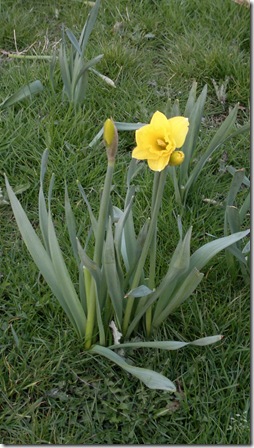
Today it’s been a rather chilly, windy, but beautifully sunny day and there are more signs that the warmth of summer is on it’s way. The photo is of one perfect daffodil in the local park in Hamworthy. But as you can see, there are still many other buds still waiting to burst into flower.

The lesson I think I can learn from this, is that even though there are indications of progress, it is important that I don’t wish my way further along the path than I actually am.

World Book Night

World Book Night on the BBCTomorrow is World Book Night, and as you would imagine, it is devoted to books.

It’s a fantastic idea, giving away books to get people reading, but I think there are a few missing from the list.

Obviously, The Buddha, Geoff and Me should be top of the list, closely followed by The Reluctant Buddhist and Buddhism and the Science of Happiness. I know I’m biased, I tend to read books to learn rather than for entertainment, though I admit I did read the entire series of The Hitchhiker’s Guide to the Galaxy in a week, whilst commuting to and from London.

The nice thing about World Book Night is that it is a fine example of the World of Bodhisattva. As there is no such thing as altruism in Buddhism, Bodhisattva is the nearest equivalent. Doing good for others results in the accumulation of good Karma, so it’s not strictly altruistic.

Reading is a great way of learning, either in paper form, or via one of the ever improving handheld readers. Learning about Nichiren Buddhism has  changed my life, I would be really pleased if you would give it a go too.

Here is what it’s all about (from worldbooknight.org)

About World Book Night

World Book Night represents the most ambitious and far-reaching celebration of adult books and reading ever attempted in the UK and Ireland.

On Saturday, 5 March 2011, two days after World Book Day, with the full support of the Publishers Association, the Booksellers Association, the Independent Publishers Guild, the Reading Agency with libraries, World Book Day, the BBC and RTE, one million books will be given away by an army of passionate readers to members of the public across the UK and Ireland.

The book give-away will comprise 40,000 copies of each of the 25 carefully selected titles, to be given away by 20,000 ‘givers’, who will each distribute 48 copies of their chosen title to whomever they choose on World Book Night. The remaining books will be distributed by World Book Night itself in places that might otherwise be difficult to reach, such as prisons and hospitals.

The twenty-five titles were selected by a wide-ranging editorial committee, chaired by James Naughtie.

See the 25 World Book Night titles here

Enjoy the evening.

What NMRK Really Means

Nam Myoho Renge KyoEvery day, twice a day, I chant Nam Myoho Renge Kyo. You see it on the headline banner of my blog and I mention it often. I thought it would be beneficial for me to revisit the meaning and I would like to share it with you. This explanation and definition comes from the Sokka Gakkai Dictionary of Buddhism.

[南無妙法蓮華経] Nam-myoho-renge-kyo

The ultimate Law or truth of the universe, according to Nichiren’s teaching. Nichiren first taught the invocation of Nam-myoho-renge-kyo to a small group of people at Seicho-ji temple in his native province of Awa, Japan, on the twenty-eighth day of the fourth month in 1253. It literally means devotion to Myoho-renge-kyo. Myoho-renge-kyo is the Japanese title of the Lotus Sutra, which Nichiren regards as the sutra’s essence, and appending nam (a phonetic change of namu ) to that phrase indicates devotion to the title and essence of the Lotus Sutra. Nichiren identifies it with the universal Law or principle implicit in the meaning of the sutra’s text.

The meaning of Nam-myoho-renge-kyo is explained in the opening section of The Record of the Orally Transmitted Teachings, the record of Nichiren’s lectures on the Lotus Sutra compiled by his disciple and successor, Nikko. It states that namu derives from the Sanskrit word namas and is translated as devotion, or as “dedicating one’s life.” What one should dedicate one’s life to, he says, are the Person and the Law. The Person signifies “Shakyamuni,” which means the eternal Buddha, and the Law is “the Lotus Sutra,” which means the ultimate truth, or Myoho-renge-kyo. According to Orally Transmitted Teachings, the act of devotion (namu) has two aspects: One is to devote oneself to, or fuse one’s life with, the eternal and unchanging truth; the other is that, through this fusion of one’s life with the ultimate truth, one simultaneously draws forth inexhaustible wisdom that functions in accordance with changing circumstances.

Orally Transmitted Teachings further states: “We may also note that the nam of Nam-myoho-renge-kyo is a Sanskrit word, while Myoho-renge-kyo are Chinese words. Sanskrit and Chinese join in a single moment to form Nam-myoho-renge-kyo. If we express the title [of the Lotus Sutra] in Sanskrit, it will be Saddharma-pundarika-sutra. This is Myoho-renge-kyo. Sad (a phonetic change of sat ) means myo, or wonderful. Dharma means ho, Law or phenomena. Pundarika means renge, or lotus blossom. Sutra means kyo, or sutra. The nine Chinese characters [that represent the Sanskrit title] are the Buddha bodies of the nine honored ones. This expresses the idea that the nine worlds are none other than the Buddha world.”

Myo stands for the Dharma nature, or enlightenment, while ho represents darkness, or ignorance. Together as myoho, they express the idea that ignorance and the Dharma nature are a single entity, or one in essence. Renge stands for the two elements of cause and effect. Cause and effect are also a single entity.”

Kyo represents the words and voices of all living beings. A commentary says, ‘The voice carries out the work of the Buddha, and it is called kyo.’ Kyo may also be defined as that which is constant and unchanging in the three existences of past, present, and future. The Dharma realm is myoho, the wonderful Law; the Dharma realm is renge, the lotus blossom; the Dharma realm is kyo, the sutra.”

As Nichiren states, namu derives from Sanskrit, and Myoho-renge-kyo comes from Chinese. Nam-myoho-renge-kyo is, therefore, not simply a Japanese phrase, but a Japanese reading of a Sanskrit and Chinese phrase. In this sense, it contains aspects of the languages of three countries in which Mahayana Buddhism spread. According to Nichiren’s treatise The Entity of the Mystic Law, Nan-yüeh and T’ient’ai of China and Dengyoof Japan recited the invocation meaning devotion to the Lotus Sutra of the Wonderful Law, or Nam-myoho-renge-kyo, as their private practice, but they did not spread this practice to others.

In On the Three Great Secret Laws, Nichiren states that the daimoku Nichiren chants today in the Latter Day of the Law is different from that of the previous ages—the daimoku T’ient’ai and others chanted in the Former Day and Middle Day of the Law—because the practice of daimoku in the Latter Day of the Law involves chanting it oneself and teaching others to do so as well. Nichiren not only established the invocation (daimoku) of Nam-myoho-renge-kyo but embodied it as a mandala, making it the object of devotion called Gohonzon. In Reply to Kyo’o, he states, “I, Nichiren, have inscribed my life in sumi ink, so believe in the Gohonzon with your whole heart. The Buddha’s will is the Lotus Sutra, but the soul of Nichiren is nothing other than Nam-myoho-renge-kyo” (412).
A World Of Tranquillity

ZzzzzzzThe past couple of weeks have been tough for all of us, mentally. Nobody has been sleeping properly and eventually it caught up with me.

We’ve all been worrying about Charlotte, and were all relieved when we learned that she can still carry her baby. I’ve been working hard on the web project, with tight deadlines. That situation has eased slightly, though by no means finished.

The combination of the two must have had more effect on me than I had realised and the slight easing in the situation let me see that.

When I got home this evening, my life-energy was low, I was so tired I was feeling ill. I had to chant, and although I felt better afterwards, I decided to have a nap.

Three an a half hours later I woke to the sound of the phone ringing.

So a good lesson, my Buddhist Practice is brilliant, it helps me handle life’s situations, but it can’t replace good old fashioned sleep.

Previous Older Entries Next Newer Entries